
This article is sponsored by Nuance Communications, a technology pioneer with market leadership in conversational, ambient, and generative AI. Nuance is a Microsoft company.
Technological advancements have always played a pivotal role in enhancing the delivery of care and improving patient outcomes. One of the latest innovations in this domain is the Dragon® Ambient Experience™ (DAX™) Copilot by Nuance, a Microsoft company. This solution represents a significant leap forward in the use of artificial intelligence (AI) to streamline clinical documentation, thereby allowing health care professionals to focus more on patient care and less on paperwork. We delve into the intricacies of DAX Copilot, its operational mechanism, and the transformative effect it has had on medical practice, drawing from the firsthand experience of health care professionals who have integrated this technology into their workflow here in this podcast.
What is DAX Copilot?
DAX Copilot is an AI-powered, voice-enabled solution that automates clinical documentation. It functions by attentively listening during patient exams to capture encounter conversations securely and accurately. DAX Copilot summarizes and organizes the dialogue creating clinical notes from patient conversations. The clinical note is available in the electronic medical record (EMR) immediately after the visit. Serving as an AI assistant for automated clinical documentation, DAX Copilot enables physicians to do more with less and improve clinical efficiency, physician and patient satisfaction, and financial outcomes. Amplified by the power and scale of the Microsoft Cloud for Healthcare, it combines Nuance’s proven conversational and ambient AI with the newest and most capable generative AI model.
Transforming clinical practice
The impact of DAX Copilot on medical practice has been profound. Physicians have reported a dramatic shift in their ability to manage clinical documentation efficiently. Before the introduction of DAX Copilot, even highly proficient users of EMR systems found themselves overwhelmed by the volume of documentation required. With DAX Copilot, the narrative changes significantly. Health care providers can now leave their clinics without any pending patient charts, a feat that was previously unimaginable for many. This efficiency gain translates into more meaningful patient interactions, as doctors can dedicate their attention entirely to the person in front of them rather than dividing their focus between the patient and the computer screen.
Patient and physician perspectives
Patients, too, welcome the adoption of DAX Copilot. The consensus among patients is one of approval, as they recognize the value of leveraging technology to enhance the quality of care. Moreover, the transparency and detail captured in medical notes, thanks to DAX Copilot, has improved patients’ understanding of their health conditions and the care they receive. This transparency is especially relevant in today’s health care landscape, where immediate access to medical records is increasingly becoming the norm. Physicians have noted that DAX Copilot has reinvigorated their practice, allowing them to reconnect with the joys of patient care. DAX Copilot has not only helped streamline administrative tasks but also facilitated deeper patient engagement by removing the barriers imposed by traditional documentation processes. This shift back to a more patient-centered approach has been a source of professional satisfaction for many practitioners.
Overcoming skepticism and embracing change
The introduction of new technologies is often met with skepticism, particularly in complex and traditional fields like medicine. Yet, the experience of early adopters of DAX Copilot demonstrates the potential to overcome initial reservations through firsthand demonstration of the technology’s benefits. Witnessing DAX Copilot in action has convinced many health care clinicians of its value, leading to a broader acceptance and enthusiasm for this AI-powered solution.
Looking ahead: the future of AI in health care
DAX Copilot hints at a future where AI and other technological innovations play an increasingly central role in health care. AI’s potential to augment the work of health care professionals is vast. From improving efficiency and accuracy in clinical documentation to enhancing patient safety and outcomes, the horizon for AI in health care is promising.
DAX Copilot by Nuance and Microsoft represents a significant milestone with the integration of AI within health care. Its ability to automate clinical documentation and tasks and enhance patient care exemplifies the positive impact technology can have in the medical field. As health care continues to evolve, embracing such innovations will be crucial in navigating the challenges and opportunities that lie ahead, always with the aim of improving the human experience at the heart of health care.
Patrick McGill, MD is a family physician and executive vice president and chief transformation officer at Community Health Network, Indianapolis, IN.
VISIT SPONSOR → https://nuance.com/kevin
SUBSCRIBE TO THE PODCAST → https://kevinmd.com/podcast
RATE AND REVIEW → https://kevinmd.com/rate
FOLLOW ON INSTAGRAM → https://www.instagram.com/kevinphomd
FOLLOW ON TIKTOK → https://www.tiktok.com/@kevinphomd
Transcript
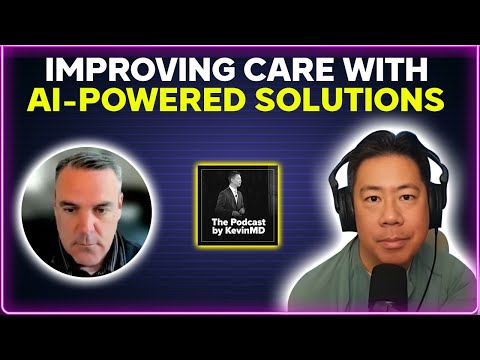
Kevin Pho: Hi, and welcome to the show, where we share the stories of the many who intersect with our health care system but are rarely heard from. Subscribe at KevinMD.com/podcast. Today we have a special sponsored episode by Nuance, a Microsoft company. We welcome Patrick McGill. He’s a family physician and executive vice president and chief transformation officer at Community Health Network. Dr. McGill is responsible for population health management, value-based care, envisioning data-enabled strategies, overseeing information technology and digital transformation, and leading Community’s effort to use analytics to drive transformation. Today we’re discussing improving care with AI-powered solutions. For more information, go to nuance.com/kevin. That’s nuance.com/kevin. You could also click the link in the show notes. Patrick, welcome to the show.
Patrick McGill: Thanks for having me. I really appreciate the invite to come on.
Kevin Pho: So let’s start by telling our viewers a little bit about yourself, where you are today, and how you got there.
Patrick McGill: Absolutely. So I’m a family physician. I still practice and see patients one day a week, and, like you said, I serve as the chief transformation officer. It’s really been an interesting journey. I don’t have a technology background. We installed Epic about 12 years ago, and I got tapped on the shoulder to lead optimization afterwards. I was just a practicing family physician at the time. It’s one of those career-journey stories: You get tapped on the shoulder and you keep saying yes, and you get tapped more and say yes.
Eventually that led into a lot of varied experiences, leading efforts around population health and value-based care. Beginning in 2018, I took over analytics, and then that led to integrating information technology under the office of transformation. So right now I have a broad range of responsibilities, but it makes a lot of sense, because it allows us to be data-driven and technology-driven as we’re trying to deliver our brand promise of exceptional care, simply delivered.
Kevin Pho: Technology has been a focal point in your career in medicine. Tell us a little bit more about why you’re passionate about technology and how you view its role in health care.
Patrick McGill: Yeah, I’ve always viewed technology as critical. I’m of the age where, when I started med school and residency, we were on paper, and then came the introduction of electronic medical records and e-prescribing and some other things. So I really saw the value where technology was used to assist clinicians. I’m very passionate about decision support. How do we make clinicians, physicians and APPs, smarter and better, to allow them to do the things that they’re trained to do? Let’s take some of the easy, burdensome work off of their plate.
And it’s not just about EMRs, right? It’s all the other things that occur in health care. It’s all the friction points that patients are frustrated with, that frustrate clinicians and other staff as well. So I’m really passionate about that. I do think that technology is not the only answer, but it’s absolutely an answer to some of those problems. And I think as technology is advancing, specifically with AI, which I know we’ll get into later, that’s going to take it to the next level. So I’m really excited about where we’re headed.
I always tell people you would never practice medicine without a stethoscope, right? So you’re not going to practice medicine in 2024 without some sort of technology, whether it’s an EMR or assistive, decision-support types of technologies.
Kevin Pho: So as technology shifts towards leveraging artificial intelligence to advance its capabilities, how do you see AI helping to solve the problems in health care?
Patrick McGill: I’m cautiously optimistic. And what do I mean by that? I’m very bullish that it can solve a lot of the problems. I think it can solve a lot of the burdens that people are frustrated with, a lot of the things that have caused burnout related to the EMR and others. We’ll talk about one around documentation. I think that there’s a lot of opportunity in some of the repetitive work that AI can help with, a lot of the things that, like we talked about before, are the friction points that patients run into, whether it’s prior authorization, referral management, or scheduling appointments. All of those things.
And really, it’s the vision to make health care and medicine more personalized. I always say we’ve had one segment, and that’s called the patient. Other industries have really focused on making those industries more personalized and segmented. I think we can achieve the same in health care, and I think that’s where technology can solve some of that, to make it more personalized and more specific, so that we see each patient or person as a person, so that we know them, we know them deeply, and have that relationship.
That probably comes from my background as a family doctor and having long-term relationships with patients. I think that’s so important, to really know people and build the relationship and the trust. And I think technology, if we use it correctly, will allow people to get back to doing what they love to do, which is taking care of people.
Kevin Pho: Now, can you explain how you and your colleagues at Community Health Network are using technology and AI today, and why you turned to AI as a solution?
Patrick McGill: Yeah, so we started several years ago leveraging AI a lot in the rev cycle space, a lot of those repetitive tasks. And now we’ve moved into AI to drive prediction. Can we predict who’s going to deteriorate? Can we predict who needs to come into the office? Can we predict who would be safe to be discharged early from the hospital? So really, a lot of those predictions, machine learning and AI, drive assistance with making clinical decisions. Not making the clinical decisions, just assisting our physicians with their decisions.
Now we’ve moved into documentation, and we’re looking at other things around previsit planning and assistance with decision support. Obviously, reading the notes to pull out additional information that may be buried in the EMR, that clinicians or physicians aren’t seeing or just don’t have the time to comb through the notes for. And how do we create summaries using AI to help patients understand, right? So translating into other languages for patient instructions, some of those things that we might take for granted in other areas are a little more complex in health care. That’s where I think technology and AI, that’s how we see it and how we’re using it.
Kevin Pho: As health care facilities integrate AI, some of the earliest wins for physicians revolve around the administrative burdens, as you said, that clinicians face every day, especially clinical documentation. So tell us your experience with that.
Patrick McGill: Yeah, so I’ll tell you two pieces: One is my personal experience, and the other is my experience as a leader. My personal experience is that, as I still see patients, I’m responsible for documenting those visits. And what I find is the busier you get, the less detailed the documentation becomes. It’s kind of the opposite of note bloat. We can use a lot of links and other things to pull a lot of information into the note, but it just becomes unusable or unreadable. So the counter is, how do we make notes more streamlined and more usable or readable? And I think the pendulum swings to where they just don’t have enough detail. They don’t capture the conversation or the history or other things. So it’s a balance, right? It’s a balance between how much time you spend documenting, how much time you spend reviewing the chart, and the number of patients that you see. So that’s my personal experience.
From a system level, we want accurate documentation. Obviously, it’s critical. It’s key. We tell people all the time, “You take care of a lot of sick people. We need to document better how sick they are.” As physicians, we often just jump in and take care of people, and we know the complexities in our head. We know the extensive differential diagnoses that we’re thinking about and all the factors, but it just doesn’t get translated into the chart. So how do we use technology and AI to really leverage and help with a lot of that documentation?
I think clinical documentation is one area where it’s overwhelmingly consistent that it’s been a major contributor to the burnout and frustration with the EMR. And I think that there are obviously better ways, and with new technologies we’re tackling that.
Kevin Pho: So let’s talk about one solution now: DAX Copilot from Nuance, a Microsoft company. What exactly is DAX Copilot, and how does it work?
Patrick McGill: Yeah, DAX stands for Dragon Ambient Experience, and it’s the ambient listening tool from Nuance that listens during an exam or an office encounter to capture the conversation and condense, summarize, consolidate, whatever word you want to use, to aid and assist in documentation. So think of it as a scribe. It’s an AI scribe. I think that’s probably the easiest way to think of it, but it’s smarter than just a scribe. It’s not just writing down everything that’s said as a transcript. It really does summarize the conversation, and it’s smart enough to put it in specific areas in the sections, whether it’s past medical history, HPI, plan, etc.
Kevin Pho: So how has DAX Copilot changed the way you practice medicine? Maybe you can share a story about how DAX Copilot really changed your practice.
Patrick McGill: Yeah, I tell people that. I’ve been live with DAX Copilot for probably about six months now. I started my administrative career in informatics. I was one of the first cohorts of physician builders with Epic, and I used to teach and train people how to use Epic and how to use all the smart tools and everything else. I say that because I’m a proficient user of Epic, right? I know how to use all the smart tools to make things better. But as a busy family doctor, I still was not able to get my notes closed by the end of the day, even with all that knowledge and education and training.
DAX Copilot really, and I don’t say this lightly, has probably been the most game-changing technology that we’ve implemented in the last 10 years since we went live with Epic. It really does. So now, instead of leaving clinic with 25 or 30 open charts, I leave with zero. In these last six months, I’ve not had an open chart when I’ve left clinic. Oftentimes I walk out of the room, review the note, and close my chart immediately. It’s that fast.
What it does from a physician standpoint is it really allows me to go back to having a face-to-face conversation with the patient. The only thing I’m on the computer for is to enter orders or if I need to go back and review something in the chart. It’s capturing all of that dialogue with the patients. So honestly, it’s brought some joy back, because I’m not focused on what they said. What was that detail? Who was that family member that had cancer? It’s all getting picked up by the ambient technology. So it allows me to go back to what I enjoy doing, which is being a family doctor and taking care of people.
Kevin Pho: I’m a primary care doctor like yourself. So you’re saying that in a typical visit, 15, 20 minutes or so, your chart is closed after seeing that patient?
Patrick McGill: Absolutely. I walk out of the room, and within seconds the visit is summarized. I review it and make sure it’s accurate. I’m still responsible for the documentation, so I’m reviewing for accuracy. Did it pick up the right laterality? Did it pick up what we were talking about? Do I need to add any details? Maybe it didn’t capture the full details of the exam or something similar. And then I close the note.
Kevin Pho: Today we have a special sponsored episode brought to you by Nuance, a Microsoft company. We’re discussing improving care with AI-powered solutions. For more information, go to nuance.com/kevin. That’s nuance.com/kevin. You can also click the link in the show notes.
Patrick, how have your patients reacted to you using AI to automate clinical documentation?
Patrick McGill: I have not had any negative pushback or feedback from patients. Quite frankly, I think patients expect us to use technology now. They’re used to 10 or 15 years of EMRs. They’re used to that, and they’re very proficient in communication. So I really don’t have any pushback.
Now, with information blocking and the immediate release of notes, they’re reading the notes, and I think that they see the difference between my old notes and my new notes: The new notes are actually capturing what happened in the exam room, not just a shorthand summary of my thoughts and what I can remember. So I do think that patients are going to start to notice. I think this is going to be an example where, when they see multiple physicians or clinicians, they’re going to notice the people that are using these assistive technologies, because the notes are more complete versus the old style that a lot of physicians document in.
Kevin Pho: Do you have to tell the patient that you are using some type of ambient listening technology before the visit?
Patrick McGill: You do. When you walk in the room, you educate the patient. You say, “We’re using a new technology,” make sure that they’re OK with it, and get their consent. Quite frankly, I’ve taken care of a lot of patients for a long time, 20-plus years, and I never have my phone in the exam room with me. So one of the first things that they noticed was me walking in holding my cell phone, which I had never done before. That prompts the conversation of, “Hey, we’re using a new technology. Are you OK with that?”
Kevin Pho: Has DAX Copilot impacted the way you provide care for your patients?
Patrick McGill: I think it’s positively impacted it, because it allows me to, again, focus more on the patient and not on trying to capture everything that’s documented. I’m not sitting behind the computer. I’m able to sit on the stool, roll right up to them, and have a face-to-face conversation. And again, as you’re talking through your assessment and plan, it’s a chance to provide education back to the patient and make sure that they understand. So there’s a win-win, right? You’re educating the patient, and the tool is capturing the information for the note.
Kevin Pho: So you mentioned earlier how DAX Copilot brought back the joy in medicine. Go into more detail about how DAX Copilot impacted you personally.
Patrick McGill: Yes, it’s personally impacted me because, even though I only see patients one day a week, I don’t have the notes hanging over my head: “Man, I’ve got to go back and finish all those notes.” Quite often I was on the naughty list, where we send out open notes for people who have open charts over two weeks. People would come to me and say, “What are you doing on the naughty list with open charts two weeks later? Aren’t you supposed to be able to do all this stuff?” I mean, that’s a personal anecdote, but it’s really impacted me personally, again, by bringing back that face-to-face interaction, to where it’s fun again. It’s fun to take care of people and not have this burden of documentation hanging over your head.
Kevin Pho: Adopting new technologies, of course, can be challenging for physicians with so many demands on their time. So describe how you approach changes to your clinical workflow, and what you would say to someone who may be skeptical about adopting AI-powered solutions like DAX Copilot.
Patrick McGill: Yeah, I think you’ll always have people that are early adopters. So when we rolled this out across the network, we targeted some early adopters. There are people that are early adopters with all technologies, and I think that created some champions across the network.
One of the things that we did: We have an all-partner meeting once a year. We get all 1,500 employed providers either in a room or online. We had about 500 people in a massive ballroom at a local hotel, and we did a demo. We had two physicians on stage. They role-played a primary care visit and used DAX Copilot to do the documentation, and you could literally see the jaws drop around the room, because it was accurate. It’s always a little hairy when you’re trying to demonstrate technology in front of a ballroom like that, so it was fingers crossed that it worked, and it worked. People’s jaws dropped.
We had two pieces of feedback. The first piece was, “Man, when can I sign up for that technology? I can’t believe that it’s that accurate.” And the second, funny thing, and you’ll understand this being a primary care doctor: The other piece of feedback that we learned was from the specialists saying, “You talk about all that during a primary care visit? I can’t believe that you talk about their family and their mood and all these types of things.” Whereas when you’re a specialist, it’s one problem and one solution. I say that tongue-in-cheek, but we got a lot of feedback like, “Man, I can’t believe that all that goes on in a primary care visit.”
Kevin Pho: So talk about the general feeling about DAX Copilot after implementation among your colleagues at Community Health Network. How has the response been in general?
Patrick McGill: Yeah, the response has been overwhelmingly positive. I think that any new technology has its growing pains. I won’t sit here and say that it’s absolutely perfect. We’ve had a lot of conversations and communication with Nuance about where we want to see enhancements and improvements, but that’s normal technology, right? Nothing rolls out and it’s perfect. But I think the sentiment overall, the feeling, is, “Hey, this is a game changer,” right?
We’ve had scribes, virtual scribes, for about 200 of our 1,500 providers, and now we’re able to roll out an AI scribe, ambient listening, DAX Copilot, to all 1,500 if they want it. So really, there’s an equity in resources when it comes to our providers. The sentiment is very positive. There are always the skeptics of new technology: “What does this mean? Is it going to change my workflow?” But that’s no different than anything, right? Think about when we roll out an EMR or other technologies. There’s just a learning curve, and eventually people will adopt it, and it becomes part of their normal workflow.
Kevin Pho: Now, as you look to the future, how do you see technology and AI evolving in health care?
Patrick McGill: I think we’re going to see a lot more adoption of AI. I think in the direct patient-facing space, it’s going to take a little bit longer to adopt AI. I don’t think we’re going to see wholesale replacement of doctors and nurses and pharmacists. But I do think there’s a lot of opportunity to help clinicians, clinician assistance, to make their jobs more efficient, to surface information that may be buried, and to help with quality and safety measures. I think that’s where you’re going to see probably the majority of technology evolve over the next five years. We might get there in 10 or 15 for some of those other things.
But I think there’s a huge, burning desire around how we augment staff so that we can do more with fewer staff. We all have staffing constraints and problems. How do we improve access? How do we improve health equity? How do we improve some of the outcomes? I think those are some of the things that we really have to focus on over the next two, three, five years in technology as we start to look at it.
And I do think generative AI is going to be a huge game changer in health care. I think that’s one of the areas where some of the technology’s been limited. But with the ability to summarize a lot of that unstructured data, and over 80, 90 percent of the data in the EMR is unstructured, that’s going to be a huge game changer moving forward.
Kevin Pho: And my final question, Patrick: Let’s end with some of your take-home messages that you want to leave with the KevinMD audience.
Patrick McGill: I think the first one I would say is that health care is constantly changing. Change is part of what we do, right? There are new treatments, new diagnoses, new conditions, new everything. So change is part of what we do, and I would encourage people to be open to change. That doesn’t mean you have to just run to every change, but be open to change and open to new technologies. I think you have to be open so that you can adapt to technology or adopt technology, so that you can focus on the things that don’t change, meaning that clinician-patient, that doctor-patient relationship. That doesn’t change, right? At the heart of health care, at the heart of medicine, it’s still people taking care of people, and that’s what we need to get back to. I think that’s where technology can help. So I encourage people to be open to change, so that you can get back to the things that don’t change.
Kevin Pho: You’ve been listening to a special sponsored episode brought to you by Nuance, a Microsoft company. We’ve discussed improving care with AI-powered solutions. For more information, go to nuance.com/kevin. That’s nuance.com/kevin. You can also click the link in the show notes. Patrick, thank you so much for sharing your perspective and insight, and thanks again for coming on the show.
Patrick McGill: Absolutely. Thanks for having me.