As a physician, I spent decades training to manage medical crises, yet I nearly lost my life savings to a calculated deception.
The caller offered me two ways to protect my assets: convert everything to gold and take it to Washington, D.C., for deposit with the Department of the Treasury, or convert everything to digital currency.
By then, I had spent nearly three weeks communicating with people I believed might be investigating identity theft involving my medical license. They had threatened suspension of my license and freezing of my assets. One of them claimed to be helping me prevent those consequences.
I transferred no assets. When I independently contacted the Utah Division of Professional Licensing (DOPL), I learned there was no investigation involving me.
Real physician voices, twice a week
Free, and one click to unsubscribe.
My experience illustrates a larger danger. Criminals can manufacture a crisis, surround the target with seemingly corroborating authorities, and then present an asset transfer as the only way to escape the threat they created.
The financial losses are staggering. According to the Federal Bureau of Investigation’s (FBI’s) 2025 Internet Crime Complaint Center (IC3) Annual Report, the center received 181,565 complaints involving cryptocurrency, up 21 percent from 2024, with reported losses of $11.37 billion. Government impersonation alone accounted for 32,424 complaints and approximately $798 million in losses. Furthermore, Federal Trade Commission (FTC) reports from adults 60 and older who lost at least $10,000 to impersonators increased from 1,790 in 2020 to 8,269 in 2024, more than fourfold. Cryptocurrency was the payment method in one-third of cases.
A threat tailored to the target
My encounter began with a call that supposedly came from Utah’s licensing agency. The woman said the medical board had received a complaint and transferred me to the assigned investigator. I normally ignore unknown callers, but caller ID showed the call was from the Utah licensing agency. I was driving and pulled over.
The supposed investigator claimed the FBI had overwhelming evidence that I had issued large quantities of opioid prescriptions in Texas without a legitimate medical purpose. My license, he said, was at immediate risk.
The accusation was false, but professionally consequential. A physician does not have to believe an allegation to fear the consequences of being accused. Health care professionals are uniquely vulnerable to these tactics because compliance, regulatory reporting, and protecting our medical licenses are central to our professional lives.
Then came the reassurance: The investigator said the board did not believe I was involved, and he would advocate for me. Someone was threatening my career, while someone else appeared to be protecting it.
Manufacturing corroboration
The investigator arranged a call with a supposed FBI agent who described the evidence as “incontrovertible.” When I explained that I had not been in Texas in over a decade, the investigator appeared to persuade the agent that identity theft might explain the evidence. But the threat remained: Unless I cooperated, they would proceed against my license and freeze my assets.
In retrospect, the apparent disagreement between the two men made the exchange more convincing. Yet both belonged to the same unverified chain of communication.
The callers reinforced their story with documents sent through a secure messaging app, purporting to come from the Utah Department of Commerce, the U.S. Department of Justice (DOJ), and the Financial Crimes Enforcement Network (FinCEN). The licensing notice announced an immediate suspension. The DOJ agreement designated me as a “Victim and Cooperating Party,” while imposing confidentiality. The FinCEN report presented purported banking records and recommended FBI-supervised “Safe Custody” of my assets. Each document served a purpose: defining the threat, enforcing secrecy, and laying the groundwork for moving my assets.
As DOPL has warned, callers frequently impersonate licensing officials to threaten health care professionals with a supposed FBI investigation. The FBI also describes multi-agency “phantom hacker” schemes that culminate in instructions to move money for protection.
Isolation before extraction
The callers told me I could not discuss the case with anyone (explicitly including my wife), framing isolation as a duty to protect an ongoing investigation. They directed me to communicate exclusively through a secure app. Daily contact followed: I had to report whenever I left home, notify them before payments exceeding $1,000, and obtain authorization before leaving Salt Lake City. These demands had no legitimate authority, but over weeks, they established a routine of compliance.
The offer to protect my assets
About three weeks later, the supposed FBI agent said the DOJ was proceeding with my suspension, offering the gold or cryptocurrency transfer options.
The FinCEN document had already supplied the premise that my accounts needed “Safe Custody.” He walked me through setting up a crypto wallet app and requested screenshots. That is when I stopped. Unwilling to convert my savings, I called DOPL directly to speak with the presumed investigating agent. DOPL confirmed, then reconfirmed, that no investigation existed. The engineered crisis dissolved the moment I stepped outside the callers’ controlled communication channels.
Why cryptocurrency matters
Cryptocurrency can be the investment bait itself, or simply the delivery mechanism for a different deception, such as a threatened government action. The FBI documents how scammers direct targets to drain retirement accounts, buy cryptocurrency, and send it to criminal wallets via QR codes, moving funds too rapidly for recovery. To make matters worse, the Internal Revenue Service (IRS) warns that scam-induced retirement withdrawals may still trigger taxes; losing the money does not necessarily eliminate the tax liability of taking the distribution.
My encounter stopped short of a transfer, so I cannot say exactly how they intended to take final possession. But the demand to convert my life savings was unmistakable.
Recognizing the method
With enough fear, most of us are vulnerable. Dismissing victims as “gullible” obscures how deliberately these criminals weaponize authority, isolation, and false reassurance. I feared challenging the callers in case I was wrong, a fear central to their method.
The practical lesson is to establish independent verification. End the conversation and call an official number obtained separately. Tell a trusted person what is happening. Be assured that real government agencies and financial institutions never ask people to send money to protect it.
Attempted theft warrants reporting. The FBI accepts reports via its Internet Crime Complaint Center or local field offices, and the FTC operates a fraud reporting website to protect communities.
I lost no assets; others have lost lifetimes of savings. Sharing these experiences can help others recognize the method before they follow the final instruction. The demand to transfer money may be brief; the work of making that instruction seem necessary can take weeks.
Lynn R. Webster is one of the world’s leading authorities on pain management, addiction medicine, and the complex interplay between public policy, misinformation, and human suffering. He is board-certified in anesthesiology, pain medicine, and addiction medicine, a past president of the American Academy of Pain Medicine, and a senior fellow at the Center for U.S. Policy.
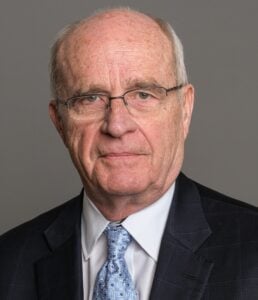
He is the author of The Painful Truth: What Chronic Pain Is Really Like and Why It Matters to Each of Us, and coproducer of the PBS documentary of the same name. With Sarah Eichberg, PhD, he is coauthor of Deconstructing Toxic Narratives: Data, Disparities, and a New Path Forward in the Opioid Crisis (Springer Nature, May 28, 2026). A complete list of his titles is available on his books page, and he shares his work on LinkedIn, X, Facebook, and YouTube.