
A fellow sits across from my desk, talking about becoming faculty in a few months. She’s nervous about her first attending rotation on the consult service and wonders whether she should do an extra rotation before her fellowship ends, just to be sure she is ready. She doesn’t want to disappoint anyone.
Down the hall, a junior faculty member works hard to prove her value. She sees the patients, writes the papers, and submits the grants. Yet whenever someone introduces her as an expert, she winces and wonders when they will discover she isn’t one.
A third colleague has just learned that the promotions committee considers her ready to become an associate professor. As she assembles her packet, she hopes this milestone will finally settle the feeling that she isn’t enough, that she doesn’t quite belong.
I recognized that hope because I had carried it myself. When an invitation arrived to speak at the annual meeting of the American Society of Hematology, I read the email several times to be sure it was real. Then, before I had even told my husband, the old question arrived with it: “When will they discover I’m not who they think I am?” Each milestone in my career seemed as though it should answer that question. Each one changed the question instead.
Real physician voices, twice a week
Free, and one click to unsubscribe.
A question about worth
Many physicians will recognize this experience. It is often called impostor syndrome, although the psychologists who first described it in 1978 deliberately called it a phenomenon, an experience rather than a disorder. The usual advice is to remember our accomplishments, keep a folder of positive feedback, and remind ourselves how much we know. These suggestions can help us see our competence more accurately, yet they rarely quiet the fear for long. I have come to believe the underlying question is usually about worth. “Am I competent?” can be answered with evidence. “Am I enough?” cannot.
With impostor phenomenon, people credit success to luck, timing, the right connections, or a burst of extra effort, so it never quite lands, and the next challenge brings the same doubt. When achievement is consistently discounted, adding more of it cannot be the whole answer. Achievement can express our curiosity, gifts, and commitment. It becomes exhausting when it also has to make us feel worthy.
How medicine shapes the fear
Medicine teaches this dependence early. From grades and evaluations through residency and fellowship selection, board certification, publications, patient satisfaction scores, and promotion, physicians spend decades being assessed by others. These assessments matter because they build competence and protect patients. They can also become the way we decide whether we are acceptable. As careers progress, the standards grow vaguer. Monthly evaluations give way to an annual review and a general expectation to do more: see more patients, join more committees, write more papers. There is always someone doing more.
The fear does not come only from within. Residents describe constant scrutiny and rigid hierarchy as conditions that intensify impostor feelings. For women, physicians from minoritized groups, and those trained abroad, the sense that belonging must be continually earned can accurately reflect how closely they are watched. Institutions have a real responsibility to build environments where belonging isn’t rationed.
Proving ourselves, hiding ourselves
When acceptance seems to depend on maintaining the image of the self-assured expert, we conceal any uncertainty we have. We hesitate to ask a question, admit we need help, acknowledge disappointment, or say that a responsibility feels like too much. The gap between our polished presentation and our ordinary human experience can itself make us feel like frauds.
We also tend to assume that other people’s composure means they don’t share our uncertainty. Yet in a national study, nearly one in four U.S. physicians reported frequent or intense impostor experiences, and more than a third reported moderate ones. Many of the composed colleagues we measure ourselves against may be hiding the same thing. Each of us concludes that our own doubt is unusual, which makes staying quiet feel even more necessary. The more we believe we must hide to belong, the more there seems to be to discover.
Being human is not evidence against us
Uncertainty, limits, and imperfection are part of being human, including for physicians at the top of their field. When there is nothing left to hide, there is nothing left to discover. That does not mean sharing everything with everyone. It means ending the private belief that these ordinary human qualities disqualify us. We can still choose privacy while no longer treating parts of ourselves as shameful evidence.
The distinction matters because some environments do make admitting uncertainty costly, and in those places we may reasonably decide what to say aloud. Deciding what to disclose to others, however, is different from accepting something in ourselves. Self-acceptance places our worth beyond the reach of any single evaluation, so it no longer depends on a verdict someone else must deliver. That inner steadiness also lets us judge which risks are real, rather than treating every moment of exposure as a threat to our place.
There is even some evidence that doubt has value. In one study, physicians-in-training who more often had impostor thoughts were rated by their patients as more empathetic and better listeners, apparently because their uncertainty turned their attention outward. Doubt may serve our patients. The goal isn’t to doubt or always be certain. Doubt and uncertainty are a part of practicing medicine. The trouble begins when we let them lead us and use them to decide whether we belong.
What self-trust makes possible
My hope for each of the three physicians I described is that they will learn to trust themselves. By self-trust, I mean staying connected to our thoughts, feelings, needs, and values without judging them, and allowing that connection to guide what we do. In my work, it rests on four practices: mindfulness, compassion, curiosity, and self-regard.
Self-trust would not make their doubt disappear, and uncertainty would still arrive with each new role. The difference is that they would no longer mistake discomfort for danger. Imagine speaking up in leadership meetings instead of researching the answer alone after hours, declining new commitments without composing an apology, and approaching unfamiliar moments with curiosity rather than dread about being underprepared. They might still feel exposed when they ask a question or admit they don’t know, but self-trust means that discomfort no longer signals that belonging is in question, and when a risk is real, they can see it clearly as a risk rather than as a judgment of who they are.
This inner work does not have to wait for institutions to change, and it may be one of the ways they do. Leaders who have made peace with their own uncertainty can more easily allow others to voice theirs. If one day they tell a room of colleagues they aren’t sure yet, the residents watching will learn they can say the same.
And for the colleague assembling her promotion packet, I hope that when the promotion comes, she celebrates it for what it is, a meaningful recognition of years of good work, without needing it to prove her worth or to settle whether she belongs. She can keep learning, contributing, and pursuing work that matters to her without asking each new achievement to justify her place in the room. She can keep learning without having to prove her worth.
Christine Kempton is a physician, certified coach, and former academic hematologist who spent more than two decades caring for patients, mentoring physicians, and leading in academic medicine at Emory University, where she holds emeritus status.
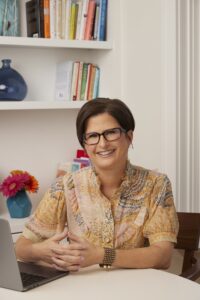
Today, through Christine Kempton Coaching, she works with high-achieving women in medicine who look successful on the outside but often find that work and life feel heavier than they expected. Many learned to handle pressure by pushing harder, carrying more, being the responsible one, and looking outside themselves for certainty. Over time, those strategies can erode self-trust and leave them disconnected from themselves.
She helps women reconnect with themselves, rebuild self-trust, and create a more sustainable way to lead, practice, and live without giving up ambition. Her work draws on her experience as a physician and leader, along with evidence-based coaching and emotional regulation, helping women create success that feels as good on the inside as it looks on the outside.
Her research spans patient-reported outcomes and quality of life in people with hemophilia, racial and ethnic disparities in hemophilia care, differences between men and women with hemophilia, immune tolerance induction, and representation in clinical trials. Her work has appeared in Blood Advances, Haemophilia, and the American Journal of Medicine, where she has also written about burnout in health care. She shares updates on LinkedIn, Instagram, and Facebook.