Subscribe to The Podcast by KevinMD. Watch on YouTube. Catch up on old episodes!
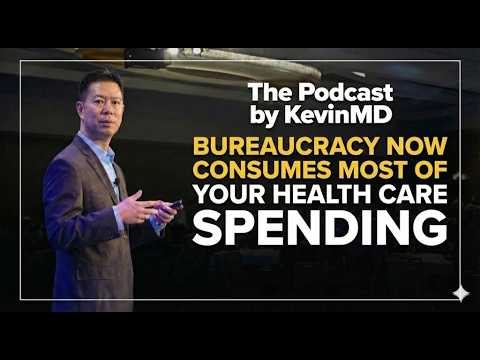
Vascular surgeon Paula Muto discusses her article “Give the health care dollar back to patients.” Paula argues that the government shutdown over health care funding misses the real issue of administrative bloat consuming 75 percent of spending. She explains how corporate consolidation and third-party administrators have turned patient coverage into captivity while driving independent physicians out of business. The conversation highlights the need to bypass insurance middlemen by subsidizing patients directly through Health Savings Accounts and vouchers. Paula advocates for transparent pricing and ending network restrictions to restore the sacred relationship between healers and those they serve. Discover how giving Americans control over their own health care dollars can build equity and lower costs for everyone.
Partner with me on the KevinMD platform. With over three million monthly readers and half a million social media followers, I give you direct access to the doctors and patients who matter most. Whether you need a sponsored article, email campaign, video interview, or a spot right here on the podcast, I offer the trusted space your brand deserves to be heard. Let’s work together to tell your story.
PARTNER WITH KEVINMD → https://kevinmd.com/influencer
SUBSCRIBE TO THE PODCAST → https://www.kevinmd.com/podcast
RECOMMENDED BY KEVINMD → https://www.kevinmd.com/recommended
Transcript
Kevin Pho: Hi, and welcome to the show. Subscribe at KevinMD.com/podcast. Today we welcome back Paula Muto, vascular surgeon and founder of UBERDOC. Today’s KevinMD article is “Give the health care dollar back to patients.” Paula, welcome back to the show.
Paula Muto: Oh, it is great to be here, Kevin. Thank you for having me.
Kevin Pho: All right, what is your latest article about and why did you decide to write it?
Paula Muto: Well, everybody knows my story by now. It is always about price transparency and access to care. Like all of us in the trenches, we just want to make it easy for our patients. The debate in Washington was raging. The government shut down over the fact that they couldn’t come to terms with subsidies. But when you look under the hood to see where those subsidies have gone, it is pretty disgraceful that those subsidies have not gone to health care.
They have not gone to pay for a doctor visit. They are not going to pay for medications. They are not going into the patient’s hands. They go to a variety of middlemen, and that has driven the price of care through the roof. I think that we have come to a time where medicine clearly happens in the home. Medicine happens in a doctor’s office. Medicine doesn’t always happen in a fancy hospital. In fact, we operate on you and we send you home. So why are the health care dollars still being directed to middlemen and an industry and a workflow that doesn’t really correspond to how we take care of patients? Wouldn’t it be better to just subsidize the patient first?
Kevin Pho: So the narrative around that shutdown towards the end of 2025 was that the subsidies decreased the premiums for patients, and without the subsidies, the premiums for the Obamacare plans would skyrocket without those subsidies. So tell me how your narrative differs from what we read in the newspapers.
Paula Muto: Well, if you look back, those subsidies were originally supposed to be like 180 dollars for a 300 dollar premium. Those subsidies now are 3,500 dollars for a premium that is much higher. So the subsidies caused the premiums to escalate, and it is about ten times what your employer premium went up. So the subsidies actually raised the premium.
Many states that agreed to do the Medicaid expansion took that money and made deals with hospitals. Those hospitals said: “Hey, don’t pay us Medicaid rates. Pay us over commercial rates.” So they kind of made a deal where they put a high price, gave a high premium, and gave a high subsidy.
But what did that do for everyone else buying insurance? For all the employer-based plans, Medicaid used to be the floor. Now the floor became the ceiling and the premiums went through the roof. So these subsidies were much more than what they seemed; they really did raise the premium for everyone in a pretty large way.
Then we realized where those subsidies have gone. So much of these health care dollars has been spent on housing, food, shelter, childcare, and stuff that isn’t actually health care. It would be fine if we had plenty to take care of our patients, but the reimbursement for taking care of a breast cancer patient now is so low that most people can’t afford to take care of them. So it is really a problem. It is not about where the money is; it is where it is going.
Kevin Pho: So it is almost like a vicious cycle, right? I think that the hospitals and medical entities are demanding rates above Medicaid, and that is increasing the cost of care. That in effect is raising the price of premiums, thus necessitating the need for more subsidies. Right? So it is almost like this vicious cycle.
Paula Muto: Yeah. And the subsidies, again, where are they going? There is so much money flowing in that you would think this is great. You think you are going to get paid and all these doctors would get paid and primary care physicians would get paid. But we are losing primary care physicians. We are losing independent doctors. The doctors are still having trouble balancing their balance sheet in their offices and are forced into consolidation. Why is that if the subsidies went out? That is sort of a logical question.
Kevin Pho: In your article, you said as much as 75 percent of those subsidies or the spending is going not necessarily to clinicians, but to administrative costs and management.
Paula Muto: Absolutely. And that is well documented. This is public information. This is not just an opinion. This is through very good accounting and very good economists that have looked at this. Luckily, the government is all public. You can dig and you can see where every dollar is spent. You just have to spend some time to look at it. Most doctors know where it is spent because it is not coming our way. We just keep getting cut. So how are these subsidies and Medicaid going up when Medicaid didn’t pay us in 2024? In Massachusetts, we went like four months without payment. So it is like, where is the money?
Kevin Pho: So I know you are an independent physician and you run a private practice. Tell me how the current environment is. We are speaking in the beginning of February 2026. What is the environment like today?
Paula Muto: So 2024 was pretty bad, right? We had the Change Healthcare breach in Massachusetts. We had the bankruptcy of a major health organization, Steward, which was the hospital I worked at. We came out into 2025 a little bit better in the sense that there was more stability.
There are still prior authorizations. There is still a tremendous amount of work. A lot of people gave up Medicare Advantage products, so a lot of patients have had access issues because there have been tremendous network restrictions now. People are just giving up those plans that cost too much. I mean providers and doctors are giving up those plans. So I am seeing a lot of access issues amongst the patients.
From a reimbursement standpoint, it is never great. There are still mysteries regarding why you get paid and don’t get paid. But for the most part, it seems to be that there is a change happening higher up that people want to be able to make this more transparent maybe, and keep doctors independent. I think there is a definite feeling that doctors would be better independent than consolidated.
Kevin Pho: So there is a path going forward. I think that we always have the threat of government shutdowns. The issue about subsidies isn’t going away. So what do you foresee happening in 2026 regarding this?
Paula Muto: It is interesting you should ask because I am going to be serving on one of those committees. They put it in August. They said they wanted committees of frontline doctors to help reshape health care. So I got nominated and am very excited to be asked to serve on one of these committees. I think they are trying to reach out to get people at the table who are in front of patients. That is the first thing.
There is a sort of desire to bring people in to hear more about how they can make changes. I think that for sure the rhetoric about moving more money to the patient makes a tremendous amount of sense. Health savings accounts have only been growing. People don’t understand them, but there has been some education toward it. Accountants and so forth are now telling their clients about health savings accounts.
I think that there is a clear movement toward outpatient services. That is just science. It is just like medicine. With that movement to outpatient services, it seems that there will be more point-of-care delivery closer to home. I don’t mean just telemedicine and things like that; I mean closer to home. So I think that rural health, for example, is getting a lot of attention and funding which will reverse this pretty bad trend where we were losing a lot of access points in rural areas.
I don’t want to say that we have come back from a cliff, but I think we have sort of gone over a curve where it is just not logical anymore. All of that requires funding. In Washington, there are soundbites. People are afraid to say: “Twenty-two million people without insurance.” I think people are scared. They need to be able to have insurance, and we are not saying to never have insurance. But I think some of that insurance could take a different form where some of it is in your pocket as savings, and some of it is for when you get hit by a truck, like Medicare Part A. Medicare Part B ideally should just be a savings account.
Kevin Pho: We have been talking about just more of a direct payment and cutting out the middlemen for many years now. I think the problem is a lot of that administration and those middle people are entities that are very entrenched, right? There are going to be winners and losers.
Paula Muto: And they are employers, Kevin. Yes. If you look at the map of the United States, health care is the number one industry in 47 out of 50 states. Now that is not a healthy map. You need to have manufacturing, agriculture, and technology. There have to be other industries. That is one of the interesting things about this. If you look at the job situation, we have been pretty anemic on job growth for the last 15 years. In the last few years, health care is always the curve to the right. It is growing, and everything else is to the left. It is like we are basically stealing jobs from the other sectors and putting them into health care.
When politicians look at that, they are afraid because you could affect jobs. But these jobs aren’t good jobs. I am going to say you know we need to repurpose some of these and go back to those other jobs because health care is putting a wage freeze in place. It has really created a wage freeze, which is what its original intent was, right? Employer-based plans in the Truman era were a wage freeze.
We created benefits, but now these benefits are sucking the life out of these small companies and mid-level companies. Today I just read that even the biggest companies are laying off because it is so expensive to employ a person because once you go over 30 hours, you are paying their health care. I think that people have to economically recognize that the health insurance burden is in fact putting a downward pressure on wages.
Kevin Pho: So if you look at a lot of cities and small towns, health care, whether it is hospitals or medical entities or insurance companies, is often that city’s largest employer. Right? So if we do what you propose and cut out those middle people, a lot of people are going to lose jobs. Right? Even though you said they are not good jobs, people are still going to lose jobs. You are right that a lot of politicians see that and that is what makes them hesitant to do what you want them to do. So what is the path forward here?
Paula Muto: Let me say that rural hospitals have closed. Rural hospitals are the number one employer in a town. When that hospital closes, you lose a huge employer. We have been facing this in areas around the country and that needs to stop. Those are nurses, doctors, and technicians. Those are people who make a hospital workplace. That is a vital service that is required like a fire station and a police station. So we need to make sure those are robust.
What I am talking about are the jobs that are eliminating anyway. For someone who needs to look at a prior authorization, AI is going to do that, right? Those jobs are simply going to eliminate, and the insurance companies aren’t upset about those because they are going to downsize their workforce too. So I think those jobs are naturally going to disappear because there is no reason to have middlemen in a world of AI, in a world that is transactional, and in a world where the hospital is no longer the necessary stop to get your care.
I am not saying underfund hospitals. I am just saying putting more of the money in the patient’s hands means that those hospitals have to be more affordable and more accessible. I just think that you are right that there will be some, but those losses of jobs have already occurred. UnitedHealthcare, I believe, cut their workforce by a significant amount. People are jumping on the bandwagon for these products to sort of do the managed care electronically through AI.
Kevin Pho: So in your ideal world, let’s say we do cut out the insurance middlemen and we subsidize patients directly through a health savings account. In your ideal world, just from the patient perspective, give us a sense of what that scenario would look like for the patient.
Paula Muto: I think when the patient signs up for a job, they will get a Blue Cross card. That Blue Cross card will be for everything that occurs in the hospital on the high end. Then they will turn their card around and there will be a chip, and that is their savings account. What they don’t spend, they get to keep and it moves forward.
People say: “Well, they are not going to get their care. They are going to underutilize.” I say no. First of all, people don’t get extra care because that is silly. People don’t say: “Please cut me open. I feel like I need to be treated today.” I think though that people will be judicious and they will say: “Wow, this is so much more convenient. I can actually go to my doctor and see them without having to go through all these millions of steps.”
I think that in the ideal world, we will decompress the system at its multiple-visit level. The 90 million visits that occur do not have to gather data, go through three-way transactions, and have all that data at risk. It is just a lot of extra steps that don’t need to happen when you have the more important things that get to be managed, like chronic disease, surgeries, and cancer treatments. Those then can be more focused on, and the insurance companies can really look at that and maybe that will alleviate some of the problems there.
Because you are going to take off your plate all of these day-to-day transactions that are very predictable. You take those and put them over aside and make those cheaper to occur. I think patients ideally will be able to take a little bit home with them in their paycheck, and that is what you want for them ultimately. They need to take more home in their paycheck to pay their mortgage and their education and all those other expenses that are being sucked away now by a health insurance benefit that they don’t utilize.
Kevin Pho: And what is the role of government? What is going to happen to Medicare and Medicaid in your vision?
Paula Muto: I think you know CMS is interesting. How are laws governed? You have all sorts of areas. The president can write executive orders, the Congress can pass laws, and then CMS can make regulations. I think the question is: who is the one in charge? CMS I think has really been the one that we feel most; those regulations come to us most directly.
When you say the government, when it comes to health care, there are all these moving parts. That was true for the Affordable Care Act. You remember when they said: “Don’t worry what is in between.” There really wasn’t anything in between. Everything was to be decided by committee.
So I think in Washington there is at least a movement that they have to change because Medicare is bankrupt in I think 2033 or 2036. So they kind of have to do something. I hope it is bipartisan because I think everyone understands this is an issue that crosses party lines. So what I am seeing out of CMS is that there has been some thoughtful change about how things are done as opposed to just cutting the doctors.
The president himself has said: “Fund the patient,” which is remarkable. This movement toward giving the patient the dollar once you square things away is happening. The drug companies have dropped their prices. That happened because they understand people can’t afford to buy their medications and many of them don’t have drug plans that can afford it.
So I think whether everyone likes it or not, we are moving in that direction because we can’t continue to have this sort of clunker of a system from the sixties. You have to modernize it, let’s just say that. And I think the government understands that, but the politicians don’t. It is still a soundbite for them.
Kevin Pho: And I know that you are implementing your vision through UBERDOC, so just tell us the difference it has made for the patients that use your service, and it is pretty much implementing what we are talking about today.
Paula Muto: So it has been really an honor and a joy to see this model come to fruition led by our direct primary care colleagues. Now it is going into specialty care and more physicians understand that they have to create a seat for a patient that is direct pay and is going to pay cash. And I think that is wonderful.
With UBERDOC, we are so blessed with so many great doctors across the country, and more join all the time. We have been servicing government service contracts for the disabled and vets, which has been great. But our plan for 2026 is that we are going to be going very heavy to the consumer now directly to the patient and to the doctors.
A lot of it is saying: “Here is the direct pay patient,” but a lot of it is telling the doctors: “Please now open up a door. Your front end can handle all of your insurance patients, but we can handle your cash patients and make it easy, convenient, and simple.” That is who we have always been: transparent. This is so they can begin to create those hybrid practices. It is like a hybrid car where you have electric and fuel. You have insurance, which you always need, and then you have a few patients that are hybrid, and you make sure that your practice is accommodating to both.
We want to give you the tools for that. We also have really exciting plans to give doctors all sorts of other tools, not just in the direct pay space, but giving them ways to understand AI, ways to understand some of regenerative medicine, and all the new markers that are out there. Lots of people come to UBERDOC because we have such a great relationship with doctors that we want to be able to give our doctors the tools to become modern doctors doing what is best for their patients.
Kevin Pho: We are talking to Paula Muto, vascular surgeon and founder of UBERDOC. Today’s KevinMD article is “Give the health care dollar back to patients.” Paula, as always, let’s end with take-home messages that you want to leave with the KevinMD audience.
Paula Muto: Well, again, your audience is wonderful. Physicians, don’t be afraid. We are here. We are all together. I think that is the one thing that we came out of this with is that the physicians are all together. We have your back all the way to Washington. Just remember to have faith that your patients will actually know how to find you. Just make it easy. We are going to get through this together and come out on the other side with all of our incredible medical technology and give the next generation of young doctors something to inherit.
Kevin Pho: Paula, thank you so much for sharing your perspective and insight. Thanks again for coming back on the show.
Paula Muto: Thank you, Kevin.