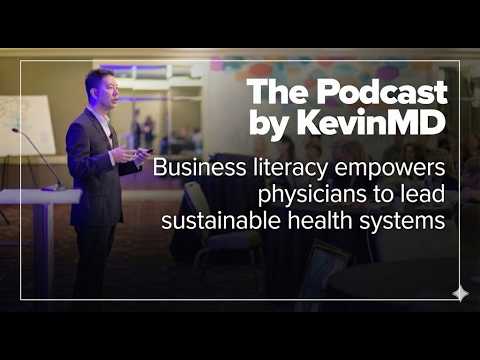
Subscribe to The Podcast by KevinMD. Watch on YouTube. Catch up on old episodes!
Family physician Kelly Bain discusses her article “Why physician business literacy matters.” Kelly explains that while doctors are trained to diagnose and treat patients, they are rarely prepared to navigate the complex financial realities of the modern health care industry. She argues that bridging this educational gap is essential for health systems to survive the shift from fee-for-service to value-based care models like WISeR and TEAM. The conversation highlights how understanding coding, risk adjustment factors, and operational efficiency empowers clinicians to become active stewards of resources rather than passive participants. Kelly emphasizes that when physicians master the business side of medicine, they protect patient access and ensure the long-term sustainability of care for vulnerable populations. Learn why the future of medical leadership requires a seat at the financial decision-making table.

True team-based care starts with you. When you join ChenMed, you’ll feel seen, heard, and valued. That’s because ChenMed practices transformative, physician-led care, focusing on prevention and empowering providers to have a lasting impact on their patients and communities.
So, whether you’re applying for a primary care physician, nurse practitioner, cardiologist, or medical director position, you’ll feel supported and fulfilled in every aspect of your career. Find a job that feels right. Visit ChenMed.com/Physicians to learn more.
VISIT SPONSOR → https://chenmed.com/Physicians
SUBSCRIBE TO THE PODCAST → https://www.kevinmd.com/podcast
RECOMMENDED BY KEVINMD → https://www.kevinmd.com/recommended
Transcript
Kevin Pho: Hi, and welcome to the show. Subscribe at KevinMD.com/podcast. Today we welcome Kelly Bain. She is a family physician, and today’s KevinMD article is “Why physician business literacy matters.” Kelly, welcome to the show.
Kelly Bain: Thank you for having me.
Kevin Pho: All right, let’s start by briefly sharing your story and then we will jump right into your article and explain about why you wrote it in the first place.
Kelly Bain: So, I am a family physician and have practiced for over 30 years. I think about my story in about three parts, if I may. My first phase I call “phase one” where I didn’t know what I didn’t know. I came from a rural area and wanted to go back and practice in a rural area, and it included a full spectrum of family medicine and OB. So I did. I just wanted to practice medicine. I did not think I needed to or did not want to mess with managing my practice or really understanding the business aspects.
But what I found was that in that employed position and with my lack of business education, I really had no control over my volumes. I did not know what kind of contracts I was in, what type of patients I was supposed to see, or who my call coverage was. I did not know how money flowed in my clinic. I did not know if I was making an adequate amount to cover my expenses. I had no idea.
What I learned as I experienced this was that it really was uncomfortable. I wanted to have some input into how my practice was managed. There were some circumstances besides that that led to my leaving in three years. But really I wanted to find a private practice or a circumstance where I could learn more about how the business of health care was done and how it could impact my practice.
So phase two of my life was joining a large private, multi-specialty group which had been involved in value-based care and value-based contracting since the early 2000s. This was when the precursor to current Medicare Advantage came about. Really before it was cool we were doing value-based care by going into homes, managing transitions of care, and having nurse practitioners go into skilled facilities making sure our patients got their preventative measures so that they did not have long-term health care complications. I was really blessed to have a group of men and women physicians who found the value in both business and our medical excellence.
But success sometimes leads to takeovers, right? So we were purchased by a large non-for-profit medical system in the region. Things changed once again. I was for the first time on a productivity payment system. Again, I did not have control over my patient panel. There was a push toward volume. I tried to get involved in things like managing our care management team, working with finance committees, and getting involved with medical directing. But I found I did not have the skill set to understand all the things I needed to be impactful.
So I went back and got my Master’s in Health Care Administration. About the time COVID hit in 2020, I decided I wanted to get back to my roots and go back into a circumstance where physicians were directing the clinic both from the business and the clinical excellence side. So then I joined Esse Health for the last three years of my clinical practice. So that is kind of my background.
Kevin Pho: All right. One of the things that struck me is that more and more physicians, as you know today, are going away from private practice. The numbers of private practice clinics are slowly dwindling. You mentioned that you did not have the business knowledge to really have that autonomy and empowerment when it comes to the patients you were seeing and the numbers behind how you are paid and compensated. For the average physician practicing today, do they need to get an MBA or Master’s of Health Administration to get that business knowledge in order to thrive in our current health care system? If you needed a master’s degree, what hope do traditional physicians who don’t have any business background have?
Kelly Bain: I do not think getting a master’s degree is necessary. I was moving toward more administrative roles and found it useful in that, but I think we can start much more basic than that. The key is to start somewhere. Start with beginning to understand your financials. Start to understand how your contracts work. Start to understand money flow within your office. So there are many things you can do to start to educate yourself in the business of health care.
Kevin Pho: And you talk more about that of course in your KevinMD article, “Why physician business literacy matters.” For those that did not get a chance to read your article, just tell us what it is about.
Kelly Bain: Sure. So the article is rooted in what I do now. I am a faculty physician with Surround Care Academy. Surround Care Academy is a division of Navvis Healthcare. We are creating curriculum that does exactly what we are talking about: educate physicians and physician leaders in the business of health care and the environment that we work in.
We cover who the payers are, how it is funded, and how policy is made. We explain what a value-based contract is and how you provide that type of care. We discuss what it means when we work in a hybrid payment model with both fee-for-service and value-based care contracting. We provide those basic business knowledge elements and historical elements, and then some more detailed things. We can dig down into how you perform well in a value-based contract and what a medical loss ratio and star rating are. So we get those terminologies and education to our providers.
Kevin Pho: So it sounds like they have to learn a whole new vernacular. Right. And that is one of the things that I often hear from physicians. They do not necessarily need to get a Master’s in Business Administration, but sometimes speaking in the language of business administrators can be helpful in terms of influence and communication. Right?
Kelly Bain: When you are sitting in the boardroom or in committee meetings with administrators, being able to communicate in the language that they use is very, very important to be heard. But I think the other value that physicians bring in is our clinical lens. We know how the decisions being made about policies or workflow are going to impact our patients. They are going to impact our fellow providers and how we provide care. That is just invaluable in driving the future of health care.
Kevin Pho: As I alluded to earlier, the majority of physicians are employed physicians similar to the situation you were in when your multi-specialty practice was bought by a nonprofit. A lot of physicians work for large medical institutions and hospitals. Give us some case studies and specific examples of how some of this business knowledge that we are talking about today, the business knowledge that physicians need, is going to affect them on a practical level. What would be some examples of that?
Kelly Bain: Employed physicians often feel that they do not have control. And that everything is on their shoulders. I think that knowledge of business and how you can work cooperatively and work with your employer to help create those teams of care is one aspect that can help lift the burden off of the shoulders of physicians.
When you lift some of those things off the shoulders of physicians, they can become more efficient. Often we are doing tasks that can be done by somebody else, or our team is not working to the top of their license. You can have folks in your office that by your workflows are setting up your visit and doing the pre-work. They take the initial HPI so you can go in and have more time with your patient. They put in orders. They do gaps-in-care work. So you can spread that work that sometimes seems like it is all on the physician’s shoulders out among your team. Then you can make the argument with your business leaders, your administrators, about why that efficiency is good and why it brings value to their business.
Kevin Pho: So sometimes in order for physicians to improve their workflows and work environment, again, they need to speak in that business language of efficiency to convince their business leaders to make those changes in the first place. Right?
Kelly Bain: I think that is a good way to say it. I think another practical example is often we feel like we are being asked to do a lot of things that are just check-the-boxes or they do not make a lot of sense. So if you understand coding as an example, right?
If you understand that if you are in a Medicare Advantage program, how you are reimbursed for that patient care is based on how you code not just CPT codes, but what we are talking about now is your HCC coding. You want to represent the full spectrum of disease that that patient has. The way you put the codes in accurately can make the 67-year-old look like a guy who is out playing tennis every day, or the guy who is in a wheelchair with an ulcer on his heel and badly controlled diabetes.
If you use the correct code versus the incorrect code, you paint a picture of the health care complexity of that patient. Those codes are multipliers to the dollars allocated for that patient’s care, trying to reflect future costs of care. So when I bring that to physicians and they understand that piece helps bring the dollars into the system to care for their patients, they are suddenly more interested in it.
I think another piece that is not always well understood is when we look for disease and find it early. There is literature that shows that those patients have slowed progression of their disease because they are getting the care and the resources that they need. So we improve quality outcomes. When we look at the whole patient and not just the complaint that they come in for that day, we can change that prognosis for them over time. All of those things are very appealing to physicians in providing quality care for the patient.
Kevin Pho: It sounds like a lot of this knowledge is given to physicians after the fact, after training, after they have been practicing for a few years and realize they are deficient in this business knowledge. Is it safe to say that the majority of physicians entering the workforce today, the newly graduated residents, do not have any of this knowledge whatsoever?
Kelly Bain: I think that is safe to say. Most residency programs do not have any business curriculum. If they do have some curriculum, it tends to be focused on how you get your job or reading contracts for getting your job. Maybe there is a little bit about setting up a practice but very little about how health care is funded.
Who are the payers? How do contracts work? How do funds flow in your office? What does it mean when you have to have quality metrics? And how does the star rating impact dollars coming back into your clinic? How does that impact your patients? How does it impact patient satisfaction? So there are a lot of dots that get connected when you start to understand the business behind health care. That helps you feel some control back into your practice life.
There is an entrepreneurial spirit to that. I know from listening to a number of your podcasts that that is something that I think is very important to providers now. It is how I have some ownership and how I have some control back over my practice life.
Kevin Pho: And given that the majority of new physicians do not have the business knowledge that we are talking about, what does that say for the potential future of our profession as it comes to physician autonomy if they do not gain this knowledge later on in their careers?
Kelly Bain: I do not think we can underestimate the value of having business education. Physicians need to take positions of leadership. And you do not have to be practicing 10 or 15 years to do that. You start small and you start to learn what you can in the time that you have. But if we do not, we are not going to be the advocates that our patients need us to be. We are not going to be the advocates for our fellow providers to change or transform health care for the future.
Kevin Pho: And where can physicians get started? I know that you mentioned a few resources, but for those physicians listening to you, and maybe this is a light bulb moment for them, give us advice on how they can get started.
Kelly Bain: I think often our professional organizations have materials. I know mine, the AAFP, there is even a whole journal geared toward management of your business in addition to the regular AAFP journal. So your professional organizations will have that information. The AMA has a lot of information in their Steps Forward program.
My organization, Surround Care, has tried to create a set of curriculum geared toward adult learners. It is a combination of live or live virtual education that does the foundational education around what value-based care and early disease recognition are, and the foundations of the business of health care and what that environment is like. Then there are shorter pieces that you can do in an LMS module on your own time. These are divided into five- to ten-minute segments that allow you to dig deeper into a particular topic and get more detailed information. So we have a whole catalog of those kinds of information. So whether your organization would choose to do something like what we provide or you are on your own doing that, there are resources out there for physicians to gain business knowledge.
Kevin Pho: We are talking to Kelly Bain, family physician. Today’s KevinMD article is “Why physician business literacy matters.” Kelly, let’s end with take-home messages that you want to leave with the KevinMD audience.
Kelly Bain: Let me think for a second. I think that doctors are full of great ideas. They often need some additional education to express those and have them be heard by their health care systems that they work for. So they have to help their administrators understand how to connect the dots as well.
In doing so, we are going to improve the future, making better choices with the limited resources that we have to reduce waste, improve value, and improve access. We will move from feeling like victims of the circumstances that we are in to being performance-minded entrepreneurs. We are rising to those health care challenges, and that is really what our country needs to improve our health care system.
Kevin Pho: Kelly, thank you so much for sharing your perspective and insight. Thanks again for coming on the show.
Kelly Bain: Thank you so much.