Subscribe to The Podcast by KevinMD. Watch on YouTube. Catch up on old episodes!
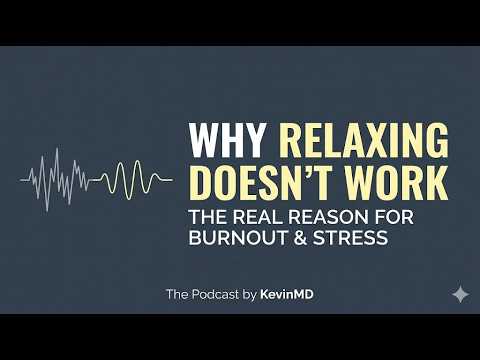
Occupational medicine physician and life coach Claudine Holt discusses her article “Nervous system dysregulation vs. stress: Why ‘just relaxing’ doesn’t work.” Claudine challenges the common advice to treat burnout with self-care like massages or vacations. She explains that for many, stress is not a mindset issue but a physiological state of the nervous system. The conversation highlights how behaviors like perfectionism and people-pleasing are actually adaptive survival strategies, not character flaws. Claudine argues that when the body is stuck in a fight-or-flight state, relaxation actually feels dangerous. She advocates for “bottom-up” somatic approaches rather than willpower or cognitive therapies alone. Discover why healing requires updating the nervous system’s safety cues rather than just trying to force calm.

Partner with me on the KevinMD platform. With over three million monthly readers and half a million social media followers, I give you direct access to the doctors and patients who matter most. Whether you need a sponsored article, email campaign, video interview, or a spot right here on the podcast, I offer the trusted space your brand deserves to be heard. Let’s work together to tell your story.
PARTNER WITH KEVINMD → https://kevinmd.com/influencer
SUBSCRIBE TO THE PODCAST → https://www.kevinmd.com/podcast
RECOMMENDED BY KEVINMD → https://www.kevinmd.com/recommended
Transcript
Kevin Pho: Hi, and welcome to the show. Subscribe at KevinMD.com/podcast. Today we welcome Claudine Holt. She is an occupational medicine physician and life coach. Today’s KevinMD article is “Nervous system dysregulation versus stress: why just relaxing doesn’t work.” Claudine, welcome to the show.
Claudine Holt: Thank you so much for having me, Dr. Kevin.
Kevin Pho: All right, so let’s start by briefly sharing your story and then why you decided to write this particular article on KevinMD.
Claudine Holt: My name is Claudine and I did an OB-GYN residency for two years before switching into occupational medicine and then lifestyle medicine. I think like so many other physicians I was burned out earlier in my career, experienced that, and then discovered coaching, which was life-changing for me. After becoming a coach like so many people, that was just kind of a snowball effect. I became certified in life coaching, then eventually in integrative somatic trauma, and then in more somatic techniques like EMDR. Finally, I became certified in polyvagal theory and polyvagal therapy through the Polyvagal Institute.
What I have come to experience and what I see in the work that I have done with my clients is that our nervous system really is so important for our experience and how we show up in life, but also how we experience life as well. For me, the nervous system is really like the operating system. That is usually how I describe it and explain it. Having knowledge about how our nervous system impacts our daily experience and understanding what state you are in really plays a huge role.
Now I also have a medical practice where I help women with their hormones and their nervous systems because I realized that it is actually the two of these systems really working in a partnership together. That was really what led me to want to write this article. A lot of physicians have the information about the nervous system. We all learned about it in medical school. We all did anatomy and we know about the nerves and how they traverse through the body. But really having an understanding of that more day-to-day application of how the nervous system shows up is incredibly important. So I wanted to really share that.

ADVERTISEMENT
Kevin Pho: All right, so we are going to talk more about your KevinMD article about that. As you know, on this channel a lot of physicians are burned out and undergoing a lot of stress. How does the nervous system play a role in that?
Claudine Holt: Of course we all lived through the pandemic and that really brought the conversation about burnout and stress to the forefront, not only for us as clinicians and other health care workers but just everyone in general. I think everyone was thinking about mental health and their well-being. A lot of that information that we tend to receive about how to deal with burnout or stress always focuses on self-care and about getting a massage or taking your PTO. We hear about making sure that you are meditating or praying or practicing mindfulness.
All of those are wonderful practices, but sometimes they can almost be like a band-aid. It is like putting a band-aid on top of what is going on underneath. The nervous system is really what is going on underneath. It is the operating system. Your nervous system state impacts how you are seeing the world, whether it is a safe space or a dangerous space. It affects whether people are safe to engage with or not and ultimately how you feel showing up or not in your life.
A lot of people have information about thoughts, feelings, and actions and that cognitive triad. But really it is the nervous system that plays a big part in even how your thoughts are coming up and how you are seeing the world. That impacts how you feel and whether or not you take action. So it is very important for us as clinicians to understand this.
For example, if your patients aren’t taking your advice or they’re not taking their medications, it is very easy to write them off as just not cooperating with the plan. But that might not be it. It might be that they have some underlying trauma or they have got other issues that are impacting their ability to show up and to take your advice. Or maybe they have other stressors that are weighing more heavily and their nervous system is in survival mode. So for them, taking their blood pressure pill or thinking about renal disease 10 years down the line is not at the forefront of their mind. It is maybe paying their mortgage or making sure their child comes home at night. It is important for us to not only understand the nervous system personally but to also see how other people are showing up in their lives because of their nervous system dysregulation.
Kevin Pho: So in your article you talk about understanding the language of the nervous system, and sometimes that can help us better interpret some of the situations that the patients come to us for. Tell us some of this verbiage that helps us understand the context of why patients come in for what they do in the context of nervous system dysregulation.
Claudine Holt: This work I do want to credit to Dr. Stephen Porges. He is the one who first posited this polyvagal theory, I think in the nineties. I highly respect his work. He really helps us to see that the nervous system is really made up of different states. There are six nervous system states altogether. Most of us simplify it into three. Most people know the terms fight, flight, freeze, and fawn. Really those are states of dysregulation based on what is happening in the body in the sympathetic system and the parasympathetic nervous system.
There are actually two branches of the parasympathetic: the dorsal and the ventral. From the three main states, there are actually three blended states as well. There could be a mix of parasympathetic and sympathetic both on board at the same time. Depending on what percentage of each you have, if you want to look at it that way, you get these blended states. It is important to understand that each nervous system state makes complete sense based on whatever is going on in your life at a particular time. I think a lot of people just turn it on themselves or they judge themselves or have this inner critical voice asking why they can’t be more like this or do this. They really want to do that, but they are doing the opposite thing that they want to do.
It all makes sense. When either patients or coaching clients are telling me what is going on in their life, I can immediately see what nervous system state they are in. It makes perfect sense. Your nervous system ultimately is designed for one mission, and that is keeping you safe. So anything that it perceives as unsafe triggers a reaction. That could be an actual danger like that bear chasing you in the woods or it could be getting an email from your boss with no context saying they need to talk to you now for a meeting. Your brain just starts creating ideas of what that could mean. Just understanding that every response and every reaction that you have at the level of the nervous system makes sense is helpful. Once you can identify what state you are in, then you know what to do from that point. Then you can sort of get yourself back to a place of regulation.
Kevin Pho: Talking to a lot of physicians who were in similar situations like you were perhaps burned out and stressed, how can understanding how their nervous system is dysregulated lead them out of that state of burnout? Give us an example.
Claudine Holt: Just in general, understanding what nervous system state you are in brings more context to what is happening. Instead of the default, which is maybe to blame yourself or to say: “I am not a good enough doctor,” or “I am not a good enough mom or wife or daughter,” it helps you to understand that your nervous system is just responding to the circumstances that are happening in your life. There is a reason why you are showing up the way that you are. It definitely helps to reduce any sense of shame or stigma that you might feel about how you are reacting in a certain situation.
Just literally understanding that your nervous system can be regulated and that you can go from a state of dysregulation to a state of regulation is helpful. It doesn’t take a lot. Even just a few minutes of regulating can have a profound impact on your heart rate, your HRV, your blood pressure, and your sense of well-being. Of course, we know that there are other consequences that come from not being regulated. You are more prone to inflammatory states and more prone to emotional and mental disturbances. You are more prone to getting sicker and having a weakened immune system.
Having that understanding of what the nervous system is, what state you are in, and how to regulate it is important. I think it is very important to say this: no one lives in a state of regulation a hundred percent of the time. So it is not about staying in ventral, which is what we call the state of regulation. No one lives in ventral. The skill is really recognizing when you are out of ventral and then getting back into ventral again and again. It becomes more of a practice. So all of those wonderful practices like meditating, prayer, going to church, getting a massage, or going to Pilates help. All of those things help to get us back into ventral again and again. We start to expand our capacity for what we can tolerate. So instead of having a very narrow window of tolerance where the smallest thing will just get us dysregulated, we expand that window. So it takes a little bit more for us to get out of that state of regulation.
Kevin Pho: Now, what kind of advice do you have for physicians to get back into that state of regulation? Is it meditation? You mentioned prayer. What are some easy ways they can do it? Obviously, they can talk to a coach like yourself, but absent of that, what are some things that they can do?
Claudine Holt: Those are great things. Everyone should have what I call their regulation list. You want to identify those things that you know make you feel good in the moment. It could be something very small like just closing your eyes for a few minutes. There are lots of different nervous system tools and techniques. There are apps that have different techniques and tools that you can use to regulate your nervous system. They can be very simple things. Breathwork is a very simple one like box breathing or four-six breathing where the exhale is longer than the inhale. There are several techniques out there that have evidence in the literature showing that these things do increase our capacity and improve our heart rate variability, which is a marker of nervous system regulation.
There is just a wide variety of tools. What I usually encourage people to do is to build their own toolbox. Figure out those five to ten tools that you can deploy in the moment. Maybe if you have an office, you shut your door and you do whatever that tool is that you know works for you in the moment and get back into a state of regulation. It is very important to understand when you are dysregulated. You actually don’t have access to the prefrontal cortex, the higher thinking part of our brain. That is the part of our brain responsible for problem-solving, creativity, and wanting to connect with other people. When you are dysregulated, you immediately get out of that state, and it is kind of like you feel it is you against the world and you have to protect yourself. That is not the state that you want to be in if you are in practice taking care of people or if you are a wife or a mom. So it always helps to try to recognize when you are dysregulated, get yourself back into regulation, and then go on to have those conversations or interactions with people.
Kevin Pho: Now, is there a diagnostic test to show whether a nervous system is dysregulated or is it based on purely clinical symptoms?
Claudine Holt: It is primarily clinical. There are some things like measuring your HRV. A lot of people have Oura rings or HRV sensors. The HeartMath Institute also has devices that you can get to track your HRV. There are other types of biofeedback that you can do to look at your nervous system state, but HRV is the main one that people will look at as a marker for your resilience or your nervous system regulation.
But the thing is, you can just track it based on how you feel. We all have access to our emotions, but we also have access to symptoms and signs in our body. When we get angry, when we are in a state of sympathetic, we get irritated and frustrated. We know what that feels like. Our heart rate goes up, maybe adrenaline is pumping, and we get really shaky. We also know how it feels to be in a state of dorsal. That is when you are all the way shut down and you are cold, numb, and clammy. Maybe you are just very listless. It doesn’t take much to use what we call interoception, which is turning your focus inward and just noticing what those symptoms, emotions, and thoughts are when you are in different states of dysregulation. Then you can notice how you feel when you are in an opposite state when you are more regulated.
Kevin Pho: And HRV is heart rate variability biofeedback. For those who aren’t familiar with that, talk to us more about how that is measured and what some of the findings mean in terms of dysregulation.
Claudine Holt: There is going to be a spectrum of HRV for different people. There are tables out there that give you normative values. I have a breathwork program that I created that is all about trying to improve your HRV through breathwork. What I tell my clients who do it is that it is more important to look at the baseline where you start and then where you end up than whether or not you are in the normative for a particular age or gender type. The most important thing is just understanding that HRV is measuring that beat-to-beat variability between your heartbeats. It is really what is happening in that window that can tell us a lot about how well your body and your nervous system is able to respond to the challenges of life.
You can measure that in several ways. Some apps actually just use the camera on the back of your phone. I have HRV sensors that you can clip to your ears, and those are pretty inexpensive. The HeartMath Institute also has more expensive devices that you can get if you are really interested in that. Your typical smartwatch or Oura ring can also give you information about your HRV. Again, it is not so much that you necessarily need to shoot for whatever that standard is for your age and gender, but you are looking for improvement over time as you start to regulate your nervous system.
Kevin Pho: Now I am a primary care physician. How can understanding nervous system dysregulation help me in the exam room when I am talking to patients? You mentioned a few scenarios earlier in our conversation where the genesis of what they come up with could be nervous system dysregulation. Give me an example of how understanding that can help patients.
Claudine Holt: I think just understanding your own nervous system allows you to have a lot more grace and compassion for other people because you understand that we are all just humans and we are all just doing the best that we can. I really do believe that. Yes, there are some bad people out there, but I think in general, we are all just kind of responding to our upbringing and some of the earlier experiences that we had in life. We know about ACEs and we know about all those things that contribute to how someone is showing up in their current life from the things that they experienced in their childhood with adverse childhood experiences.
Understanding the nervous system can help us to have more compassion and more grace for people. Understanding that the patient who is in front of you who is not taking your advice is not necessarily just dismissing you or trying to ignore your advice is key. There may be something else that is going on. Once you can sort of recognize the signs of dysregulation in yourself, you will start to be able to recognize them in other people. I know we are all strapped for time. If you are in a traditional insurance-based model, maybe you don’t have more than 15 minutes with a person. But even just being able to notice and say: “Hey, it looks like you are looking a little shut down or you are not really making eye contact. You look a little agitated. Can you just tell me what is going on?” is helpful. Sometimes just asking the question allows the person to feel safe enough to share what is going on in their life. Again, the nervous system is all about safety. So if you feel like a safe space to a patient as a clinician, they may feel safe to share and to open up more with you as well. So becoming a safe space for yourself, but also a safe space for your patients is huge.
Kevin Pho: We are talking to Claudine Holt, occupational medicine physician and life coach. Today’s KevinMD article is “Nervous system dysregulation versus stress: why just relaxing doesn’t work.” Claudine, let’s end with some take-home messages that you want to leave with the KevinMD audience.
Claudine Holt: I think the most important lesson maybe that I would impart is understanding that the quality of care that you can give to your patients is really going to be dependent on the quality of life that you give to yourself. Those things can’t really be separated. So if you are constantly stressed, if you are burned out, if you are hating your work and hating your life, it is going to be very hard for you to give quality care because of what I said earlier. When you are in a state of dysregulation, your priority is just surviving at that point. Your priority isn’t the patient who is in front of you or your spouse or your child. It is really important to understand, especially as doctors who are sort of wired to give and give and give and sort of put ourselves last, that we really do need to take care of ourselves. We can’t be the best at what we do if we don’t take care of ourselves first. Nervous system regulation is going to be a core pillar of that, making sure that your gas tank is full, so to speak, so that you can give the best quality care that you can to your patients.
Kevin Pho: Claudine, thank you so much for sharing your perspective and insight. Thanks again for coming on the show.
Claudine Holt: Thank you. Thank you for having me.