Listen and followApple PodcastsSpotifyYouTubeMore apps · Browse all episodes
A week off does not fix burnout. The same problems are waiting when you get home, and the same person is walking back into them. Stacey Funt is a radiologist who runs a boutique wellness adventure travel company, mostly for women in their 40s through 60s, including a high share of physicians. She discusses the KevinMD article “Why immersive travel may be a powerful tool for behavior change.” You will hear the science behind identity-driven behavior change: awe, novelty, supportive groups, meaningful challenge, and a clear before-and-after marker she calls a temporal landmark. She tells the story of a physician who had a benign brain tumor resected and rebuilt herself from post-operative patient to hiker at the front of the pack, and a burnt-out physician at a crossroads who used the trip to make a hard call about her career. You will hear what to do at home when a trip is not on the table: take an awe walk, set a temporal landmark, build a meaningful goal that requires real training.
Partner with me on the KevinMD platform. With over three million monthly readers and half a million social media followers, I give you direct access to the doctors and patients who matter most. Whether you need a sponsored article, email campaign, video interview, or a spot right here on the podcast, I offer the trusted space your brand deserves to be heard. Let’s work together to tell your story.
PARTNER WITH KEVINMD → https://kevinmd.com/influencer
SUBSCRIBE TO THE PODCAST → https://www.kevinmd.com/podcast
RECOMMENDED BY KEVINMD → https://www.kevinmd.com/recommended
Transcript
Kevin Pho: Hi, and welcome to the show. Subscribe at KevinMD.com/podcast. Today, we welcome back Stacey Funt. She is a radiologist and the founder of LH Adventure Travel, a boutique wellness adventure travel company. Today’s KevinMD article is “Why immersive travel may be a powerful tool for behavior change.” Stacey, welcome back to the show.
Stacey Funt: Thanks so much. I’m really happy to be here.
Kevin Pho: It’s been a few years since you were last on, so briefly reintroduce yourself to my audience, and then tell us why you decided to share this particular article on KevinMD.
Stacey Funt: Thanks so much. I’m a radiologist, and I’ve worked part-time, per diem, for a long time now. About 14 years ago, I went back for health coaching, and a little over three years ago, I combined my lifelong love of travel with health coaching and formed a wellness adventure travel company. It’s predominantly women. We run one couples trip a year, but otherwise it’s all women.
We travel around the globe, incorporating components of lifestyle medicine. There’s movement, there’s time for managing stress, and we eat well, so there’s always a food component. But the biggest part for me is building the community on the trips. It’s been amazing. I’ve personally hosted more than 10 trips now, and I have other people hosting trips with me as well.
I decided to write this article because I started to see so many powerful transformations, far more than I did when I was working as a health coach. I saw the impact that travel has on our core identity, and I think identity change is the biggest driver of behavior change. That’s what inspired me to write the article.
Real physician voices, twice a week
Free, and one click to unsubscribe.
Kevin Pho: And the people who go on your trips, can you tell us a little about who they are? Are they all physicians, or do they span a range of professions? What are some of the reasons they decide to go?
Stacey Funt: It’s not all physicians, though I do have a lot of physicians, maybe 60 to 65 percent. It depends on the trip, and on some it’s a bit higher. They’re all curious women, mostly in their 40s through their late 60s. Anyone can come; there’s no age limit. I mention the age range so that a 25-year-old knows we’re not running up Kilimanjaro.
But these are active trips. They’re moderately active. We hike, we e-bike the hills of Tuscany, we kayak on the lake in Guatemala, we hike in Bhutan, we do all sorts of things. People choose these adventures for many different reasons. Again, I do run one couples trip a year, but I’ll speak mainly about the women.
Some of the women come because none of their friends or their partner likes to do what they do. Others simply want time away with a group of women. There’s a very special chemistry and a special magic, to me, that happens when like-minded women, and I know that word is overused, go on an adventure together. They’re curious, open-minded, and excited. They’re moved by nature, because all of our trips include natural immersion, and they want to move their bodies. It’s moderate movement, but this is adventure travel, so we’re willing to get a little out of our comfort zone for that big “wow” moment, the awe factor that you sometimes have to go a little further to reach.
Kevin Pho: In your article, you talk about behavior change and how immersive travel can lead to it. For those who didn’t get a chance to read it, delve a little deeper, and maybe give us some examples of what you mean by behavior change.
Stacey Funt: Sure, thanks. The crux of the article is that immersive travel can support identity, because we pretty much act according to who we think we are. If I think I’m a runner, I’m going to run. If I think I’m lazy and a couch potato, I’m pretty much going to stay on the couch; it will be much more of a struggle. So when we shift our identity toward the person we believe we are, one more aligned with how we want to act, we’re much more likely to become that person.
The article talks about how immersive travel creates opportunities for this identity shift, and there are certain factors involved. Awe is one; being in awe can biologically open us up to an identity shift. Novelty is another, the way we experience the world. I could go into much more detail because it’s fascinating, but the key factors are awe, novelty, being in a supportive group, having meaningful and challenging goals, and having what we call a temporal landmark, when a trip serves as a clear before-and-after. A lot of people say, “When I get home, I’m going to start.” It’s very easy to change behavior when our habitual routines are disrupted because we’re in a completely new environment. It’s easy to get attached to staying on our phone, coming home, and sitting on the couch, but when you go to a whole new environment, it’s much easier to start different behaviors. And when you’re with a group of people doing them, when others start to see you differently, it’s much easier to make these identity shifts.
I could give you so many examples, Kevin; it’s just so fun to watch. I mention two in particular in the article, and I have many more. One woman, a physician, had a benign brain tumor resected, and it left her with residual deficits. She was in physical therapy for a very long time. It was life-changing for her, and she gave up her practice. It was a really big deal.
She contacted me wanting to go on one of the trips, and we talked. At first I had some concerns, because we’ll hike for three or four hours in a single day. It’s not over the top, but the trips are active. She thought she could do it; it was a big goal for her, and she’d been working toward it. So I said, “OK, come. We’ll hire a separate guide for you, just in case.” And she did amazingly. She was at the front of the pack. She used hiking sticks to help with her balance, and she was so inspirational to everyone.
When she first arrived, I felt she saw herself as someone in physical therapy recovering from a catastrophic event. This was a longer journey, and by the end of the trip she was a hiker, right at the front of that pack. She was no longer the post-operative patient; she was in the next chapter of her life.
I’ve seen that with so many people. Some women come just for a good time, with no transition at all. Others are thinking of changing jobs, or going through a divorce, and I do get quite a few empty nesters. Their kids have gone off to college, and they’re asking, “Now what do I do?” It’s time to rediscover what brings them joy and who they are again, and to start giving to themselves. I see women find their power and their strength, and when you find that, it’s a lot easier to be who you want to be, to behave the way you want to behave, and to take care of yourself the way you want to.
Kevin Pho: So I’m hearing that many of the women on your trips come from similar positions, and they share a sense of belonging. Because they may be overcoming obstacles, and on the trip they have that shared sense of belonging, they become more willing to take risks and try new things. And that sense of belonging, in itself, can of course lead to identity and behavior change.
Stacey Funt: You are 100 percent correct. I just got back two days ago. I took a group to the Southwest, to Utah and Lake Powell, and we were kayaking and hiking in Horseshoe Bend and Antelope Canyon. Some of it was really windy, and the water was choppy in parts, so it was challenging. And it was spectacular. If you’ve been to that region, it’s pure magic. It really is.
These women were amazing, all of them, and they formed such a tight bond. Some struggled more than others on the windy day, and the kayaking was tough, but everybody was so supportive of each other, and they drew so much strength from one another. We all felt so good as a group at the end. We did it. And then we went on this magnificent hike among the red mountains. It was such a peak moment for so many of them, and because it was a shared peak moment, it was amplified tenfold. It really was.
Kevin Pho: You mentioned that about 60 percent of your clients are physicians, and as a physician yourself, you know it’s a very difficult practice environment right now. We talk a lot about physician burnout. Are there any stories you could share about a burnt-out physician going on one of your immersive trips and experiencing some kind of identity or behavior change that helped them professionally afterward?
Stacey Funt: I can tell you what they share afterward. We have a private WhatsApp group, and women from trips two years ago still post in it. The group bonds a lot. I have a Nepal and Bhutan trip coming up, the second one, and it’s about 80 percent physicians, so it varies. One woman in particular comes to mind. Not too long ago, we had a woman who was struggling in her practice. Her practice had been bought out by a system, and she was struggling to make peace with what she wanted to do and where she belonged.
How do I put this? She was really at a crossroads, trying to decide what to do. I hesitate to give this example, because she decided to leave, and I’m not saying that’s the answer to burnout. There are definitely ways to stay, and she was at a different stage of her career. But it was a really hard decision for her. A while after we got back, she shared that simply getting time away and being able to reflect had made the difference. She was in a position where she could leave; what held her back was the identity of being a physician. Sometimes leaving is a financial decision, but that wasn’t the issue here. It was a lifelong career and an identity, and the fear of the unknown, of what comes next.
She took a lot of risks on our adventure, and she shared in our group that it started her on a new path, which was just so amazing. The whole group was setting off fireworks all over the WhatsApp, because they were so excited for her. Other people choose to stay, and that’s fine too. But she made the decision she needed to make to find peace, rather than staying in that undecided, miserable, stuck feeling, because that is a miserable place to be. When you’re not happy where you are and you can’t decide what to do next, you feel helpless, and victimhood is never a positive feeling.
I’ve also had women talk about the stress of malpractice cases and speak very honestly about them. Once you’ve been sued, you’re not supposed to talk about it, so people don’t really discuss it. A couple of years ago, there was a really powerful moment, a genuine emotional release, and the compassion from everyone else in the group, physicians and non-physicians alike, was so healing for her. It truly was.
There are so many examples. It’s one thing to just go on a vacation. You could be burnt out and exhausted, and you could go to Florida or the Caribbean for a week, but then you come back to all the same problems and think about them in all the same ways. It’s a totally different experience to go away and then see your life differently. To me, that’s what helps. Taking a break can recharge you, but then you go right back into the same mindset, the same thoughts, the same depleting experience.
Again, it doesn’t mean you’re going to leave at all. It might mean deciding to look at something differently, to approach life differently, to set boundaries, to take care of yourself differently, whatever it is. That’s such a big thing, being able to step out completely. That’s why about half the women come alone on my trips. Some come with one friend. I never have more than about four people who already know each other, because I don’t want eight close friends and then two outsiders. So it’s pretty much half and half, depending on the trip.
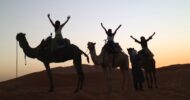
When you step completely away and go into the total unknown, when you come to Tanzania and spend time with the Maasai, you’re not thinking about anything back home at all. And when you get so immersed in nature, walking in the Andes on the Inca Trail, or wherever we happen to be, or standing in the dunes in Morocco, when you’re immersed in these magnificent environments, it just opens up your soul. It connects you. For me, and I’ve seen it for so many people, it connects me to my authentic self. It brings me back to the core of who I am, what I want, and the direction I want to be heading. It’s a really good reset, a chance to reassess whether I’m going in the direction I want, and to figure out where I need to go, all while having an amazing time and being supported by these wonderful people.
Kevin Pho: I know it’s impossible to compete with these exotic adventures at home. But are there elements of these trips, some of these identity-shifting conditions, that people can apply at home, based on the characteristics you’ve seen?
Stacey Funt: Yes, absolutely. At the end of the article, I give very concrete things you can do, because not everyone can travel. I couldn’t do this when my kids were younger. People may not have the finances, the time, or the desire, and not everyone can get on a plane. But there’s so much we can do once we keep this idea of identity change in our consciousness and ask ourselves how we want to see the world.
Once I started learning more about this and intentionally tried to create change, I applied it to my daily routine. I walk my dog every morning. Normally I would just walk and come back, but instead I started going on an awe hunt, looking for moments of awe or beauty on the walk. I’d notice, “Oh, the flowers are coming out,” or, “Look at the way the sun is setting,” intentionally seeking out those moments.
Then there’s the idea of a temporal landmark. I can use a Monday as a temporal landmark; these markers just make it easier to create behavioral shifts. And I can create temporal landmarks whenever I want. Memorial Day weekend can be a temporal landmark, or anything else. It’s about taking advantage of things that make change a little easier.
Meaningful goals are another. I don’t get to the gym easily; I’m just not one of those people. A lot of people in lifestyle medicine naturally are, but I’m not. I need the fear of getting stuck on a mountain to make me train. But it doesn’t have to be Peru. I live on Long Island, and I can go hiking an hour away. When we find personal goals that require a bit more effort to reach, it becomes much easier to do the mundane-feeling work of taking care of ourselves, because it’s attached to something we want.
And then there’s novelty. I can create novelty just by taking a different route to work, or exploring a new park or a new restaurant. It’s about being intentional about bringing these elements into my life, because I know they genuinely affect my brain.
Kevin Pho: We’re talking to Stacey Funt, a radiologist and the founder of LH Adventure Travel, a boutique wellness adventure travel company. Today’s KevinMD article is “Why immersive travel may be a powerful tool for behavior change.” Stacey, as always, let’s end with the take-home messages you want to leave with the KevinMD audience.
Stacey Funt: Thanks so much, Kevin. If I had to leave a few take-home messages, I’d say we’re so much more powerful than we believe, and sometimes we just need a little support, or something to change the way we’re looking at things. Whether it’s a trip across the globe or a walk around the block, when we allow ourselves to see the world differently, our whole life can change.
Kevin Pho: Stacey, as always, thank you so much for sharing your perspective and insight, and thanks again for coming back on the show.
Stacey Funt: Thanks, Kevin.
Listen and followApple PodcastsSpotifyYouTubeMore apps · Browse all episodes