Unlike my earlier pieces, which often stitched together studies and data to build an argument, this one grew straight out of ordinary mornings. Pulling up to the same stop sign on my commute, waiting for the light to turn green, easing over to let an ambulance through with its urgent lights flashing. Touched by a reality check, one of my friends who lost his significant other of long years has been documenting and discussing all the emotions and processes that he is going through and sharing it via email to a closer group of acquaintances. In those small but not so small, repeated but not so repeated moments, something clicked: Life feels a lot like moving through a vast, interconnected transportation system. In moments of pause during this move and shared vulnerability, the metaphor crystallized. I picked up my recorder and started dictating this note. Life moves through green lights of momentum, yellow lights of uncertainty, and red lights that demand we stop, and sometimes for reasons that feel deeply unfair.
Life doesn’t usually follow a straight, easy highway. Instead, sometimes, it feels like a long, living road trip across a vast and ever-changing landscape of smooth interstates, bumpy backroads, misty mountain passes, sunny open plains, and quiet lanes shaded by trees. Every stretch has its own rhythm, surprises, and quiet beauty. And running through it all is one gentle truth worth remembering: Every journey has “stops” built into it. Some are planned rest areas. Others come suddenly, like an engine stall, a detour, or a barrier raised by forces we sometimes call “regulators.”
The lights that guide our days
Along any road trip, you encounter traffic signals. The same happens in life.
Red lights and stop signs force you to pause. A job offer falls through. A health issue appears. A relationship needs space. You sit there, engine idling, watching others move ahead. Some stops feel fair and protective. Others seem unfair, frustrating rules or obstacles that test your patience. It’s easy to feel jaded when the wait feels pointless.
Real physician voices, twice a week
Free, and one click to unsubscribe.
But here’s where resilience quietly grows. Remembering that stops are part of every journey helps you breathe through them. They aren’t always dead ends. They can become moments to rest, reflect, refuel, and sometimes choose a better route. Science may extend our travels and smooth more paths, but full control over the final destination remains out of reach. Holding this truth lightly turns frustration into strength.
Yellow lights are the uncertain in-between times like career changes, tough conversations, or big life transitions. The signals feel mixed. Do you slow down and proceed carefully, or trust your gut and move forward? These moments ask for quick judgment and steady nerves.
Green lights, when they arrive, feel pure grace. Momentum builds. Opportunities line up. The road opens wide, music sounds better, and the miles seem to fly by. These stretches remind us why we keep going.
Dreaming big fits naturally here. It’s the courage to take the exit toward higher ground, to chase distant mountains even when the road ahead looks winding. Ambition lifts us, but the real wisdom is enjoying the ride no matter the pace.
Different ways to travel: different views
How you choose to move shapes both the scenery you see and the person you become.
- Walking invites deep presence. It’s slower, but you feel every step. You notice wildflowers in the grass, the smell of rain on the pavement, and the stories of fellow travelers. This is the pace of building something meaningful over time, raising children with care, mastering a craft, or sitting with aging parents. You trade speed for connection and richness.
- Driving a regular car mirrors everyday life for most of us. It’s practical and flexible. You handle work, errands, family duties, and spontaneous detours. The car needs regular care and fuel for your energy, maintenance for your well-being, just like we do. You’re in control, yet still part of the flow of traffic.
- Flying by airplane represents the bold leaps. Big promotions, major moves, or chasing ambitious dreams. You cover huge distances quickly and see the world from a new height. The view is breathtaking sometimes, though you might miss the small details below. Turbulence tests you, but the thrill of altitude brings its own reward.
No single speed is considered the best or ideal. Some travelers collect achievements rapidly. Others gather deep stories, strong relationships, and inner peace. Both paths have cost and gifts. Resilience shows up in the balance, dreaming big enough to reach the heights, while staying humble enough to appreciate the slower, beautiful miles.
The rules that keep the road alive
A shared road only works when people follow basic courtesies. You pull over for emergencies. You yield merges. You check your blind spots and sometimes wave someone in with a kind gesture. These small acts, via the concept of Kindness Karma, are more than rules; they’re everyday expressions of empathy and respect.
We share the road with all kinds of travelers: busy colleagues, families on adventures, and strangers carrying hidden loads. How we treat them, with patience, generously, or selfishly, all slowly but surely reveal who we are becoming. Resilience includes choosing kindness even on hard days.
What success really looks like
Success appears different in every rearview mirror. For some, it’s the visible milestones like homes, titles, adventures checked off. For others, it’s simply the quality of the journey: laughter filling the car, songs sung off-key, golden sunlight on the hills, and knowing you treated people well. And for many it is a mix of the above.
The strongest travelers eventually turn around. They pull over to help newer drivers, sharing lessons about reading the lights, surviving detours, and getting back on the road after a crash.
Detours, storms, and graceful recovery
There is no one “right” route. Some people love speed and bold moves. Others find meaning in the slow, scenic path. The only real mistake is ignoring the shared rules or believing your lane is the only one that matters.
Flat tires, wrong turns, and sudden storms will happen. That’s normal. The road is forgiving if you let it be. Pull over. Assess the damage. Ask for help if needed. Change the tire, maybe gain a new traveling companion, and ease back onto the road wiser and stronger.
Dream big as you go. Chase the open road that calls you. But hold gently the awareness that stops are woven into every journey, some fair, some frustrating. Don’t let the unfair ones harden your spirit or dim your lights. Resilience is choosing to keep moving anyway, with eyes open to beauty and a softer heart for everyone else on the road.
Where are you right now?
So, tell me my friend or colleague, where are you on this road today? Are you waiting at a long red light, enjoying a peaceful walking pace, or riding a beautiful green stretch with the wind at your back? Wherever you are, may you travel with reflection, courage, and compassion for the road, for yourself, and for every fellow traveler. The journey becomes richer when we remember we’re all in it together. Safe travels.
Kayvan Haddadan is a physiatrist and pain management physician, and president and medical director of Advanced Pain Diagnostic & Solutions, a multidisciplinary pain management practice in California that he founded in 2012. A physician and surgeon licensed by the Medical Board of California, he is double board-certified in pain medicine and physical medicine and rehabilitation. He is also certified in controlled substance registration through the DEA and serves as a qualified medical examiner through California’s Department of Industrial Relations Division of Workers’ Compensation.
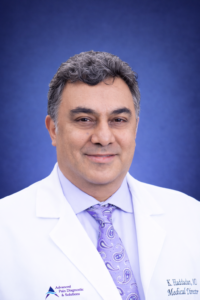
Dr. Haddadan earned his Bachelor of Science degree from the College of Alborz in Tehran, Iran, and his medical degree from Shahid Beheshti University of Medical Sciences. He later received his Educational Commission for Foreign Medical Graduates certification in Philadelphia, completed an internship in medical surgery at Loyola University Medical Center’s Stritch School of Medicine in Illinois, and finished his residency in physical medicine and rehabilitation at the same institution. He completed his fellowship in pain medicine at California Pacific Medical Center’s Pacific Pain Treatment Center and also trained in medical acupuncture for physicians at the University of California, Los Angeles David Geffen School of Medicine.
Dr. Haddadan has contributed to 29 research publications across multiple specialties, including pain management, cardiology, pulmonology, endocrinology, gastroenterology, and infectious disease. His work has examined topics such as hyperlipidemia in high cardiovascular risk patients, hyperuricemia and gout management, type 2 diabetes and hypertension, chronic obstructive pulmonary disease and asthma therapies, influenza treatment, irritable bowel syndrome, and opioid related complications in chronic pain care. His research has also included clinical outcome studies in spinal cord stimulation and award-winning presentations on neuropathic pain management and neuromuscular disorders.