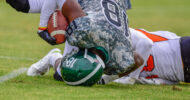
During this summer’s World Cup, we all watched players redirect the ball with remarkable precision. Our first reaction to a well-executed header was probably, “What a play.” But as a neurosurgeon who has spent much of my career studying head trauma among athletes, I also view those moments through a more clinical lens.
The concern around head impact is not limited to a dramatic collision that produces symptoms or a diagnosed concussion. Now, researchers are increasingly examining the effects of repetitive head impacts that may occur without an athlete reporting symptoms. An isolated head impact may not constitute an injury, but cumulative exposure across practices, games, and seasons may reveal risks that traditional assessments do not capture. That distinction is reshaping sports medicine.
Twenty years ago, concussion care centered largely on identifying an acute injury, monitoring symptoms, and determining when an athlete could safely return to play. We had not yet weighed the significance of the biomechanics occurring during an impact and the potential consequences of repeated exposure on the brain.
My work helping advance the clinical understanding of chronic traumatic encephalopathy, or CTE, reinforced the limitations of focusing only on documented concussions. Through studying CTE, it became increasingly apparent that the more important question was not always how many diagnosed concussions an athlete had sustained, but what repeated exposure to head impacts may have done to the brain over time.
Real physician voices, twice a week
Free, and one click to unsubscribe.
In sports medicine today, improved baseline testing, post-impact assessments, and return-to-play protocols have strengthened concussion care. Neuroscience is now pushing us toward another question: Can we identify neurological changes more objectively and recognize risk before symptoms become apparent?
Symptoms only tell part of the story
For decades we focused concussion care around identifying injury after symptoms appeared, using clinical evaluation tools like Sport Concussion Assessment Tool 5 (SCAT5), Balance Error Scoring System (BESS), and Vestibular Ocular Motor Screening (VOMS). However, none of these are sufficient on their own. Results can be influenced by symptom reporting, effort, testing conditions, and preexisting factors. An athlete may also sustain a concussion despite scoring within normal limits.
Emerging objective measures could help fill those gaps. Blood-based biomarkers may identify proteins released following neurological injury. Advanced imaging may reveal changes in brain structure, white matter fiber tracts connectivity, or blood flow, while electrophysiological testing may provide insight into altered neural function.
By combining biological data with clinical assessments, neuropsychological testing, symptom reports, and the biomechanics and forces involved in an impact, we can make a more accurate assessment on the severity of a brain injury. That approach could help clinicians better determine whether an injury occurred, monitor recovery, and study cumulative exposure over time.
From diagnosing an isolated injury to measuring exposure
Historically, the central question was: Did the athlete sustain a concussion? Now, we’re asking broader questions. How many impacts has the athlete experienced? How much force did the athlete sustain upon impact and from which direction? Has neurological function changed over a season? Are biological indicators recovering at the same rate as symptoms?
Just because a brain injury goes undiagnosed does not necessarily mean the brain experienced no physiological stress or alteration. The brain is suspended in cerebrospinal fluid, allowing it to move within the cranium. During a collision or sudden stop, the brain can accelerate, decelerate, and rotate within the cranium, placing strain on neural tissue, stretching or tearing fibers. By studying these biomechanics alongside biomarkers, imaging, and electrophysiology, researchers may identify patterns that symptoms alone cannot reveal.
This is one of the most important lessons from the study of CTE: Waiting for clear symptoms or a formal diagnosis doesn’t allow clinicians to assess the full story, implying injury can accrue.
A new framework for prevention
More precise measurements and a fuller understanding of brain injury could allow sports medicine to move beyond reacting to diagnosed injuries and toward monitoring brain health over time. While current prevention tactics like rule changes, safer coaching and playing techniques, reduced contact, and responsible return-to-play protocols are important, interventions grounded in the biomechanics of brain movement will ultimately define a new framework for prevention.
The Q-Collar is one example born from our evolving understanding of brain health and protection. Worn around the neck during athletic activity, it is an FDA-cleared medical device designed to address forces associated with repetitive head impacts. Unlike a helmet or traditional headgear, it regulates jugular vein compression, retaining more blood inside, to help reduce “brain slosh,” the movement of the brain inside the cranium. A protective “blood cushion” inside the skull serves to reduce the twisting and tearing of neurons, which causes traumatic brain injury (TBI). It does not claim to prevent concussions or serious brain injuries but reflects a broader shift toward preventative brain protection born from modern understanding of brain health and biomechanics, complementary to the helmet.
There are still lots of questions to answer, like how many impacts are too many, which objective measures are most clinically meaningful, or how results may vary by person. Yet the future of brain protection remains bright as we continue to bring clinical evaluation, biomechanics, and objective neurological measures together.
Our goal is no longer to just diagnose concussions more accurately, but to understand an athlete’s brain health more completely and reduce potentially harmful exposure before its effects become apparent or permanent.
Julian Bailes is a neurosurgeon and chair of the Department of Neurosurgery at the Endeavor Health Neurosciences Institute in Chicago, Illinois. He is affiliated with the University of Chicago Pritzker School of Medicine.
A nationally recognized leader in neurosurgery and brain injury research, Dr. Bailes has played an instrumental role in advancing the clinical understanding of chronic traumatic encephalopathy (CTE), with laboratory research focused on the mechanisms and treatment of cerebral concussion and traumatic brain injury. His scholarship spans the histopathology of CTE, the role of subconcussive impact in repetitive mild traumatic brain injury, and internal jugular vein compression as a strategy for mitigating traumatic axonal injury, with work appearing in Neurosurgery, the Journal of Neurosurgery, the Journal of Neurotrauma, and Neurosurgical Focus. He has authored more than 300 publications, including five books on neurological sports medicine.
Dr. Bailes is a founding member of the Brain Injury Research Institute, has served as a neurological consultant to the National Football League (NFL) Players Association, is a member of the NFL Head, Neck, and Spine Committee, and is the chief medical advisor for Q-30 Sports Science. He has advised the National Collegiate Athletic Association on concussion in sports medicine and has chaired the Medical Advisory Committee for Pop Warner Football for the last fifteen years. He can be found on LinkedIn.