Listen and followApple PodcastsSpotifyYouTubeMore apps · Browse all episodes
“Much is written about the advantages for primary care physicians and patients of working within a retainer model, direct primary care, concierge-type care model. Little is written about the downside or disadvantages. It is time to shine a light on the benefits and challenges of concierge and standard models through an experienced lens, particularly as drivers of burnout and the primary care shortage loom so large. The phase of a career may be an important factor.”
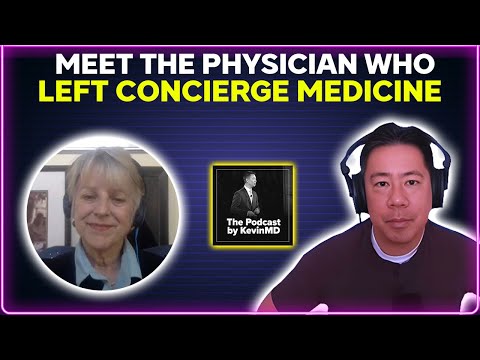
Annie Moore is an internal medicine physician.
She shares her story and discusses her KevinMD article, “A physician leaves concierge medicine after 13 years.”
Did you enjoy today’s episode?
Please click here to leave a review for The Podcast by KevinMD. Subscribe on your favorite podcast app to get notified when a new episode comes out!
Do you know someone who might enjoy this episode? Share this episode to anyone who wants to hear health care stories filled with information, insight, and inspiration.

Hosted by Kevin Pho, MD, The Podcast by KevinMD shares the stories of the many who intersect with our health care system but are rarely heard from.


Transcript
Kevin Pho: Hi, and welcome to the show, where we share the stories of the many who intersect with our health care system but are rarely heard from. My name is Kevin Pho, founder and editor of KevinMD. Today on the show, we have Annie Moore. She is a physician who wrote the KevinMD article “A physician leaves concierge medicine after 13 years.” Annie, welcome to the show.
Annie Moore: Thank you. Nice to be here.
Kevin Pho: So before we get into that article, I was wondering if you could share your story and your journey to where you are today.
Annie Moore: In a nutshell, I grew up as a farm girl. We had orchards in rural Oregon. I went to college and medical school and then have had a unique career: 15 years in private practice and then three different academic organizations, Oregon Health and Science, Duke University, and now I’m at the University of Colorado.
Real physician voices, twice a week
Free, and one click to unsubscribe.
Kevin Pho: Wonderful. And you’ve practiced in a variety of practice settings. You’re in the academic setting, private practice, and concierge medicine. Is that correct?
Annie Moore: That’s correct. And along the way, I got some training in integrative medicine and an MBA, and I’m just continually trying to reinvent myself, I think.
Kevin Pho: So a lot of physicians are hearing about concierge medicine. It’s advertised as a way to alleviate the burden of bureaucratic paperwork and all the obstacles that prevent us from giving the best patient care. So can you share with my audience what exactly concierge medicine is?
Annie Moore: I think it means different things for different people. I think many of the direct primary care models are thought of now as a form of concierge. It can be a very small retainer fee to quite a large retainer fee. I think practice size in a concierge practice can be 400-850 patients, depending on the model. It’s not well defined, I don’t think. I think there are usually some aspects of a highly personalized form of medical care, usually cell phone number, 24/7 access, some of those types of features. But lots of various models through the years, I think, have developed.
Kevin Pho: So tell me about your decision to first go into concierge medicine and maybe some of your experiences in that practice.
Annie Moore: Right. It was not something I had seen myself doing. I’d been up at OHSU in Portland for about five years, and it was becoming quite popular for patients to be in concierge practices in the Palm Springs area. So I was asked by the organization to start what became the largest such concierge practice in an academic center in the United States. It was a women’s-only model, because I was working within a center for women’s health at that time. We did a pretty small retainer model, an average annual fee of about 600, but we offered a higher-end product that had house calls with it, too, and that was popular. It was really interesting, and at the time, I really enjoyed it. I loved the time with patients. We did that for about six years.
Kevin Pho: One of the things that I hear physicians say when they’re thinking about a transition is that the financial footing at first is uncertain, because there’s not a stable base of patients. So what was it like for you to transition from a traditional practice to the concierge model?
Annie Moore: Well, we had none of that risk, because we all had very large practices. And so, sort of surprisingly, we were pretty much full with what we perceived as a full panel, because that many patients selected into the model. I think that was partially it: It was 2005, the economy was doing well at that point, and our price point was relatively low. We used to say it’s less than a Starbucks a day, that type of thing. And so we didn’t have much concern about that. In fact, our revenue really improved immediately for our division in this center for women’s health.
Kevin Pho: Fair. Now, what kind of physician is best suited for a concierge practice? What kind of characteristics should they have?
Annie Moore: I think that’s an excellent question. I think a willingness to be really readily available. And also the self-learning model: You’re not having quite as many patients, so you want to have a good base for your own self-learning if you’re not seeing some of the more complex patients frequently. I also think someone who’s pretty tolerant, because some of the calls you get on off hours would not seem worthy of bothering a physician at that time of day. So just being able to roll with the punches when it’s Sunday morning and someone just wants a refill.
Kevin Pho: Now, I know there’s a lot of trepidation for physicians giving out their cell phone number and being available 24/7. Now, what was your work-life balance like? Did patients call you all hours of the day?
Annie Moore: Yes, although the majority of patients are respectful, absolutely, even in concierge. Even when they’re paying, people respect that it’s night, the middle of the night. And some, I don’t think I had any more calls than you do in a busy primary care practice in the middle of the night. I think that you get the call on Christmas Day more than you might normally. People do feel a bit privileged or entitled to call you whenever they are wishing to.
But I think it also gave flexibility, because since you’re managing a panel, you can somewhat schedule when you see patients in person. And so for my work-life balance, I felt like I had more flexibility. At the time, I had young children, which is sort of part of the decision I think physicians can make: When they’re needing that flexibility in their life, it might be worth the trade-offs.
Kevin Pho: And how long were you in this concierge practice for?
Annie Moore: Well, in that one, I was in six years, and I was recruited to Duke, and I did that one for four. And then I was recruited here to the University of Colorado. I wasn’t going to do it initially, and I was here about six months, and they asked me to start one up here. And so we got that one started. After a couple of years, I decided I was sort of done with concierge, and I moved it back into a regular setting, a regular internal medicine practice.
Kevin Pho: So we don’t often hear about that reverse transition, transitioning out of concierge back to traditional medicine. So share with my audience some of the reasons why you made that move.
Annie Moore: Well, this model was a little bit different. It was no retainer fee; it was invitation-only. And I liked the retainer fee model better, since I had more autonomy for the budget and a little more freedom: Anyone who wanted to pay the retainer fee could be admitted into the practice. So I think the model itself was not my first choice.
But also, I was ready to see more patients. I was ready to see more complex patients. I had sort of felt my skills were failing after 13 years in concierge. I wasn’t seeing enough really sick people. It does tend to attract more of a worried-well model, the concierge. And I wanted to see more patients, I wanted to have more peers, and I wanted to get more peer learning in my life. I was at a stage in my career where I had the freedom, and I also wanted to be able to unplug on the weekends and go enjoy Colorado.
Kevin Pho: Sure. So knowing what you know now about concierge medicine, what’s something that you wish you knew before you made that transition?
Annie Moore: Knowing what I know now, you will miss some peer respect. There are groups of colleagues that don’t appreciate concierge, and you’ll always be seen a bit as an outsider. You won’t feel like you’re really one of the team in the bigger sense of the physician community. And that sort of outsider, I didn’t like that. I want to be part of the team. I want to be part of our physician community. There’s a segment that, you know, appreciates it, but there’s also a segment that is not very supportive. It didn’t feel good.
Kevin Pho: You’ve practiced in so many different practice settings. So given what you know now, what do you anticipate the future of concierge medicine to be?
Annie Moore: Well, I think it will boom. I think that people’s desire for that personal relationship is ever-present. I also have a dream, though, that standard primary care can be re-envisioned to more of a population panel management, where, with all the new technology, we can continue that personal relationship. I like to pride myself that you can’t take the concierge out of me: Even though I have a large panel of well over a thousand patients, I still have that very personalized approach to my care. I’d love to see us being supported to do that more in standard primary care, so that there’s not such a distinction for patients.
Kevin Pho: We’re talking to Annie Moore. She’s a physician who has practiced in both a traditional model and a concierge model, and she wrote the KevinMD article “A physician leaves concierge medicine after 13 years.” Now, what is your number one tip for physicians who may be burned out with traditional primary care and may be thinking of alternative models of care?
Annie Moore: Go for it, I think. And don’t think of it as you can’t go back. Don’t think of it as, “I have to decide this for the rest of my practice or my career.” Absolutely, if you’re thinking of leaving practice, I think it’s something to explore before you give up clinical medicine, which breaks my heart. It’s been a wonderful career for me, and if this is a path to keep people practicing, go for it. Absolutely, explore it, enjoy it. Don’t limit yourself.
Kevin Pho: And my final question: What is your take-home message for the KevinMD audience?
Annie Moore: Keep writing those blogs. I just love it. I think that we’ve got to have more freedom to talk among ourselves about our challenges and our struggles, and I’m so pleased that your blog has become so well known and is getting such good contributions. I think it’s great.
Kevin Pho: Well, thank you so much for your kind words. Thank you for sharing your story and your insight, and for being on the show.
Annie Moore: Thank you.
Listen and followApple PodcastsSpotifyYouTubeMore apps · Browse all episodes