Listen and followApple PodcastsSpotifyYouTubeMore apps · Browse all episodes
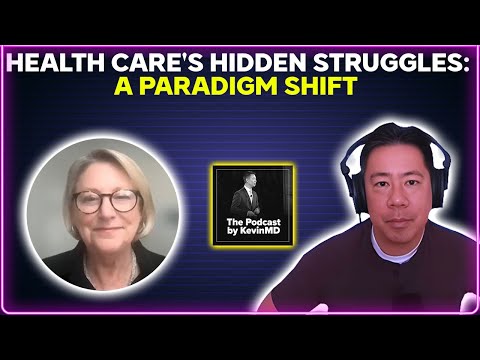
Join Vickie Leff, a palliative social worker. We’ll dive into a thought-provoking conversation about shifting the health care paradigm, where we explore the emotional toll on health care professionals, the need for sustainability, and how institutions can take more responsibility in supporting their staff.
Vickie Leff is a palliative social worker.
She discusses the KevinMD article, “Revolutionizing health care: Rethinking burnout and resilience.”

Our presenting sponsor is Nuance, a Microsoft company.
Do you spend more time on administrative tasks like clinical documentation than you do with patients? You’re not alone. Clinicians report spending up to two hours on administrative tasks for each hour of care provided. Nuance, a Microsoft company, is committed to helping clinicians restore the balance with Dragon Ambient eXperience – or DAX for short. DAX is an AI-powered, voice-enabled solution that helps physicians cut documentation time in half. DAX Copilot combines proven conversational and ambient AI with the most advanced generative AI in a mobile application that integrates directly with your existing workflows. DAX Copilot can be easily enabled within the workflow of the Dragon Medical application to bring the power of ambient technology to more clinicians faster while leveraging the proven and powerful capabilities used by over 550,000 physicians.
Explore DAX Copilot today. Visit https://nuance.com/daxinaction to see a 12-minute DAX Copilot demo. Discover clinical documentation that writes itself and reclaim your work-life balance.
VISIT SPONSOR → https://nuance.com/daxinaction
SUBSCRIBE TO THE PODCAST → https://kevinmd.com/podcast
RECOMMENDED BY KEVINMD → https://kevinmd.com/recommended
GET CME FOR THIS EPISODE → https://earnc.me/DNSZ9v
Powered by CMEfy.
Transcript
Kevin Pho: Hi, and welcome to the show. Subscribe at KevinMD.com/podcast, and get CME for this episode by clicking on the CME link in the show notes. Today we welcome back Vickie Leff. She’s a palliative social worker. Today’s KevinMD article is “Revolutionizing health care: Rethinking burnout and resilience.” Vickie, welcome back to the show.
Vickie Leff: Thanks very much for having me. I’m excited to be here. Thank you, Kevin.
Kevin Pho: So Vickie was on in the past. Go to KevinMD.com/podcast to search her name and hear her story. But today we’re going to jump right into your most recent KevinMD article about “Revolutionizing health care: Rethinking burnout and resilience.” Tell us about this article.
Vickie Leff: Well, I have been in clinical practice in serious illness for over 35 years, and one of my keen interests, really from the beginning, is how do health care providers do this work for the long haul? And of course burnout was talked about in, I think it was 1974, and there’s been a lot of discussion around how folks get through this work. And so we’ve had great words like resilience and self-care and all kinds of things that really have not brought us to any good solution, according to the data.
And so as I read through articles and blogs and so forth, and I read how folks are working to help their work-life balance be better, and do the yoga and do the massages, which is all fine and well, but what I have found in my work, specifically through looking at moral distress, is that that’s not enough. It’s not nearly enough. And in fact it actually doesn’t give the level of responsibility to the hospitals and the institutions that they should have, which I think came out in full bloom in many articles during COVID. And it kind of really unveiled some of the shortcomings that institutions have, not in a nefarious way, but rather, that’s not going to cut it. We really need more than that. We need to change the whole paradigm about how we think about this and stop using the words that presume that we can get to an endpoint and none of us will ever have a crispy day again.
Real physician voices, twice a week
Free, and one click to unsubscribe.
Kevin Pho: So you make the distinction between resilience and sustainability in the context of health care burnout. So tell me the differences between the two.
Vickie Leff: Yes, this is not an original idea from me. I got it from a couple of different articles. The idea is that if we presume that this work is difficult and stressful pretty much all the time, obviously some days are better than others, we don’t need to be in a pandemic to be distressed about the work, certainly that’s been my experience. If we accept that premise, then isn’t it more usable to say, how do we sustain ourselves during this practice, accepting the fact that there will be ups and downs, that there will be moral distress, that that’s not avoidable, nor is it something that we should avoid, actually? So we don’t want to immunize ourselves against it. Sustainability to me is an ongoing, flowing kind of life term that helps us rethink, how can we do this work for the long haul, as opposed to come to a resilient state, which I think sets us up for failure all the time.
Kevin Pho: During the pandemic health care workers were commonly referred to as heroes, right? Did you find that framing helpful?
Vickie Leff: So that is the biggest bee in my bonnet. I did not find that framing helpful. I know that it came from a very, very grateful place in managers and hospitals. I have no doubt that it was not meant to be stigmatizing or disenfranchising, but in fact my experience as a clinician during that time, and the experience of others that I would talk with, is that it absolutely was, in the sense that it’s the same concept, similar to resilience. And that if you say I’m a hero and you put that big sign up on the hospital’s board, which I understand where it comes from, it means that you can just keep piling on. You can keep piling on work and work and work without taking much responsibility for yourself, or without really recognizing the burden that that causes to the individual.
I understand the language of it. I think it’s misguided, similar to how using battle language in cancer I think is misguided. It doesn’t help people, because then you’re either a hero or you’re not. What does that mean if you’re not? If you’re actually going home on time to take care of yourself, then you’re not a hero? So I think it was misguided. I think that we’ve got to stop using that. And again, if people accept the premise that the work is always difficult, it changes the discussion, as opposed to, you find a way to make this work not difficult. That’s a very, very different conversation. And frankly it’s just not gotten us very far at all. It’s just made, you know, burnout, so to speak, if you’re going to measure it in that sense, is still very high, maybe worse than it used to be.
Kevin Pho: So you mentioned earlier that health care institutions and systems need to take more responsibility to address the emotional impact of the work on health care workers. Tell us more about that and why that’s so important.
Vickie Leff: I think that institutions have traditionally said, you figure it out, we’ll give you the pizza party and that’ll make you feel better. But in fact, again with the premise that the work is difficult, the institutions have a responsibility, if not a moral responsibility, to provide strategies that tend to that.
As an example, debriefings. Really simple, but intentional, deliberate, carved-out time for health care providers to have a chance to talk about the impact of this work on them, which of course there is. And so being able to put that into place changes the culture. It changes the responsibility from, it’s your fault because you didn’t go to yoga yesterday, to, we know this work is hard, we identify that, we acknowledge it, it normalizes it. And that opens a whole other conversation of, wow, I’m not the only person. It opens the door for social support, which is so key, and obviously we heard all about not having the social support during COVID.
And it sounds so simple, why would you do it? But it’s so simple, we must do it, because we know from data that the social support will absolutely help providers have more meaning in their work. And what does that lead to? That leads to staying in the job longer, that leads to not thinking about leaving quite as often. It’s not necessarily the pay, it can be sometimes, but shockingly that’s not what really sends people out the door. It’s feeling like they don’t matter, that they don’t make a difference.
And how does an institution take responsibility, other than the pizza party, which is not really taking responsibility? It puts in programs that acknowledge that it’s perfectly normal that you’re going to have stressful days, that you’re going to feel moral distress in health care, that the system is really challenging in a lot of different ways, and that that’s OK to talk about, because everyone is probably feeling it. And if you’re not feeling it, I’m really worried about you.
Kevin Pho: Now, are you seeing more health care institutions implement those ideas?
Vickie Leff: I would like to say that it’s all over the place. I think it is. I’ve been talking about debriefings since about 2016, 2015, worked with Project ECHO on them. Very pleased to say that CAPC, the Center to Advance Palliative Care, does health care debriefings for anybody in the country for free.
So the answer is yes, it’s getting a little bit more common, Kevin. The problem is that there’s still just a lot of pushback to, well, we can’t fit that in, there’s just too much going on. And speaking of sort of changing the paradigm, I would say we have to push back to that and say, you must fit it in. You fit in times for trainings, learning things, CEs, you fit that in all the time. This needs to be something that gets fit in, not as an aside, not as an extra, but, we get it as an institution, we get that this is hard, and we know that this is one thing, certainly not the only thing, pizza helps too, not the only thing that can help people stay together and recognize and learn from each other, learn coping skills from each other, learn what doesn’t work from each other, and know that you’re part of a moral community that values what you do and the impact it has on you.
Kevin Pho: So tell us a success story of an institution that may have successfully implemented some of these ideas and really moved the needle for their clinician staff, for their jobs to be more sustainable. Do you have a success story?
Vickie Leff: I do have a success story, and I appreciate your asking. So I used to work at Duke University Hospital, a very large academic center, and I started doing debriefings for nurses in particular. And at Duke the floors are by disease and so forth. So I thought, nurses do not have protected time ever, right? I know physicians do sometimes, and that’s not nearly enough. Students, or residents, have protected time, but nurses don’t. When during the day, other than a fly-by two-second conversation, do they have that?
So I talked to the manager of the oncology floor at Duke and talked about debriefings and how I thought it would be something that would really help them, in the sense that they’re probably seeing a lot of stressful things just like any other floor. And could we just carve out a half an hour once a month? I mean, it was a small ask. We started it as a pilot, because I think folks were like, I don’t know if we can spare the time. And we did, and people came. We built it, they came.
And inevitably the conversation would be the same as most other debriefings I ever did, which is about, I don’t know how to get through this work sometimes, it’s really lonely, or I’m really sad. And, oh wow, you feel that way too. They get so much from each other, not from the facilitator. And these are peer-facilitated debriefings, specific to just how the work is impacting you.
So it was very successful. There was a lot of hesitation and certainly a lot of, oh, she’s going to make me talk about when I was 5 years old. I don’t care what you did when you were 5 years old. I care about how you get through this work and what you’ve done to sustain yourself, and hear stories from each other. So it went really well.
On another floor, an OB/GYN floor, there was a lot of hesitation, like, what are we going to talk about? And so we designed the peer debriefings around really broad topics like moral distress, grief, and so helped folks feel a sense of safety of, oh, that’s what we’re going to talk about. And that was a great success story, and folks started to really attend, and by and large folks have come back to say it was really helpful. I’m not sure, I can’t measure it, it’s hard to measure, but it was like, I’m not the only one. And we know how helpful that is. It’s a no-brainer.
Kevin Pho: So just to be clear, half hour every month, that’s all it takes?
Vickie Leff: So I would prefer an hour, but I’m very cognizant of that, especially nurses do not have that kind of time. You can make the time by having management bring in some folks to work at the same time as the debriefing. So I’ve done debriefings for an hour. I think a half an hour is the least amount of time people need to get settled in, have a little time to decompress and talk to each other. So it can be on-site, off-site. All of those parameters depend on someone’s culture and what the institution needs to do.
So there’s certainly management buy-in, they have to value that, because it’s not billable, right? You can’t bill for a debriefing. But why wouldn’t you invest in that, when it costs billions to get people onboarded over and over and over again? It just, but it’s not a tangible goodie. It’s not hiring a wellness coach, it’s not doing a resilience workshop. So it doesn’t have that kind of appeal to it. And I think some folks are not sure how that’s going to work because it is so simple, if that makes sense.
Kevin Pho: So is there any data that these debriefings would definitively lead to fewer people leaving?
Vickie Leff: There is. It’s in the nursing literature, specifically the critical care nursing literature, that doing debriefings, tending to social isolation, and providing social support reduces the number of folks who want to leave and who do leave. I don’t have the percentage off the top of my head, but there is data that supports that. Almost all the nursing data, when they talk about resilience, have tending to social isolation as one of the primary interventions. That’s simple and easy and really, really important to do, in addition to whatever the pay scales and all that other stuff that is in almost every discussion of moral distress or stress in general for nurses, especially in acute care.
Kevin Pho: And who would lead these debriefings? You mentioned that you as a social worker would do so in a relatively structured format. Can anyone do it?
Vickie Leff: Yeah, that’s the cool thing about this, is that yes. And just very briefly, I know that we didn’t necessarily set out to talk about debriefings, but as a strategy to help folks sustain themselves, the reason that there’s a peer facilitator is that that person is trustworthy, they understand the system, no one has to explain what an ICU is all about, and they provide some safety for the participants, to start and end on time, make sure that the meeting isn’t taken over by somebody.
So it takes some emotional intelligence and being really quiet, which for me as a facilitator is extremely difficult, because I just want to jump in and say what I think. That’s not what folks want to hear. They want to hear from each other. So yes, anybody can do it. I’ve done them with nurses, docs, surgeons, anybody. Anybody can, who has the passion and understanding of what that takes. It’s kind of a natural fit for social work because we understand group dynamics so well, but certainly not limited to that.
Kevin Pho: Are there any differences when you do it with a group of physicians versus a group of nurses?
Vickie Leff: Well, the content’s different and presented in a different way. And with all due respect to physicians, my experience is that they love to start with numbers and data and get in the weeds with labs about cases. But it doesn’t take long to veer from that, like, oh, I can’t believe I didn’t get that blood count on this one, I’m worried that that caused such and such. Pretty much after that comes out initially, it’s pretty easy to direct physicians to say, so what did you do that night when you felt bad about that? Who was your support? How did you manage it? And pretty easily, opening that door made it easier for folks to be able to talk about, oh, this impacts me. Sure. Oh, that’s really important. Not that they don’t know that, of course they do, but it’s not really in the lexicon of physicians, I don’t think, to be reflective terribly much, and I understand why.
And nurses I think similarly can get a little bit data-driven, but are much more eager, mostly, and as well because they’re mostly women and I think that there are some relational communication differences there, are a little freer to talk about the emotional impact of the work on them. Not just, but anybody can respond that way, and with a little nudging they do. We even had the thoracic surgeons do a debriefing, if you can believe that, which I could not believe.
Kevin Pho: We’re talking to Vickie Leff. She’s a palliative social worker. Today’s KevinMD article is “Revolutionizing health care: Rethinking burnout and resilience.” Vickie, let’s end with some of your take-home messages to the KevinMD audience.
Vickie Leff: Thank you very much, I appreciate that opportunity. I guess I would really encourage folks to start with a different premise than perhaps they’ve thought of before, or invite you to think about that, and that is to acknowledge and normalize the fact that the work is difficult. It always is, for any provider. So if we start there, then we can really open the discussion to, so what would be helpful?
And push back a little bit against some of the self-care strategies that, while they’re lovely, probably are not going to help much, I’m sorry to say. I mean, yes, vacations are great, but the institutions really need to take some responsibility in this and create a moral community for their staff. Kind of push back against some of the resilience language and discussion, because it obfuscates their responsibility, and it presumes that you can get to a resilient state and be fine, which of course, or a burnout state and never be fine again.
So I think just thinking through the language that people are using, thinking about not just what you can control for yourself, of course you have that responsibility, but what the institution can do culturally to try to embed some sense of, we get it, we know it’s hard, and we’re going to provide some things that hopefully are supportive to you, that help you make meaning of this work without taking you away from the job for more than a short period of time.
And please stop using language like heroes. It’s not helpful. I think that it really disenfranchises people’s stress, and it leaves no space to be able to say, I’ve had it. Sure, I’ve run out of nice, I can’t do this anymore. And a space where you can kind of process that and figure out a way back. So I know it comes from a good space, but I would really encourage folks to push back against that.
Kevin Pho: Vickie, thank you so much for sharing your perspective and insight, and thanks again for coming back on the show.
Vickie Leff: Oh, my pleasure, Kevin. Thank you so much. I could talk all day about this topic, so I really appreciate a few minutes to discuss it. Thank you very much.
Listen and followApple PodcastsSpotifyYouTubeMore apps · Browse all episodes