Subscribe to The Podcast by KevinMD. Catch up on old episodes!
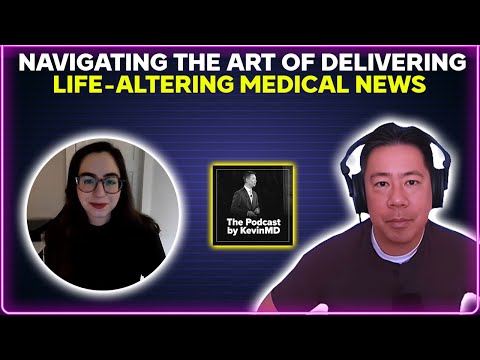
Join Emily Schehlein, a glaucoma and cataract surgeon. In this episode, we delve into the emotional and ethical complexities of delivering life-altering medical diagnoses. Emily shares her insights and experiences in the world of ophthalmology and how she navigates the challenging task of delivering bad news to patients.
Emily Schehlein is a glaucoma and cataract surgeon.
She discusses the KevinMD article, “An eye surgeon’s unexpected finding: a brain tumor diagnosis.”

Our presenting sponsor is Nuance, a Microsoft company.
Do you spend more time on administrative tasks like clinical documentation than you do with patients? You’re not alone. Clinicians report spending up to two hours on administrative tasks for each hour of care provided. Nuance, a Microsoft company, is committed to helping clinicians restore the balance with Dragon Ambient eXperience – or DAX for short. DAX is an AI-powered, voice-enabled solution that helps physicians cut documentation time in half. DAX Copilot combines proven conversational and ambient AI with the most advanced generative AI in a mobile application that integrates directly with your existing workflows. DAX Copilot can be easily enabled within the workflow of the Dragon Medical application to bring the power of ambient technology to more clinicians faster while leveraging the proven and powerful capabilities used by over 550,000 physicians.
Explore DAX Copilot today. Visit https://nuance.com/daxinaction to see a 12-minute DAX Copilot demo. Discover clinical documentation that writes itself and reclaim your work-life balance.
VISIT SPONSOR → https://nuance.com/daxinaction
SUBSCRIBE TO THE PODCAST → https://kevinmd.com/podcast
RECOMMENDED BY KEVINMD → https://kevinmd.com/recommended
GET CME FOR THIS EPISODE → https://earnc.me/3ogak0
Powered by CMEfy.

ADVERTISEMENT
Transcript
Kevin Pho: Hi, and welcome to the show. Subscribe at KevinMD.com/podcast, and get CME for this episode by clicking on the CME link in the show notes. Today we welcome Emily Schehlein. She’s a glaucoma and cataract surgeon. Today’s KevinMD article is “An eye surgeon’s unexpected finding: a brain tumor diagnosis.” Emily, welcome to the show.
Emily Schehlein: Thank you so much for having me.
Kevin Pho: So let’s start by briefly sharing your story and journey.
Emily Schehlein: Absolutely. So I am a glaucoma and cataract surgeon, originally from the East Coast. So I did my medical school at University of Maryland and my residency in Michigan, where I am now. Went back to Hopkins for my glaucoma fellowship, and now I am here in snowy Michigan. Not freezing, but pretty cold.
Kevin Pho: All right, so for those who aren’t familiar with what glaucoma cataract surgeons typically do, just walk us through a typical day for you.
Emily Schehlein: Absolutely. So I typically see patients about three or four days a week, and then I operate one day a week. So during a typical clinic day I’m seeing patients, signing them up for surgery. I will also have a couple of lasers or small procedures sprinkled in there. I’ll see about 30 or 40 patients a day.
And then on a typical surgery day, I’m in my second year of practice now so we’re ramping up, but we’ll do anywhere from 15 to 18 surgeries in a day. So it’s pretty high volume, you’re seeing a lot of patients, you’re needing to make an impact and tell them what’s going on pretty quickly, so that you can move on and be efficient. But I really love it. I work in a small physician-owned private practice, and it’s really been wonderful.
Kevin Pho: And for those medical students who may be listening to this, tell us some of the reasons why you chose this field.
Emily Schehlein: I think with ophthalmology, and especially with glaucoma, you can make this initial impact where, with cataract surgery, someone many times was blind and now they can see a couple of minutes later. So there’s that instant gratification.
But then, as a glaucoma specialist, this is a lifelong disease, so patients are going to be coming to me for many, many years, and I can get to know them and get to know their families. And so I feel like I’ve curated this really nice balance of having this really exciting time where patients are like, oh my gosh, I can see, thank you so much, and it really gives you a boost in your day. But then at the same time, being able to be with those glaucoma patients for many, many years.
Outside of my clinical practice, I do some consulting. I work a lot with sustainability in eye care. Cataract surgery is the most commonly performed surgery in the entire world, so 25 to 30 million surgeries every year. So I’ve really been very lucky to have a great clinical practice, but also have time to do these things, not outside of medicine but surrounding medicine, that I’m really interested in.
Kevin Pho: Now, you mentioned that you’re in your second year of practice. How has that transition been from training to private practice?
Emily Schehlein: It’s really been challenging. I think everybody talks about that. But for the medical students and the residents out there, when you graduate residency you think, well, I’m finished, I learned everything. But that’s totally not true, and you find that out pretty quickly.
So especially if you’re going into private practice, you have this whole business side of medicine that you’re learning about. You’re learning about how to talk to patients. That first year, I hate the term spiel, but the reality is that you see patients with very similar problems, and coming up with those ways that you’re going to express that to them and talk to them, and then also tailor it to their specific problem.
And then you’re also coming up with challenges. Your first couple of days in the OR by yourself as a young female surgeon, sort of navigating prejudices against you, of how young you look, or being a woman in surgery. So there’s definitely been challenges. And I think that having great mentors and working in a place that’s really supportive has been wonderful, but the first year is no joke. The second year has definitely been a much smoother ride so far.
Kevin Pho: And today we’re going to talk about one of your cases in the KevinMD article, “An eye surgeon’s unexpected finding: a brain tumor diagnosis.” So tell us about this KevinMD article.
Emily Schehlein: So this article is something that came up for me after seeing the same thing over and over again, like you do in your first year. The first time as an eye surgeon you see a patient come in and you think, well, I think there’s something going on here more than the eyes. You sort of have to go back to your training. When I was in medical school and I was on my neurology rotation, what did those people say to those patients?
Because I think that a lot of what this article has to do with is our role in patients’ lives. So this patient might remember this moment and this interaction for the rest of their lives. You want to be really honest and forthright, but you also want to say it in a way that they’re going to remember this interaction not favorably, but they’re definitely not going to be traumatized by it.
So I spent a lot of time really coming up with, how do you break this down for a patient? What is the right way to sort of lead into this topic, and let them know, you’re going to need this brain imaging, this is how things might go, but it could go also a totally different way.
And what it really is about is this one key moment in a patient’s life, and in a human’s life. We’ve all had those moments where we’ll say, oh, well, before my car accident things were like this and after it was like this. And you have those moments in your life where you never know when it’s going to be. And to be on the other side of that, and knowing, not that you’re going to cause that, but you’re going to be a part of it and really see the fallout in that moment, I think is a great privilege as a physician, and I think there’s a lot of pressure as well. And so I really just wanted to write this article to express my feelings of what it’s like to be on that other side.
Kevin Pho: Now, for those who didn’t get a chance to read your article, tell us about this particular case that you wrote about.
Emily Schehlein: Absolutely. So this particular case is one true case, but also an amalgam of cases. A young man who comes in just saying he has blurry vision. It turns out that he is completely missing his temporal vision on both sides when we did a visual field, and then he also has decreased vision in one or both eyes. And the idea here is that this patient likely has a brain tumor that will need to get imaged.
And there’s this big moment in his life where I’m going to tell him that. And I’m going through, what exactly should I say? I could say, well, this isn’t the eyes, I think there’s something going on with the brain. I could say, hey, I think you have a brain tumor, you should get an MRI.
And I think that you need to be honest and truthful with the patient, but you also need to find the right words and say them kind of in the right order. And that’s different for everybody, because everybody has a different way that they would like that news presented to them. And so in this very short interaction with someone that you’ve never met, you kind of have to figure that out to the best of your ability and then go through with it.
And it’s very traumatizing on both ends. I think that a lot of times when patients write about their experience, you think, oh my gosh, it must be so terrible to be told that you have a brain tumor, how do you deal with that information? But physicians are humans too, and I don’t want to have to give that news to somebody on a Friday afternoon, the day before they’re going to go into their weekend. And I want to find a way to do it in the most humanistic way and the most kind way, but also be honest and thoughtful and truthful.
Kevin Pho: And how do you learn how to do that? Because threading that needle is a goal that every physician should have when delivering bad news. They want to be forthright, they want to be direct, but they want to do so with the sensitivity and knowledge that this is probably going to change that patient’s life.
Emily Schehlein: Well, when I was in medical school I actually taught a course on humanistic medicine, it was a symposium that we developed. And we would read patient stories, we would read physician stories. And when I graduated from medical school and residency I thought, well, great, I took that course, I actually taught that course, I must be really good at this.
And the reality is that you get good at it, number one, through experience, by doing it, but also by having your own experiences. So as we get older we enter the health care system in a different way, as patients, and there will be a time when we also get bad news. And so I think for me, the way that I deliver things to patients and the way that I say that to them has changed based on my own personal experience, and based on my experience with the patient.
But I think in general, a couple of things that I try to think about are, number one, I know what the problem is and I don’t really need to listen to what their symptoms are, because I have the imaging in front of me, but it’s really important that they feel heard. So even if I know exactly what I’m going to say, I want them to kind of get it all out, because they really feel listened to in that moment. And I think that’s really important, because when we graduate from training we’re so focused on doing the right thing, getting the right imaging, what’s the plan, and that’s not really what patients are focused on. So I really try to focus on their experience, because that’s what they’re going to remember.
And then your body language. How do you come in? If you have a scribe or someone else in the room with you, you need to maybe give them a heads up so that they have the appropriate body language. Make sure you introduce yourself to everybody who’s in the room, and you know who everybody is. How are you related to this person? Don’t make assumptions.
And then you want to make sure that you have adequate time for this appointment. Like I said, especially as an ophthalmologist, we are a very high volume specialty, and so it’s really easy to go in and say, hey, you have a cataract, we’re going to take it out, we’re going to do this, and have a really efficient visit. But of course this visit is not going to be like that. So letting the patient know, hey, I’m going to be in in a couple of minutes, I want to make sure we have enough time together. And maybe they need to wait a little bit longer before you see them, but that way they have that time with you and there’s no rushing, because this is not something that I want to rush.
Kevin Pho: Now, how do you put yourself in that moment? Because like you said, ophthalmology is a high volume specialty, so on a Friday afternoon, if you’re on your 35th patient and you’ve seen so many cataract cases, glaucoma cases during the day. But people have to realize, of course, that when patients see you it’s probably the most important thing that they’re doing that day. So how do you reconcile those two perspectives?
Emily Schehlein: Absolutely. I think that’s something that I’ve learned in the past couple of years, is that while this patient interaction might be something I’ve done 35 or 40 times that day already, this patient might have been waiting months for this appointment. And so I think that you just find little ways as a physician to make people feel welcomed and make people feel heard, and I try to do that every day.
But I think in this particular instance, the challenge for me is sort of switching tracks in your brain. If you are an oncologist, you are like, OK, every patient’s probably going to come in with some type of oncology issue. And so I’m really thinking that my patient’s going to come in with glaucoma or a cataract, because that’s my specialty.
And I think that when you first start out you have this sort of broader view of things that you’re going to see, because you’ve been in training, maybe you’ve just taken your boards, so everything is top of mind. But as the years go on you get more narrow and focused, and you’re like, well, this isn’t glaucoma or cataract, hang on a second, let me change tracks in my mind.
And so I really just try to take a deep breath and say, OK, maybe this isn’t what I was dealing with all day, but I need to refocus and make sure that I’m treating this patient appropriately, that I’m thinking of all those diagnoses, that I’m going back to that boards question that I answered a couple of years ago, and really just focusing in on what the actual situation is versus maybe what I would like it to be, which is somebody who has a little bit of eye irritation.
Kevin Pho: Now, when you give patients bad news, potentially difficult diagnoses, does that change you as a physician?
Emily Schehlein: Of course it does, oh my gosh. I think that anybody who says otherwise is kidding themselves. Life is about human interaction.
I’ve had the pleasure to work with some really amazing people in my office that support me, my support staff. And really talking with them, and having them say things to me like, I always thought that physicians were just kind of always right about everything, all knowing, and didn’t really have any feelings. And then when we’ve gotten to know the physicians at our practice, they realized that’s not true.
Because of course, if I’m going to tell somebody bad news, I’m going to think about it, and I’m going to go into my Friday night thinking, I wonder what this gentleman is doing, has he gotten his MRI, did he blow me off and think that I didn’t know what I was talking about?
And I think that those interactions add up. And I thought that I would become a little more callous to them, because it seemed like people that I trained with maybe did, but I feel like I’ve actually become more sensitive to those things. And as time goes on and I have friends that go through medical problems, or I myself go through things in the health care field, I feel like I become more empathetic and more sensitive to those people as I move on in my career, which is great.
I’m really grateful for that, because I think that medicine is really hard, and some patients are sometimes not very nice, and it really could be easy to become hardened and to say, well, sorry, you have probably a brain tumor, best of luck with that, happens to a lot of people. But fortunately I feel like as time goes on I’ve actually become more worried about these patients after they leave. I’m thinking like, oh, I wonder what happened to them.
So I think that I’m really grateful for how my career has gone, and the way that patients have taught me to give them news and really have that empathy for them.
Kevin Pho: How can physicians get better at delivering bad news? Are there any resources that you could share, any places that physicians can go to to improve giving bad news?
Emily Schehlein: Absolutely. One of the things that I feel like I’ve really turned to is narrative medicine, so reading articles about how physicians deliver bad news, how I deliver bad news.
But I think that one thing that physicians really always need to work on is kind of public speaking. How do you talk to people? You might know the answers and you might know the options that patients have, but you have to be able to present them in a succinct way. And so the same way that I do it with a cataract surgery, I’m going to tailor it to each individual person.
You can take that sort of good news, that normal patient interaction, and apply it to the bad news interaction. So, this is the problem, this is what we’re going to do about it, I’m so sorry that this is happening. People don’t want to hear you ramble on, and they know that you probably feel badly for them, and they don’t want to hear that a bunch of times either.
So I think that you just need to listen to what they have to say, and then say, OK, this is the plan and this is what we’re going to do. And then you need to repeat that, because the amount of times that I’ve said something to someone and they call the next day, they just hear 20 to 30 percent of what you’re saying.
So I think the main things are experience, and just really highlighting what the plan is to the patient, because they are going to want to know, what are the next steps, what’s the next thing that I do?
Kevin Pho: We’re talking to Emily Schehlein. She is a glaucoma and cataract surgeon. Today’s KevinMD article is “An eye surgeon’s unexpected finding: a brain tumor diagnosis.” Emily, we’ll end with some of your take-home messages to the KevinMD audience.
Emily Schehlein: My take-home messages would be, number one, listen to your patients. I think that even if it’s 60 seconds, sit down, let them say what they want to say, don’t say anything until they stop talking. And if you do that, patients will really feel like you have spent a lot of time with them and that you have listened to what they have to say.
I think the second take-home message would be, have a plan. You are delivering bad news, patients want to know, what are they going to do next?
And the third thing would be, don’t forget about these people. I think that that is the way that you learn, is by doing. And so when you think about these people, think about how they reacted to that session, and improve it for the next time.
Kevin Pho: Emily, thank you so much for sharing your time and insight, and thanks again for coming on the show.
Emily Schehlein: Absolutely, thank you so much.