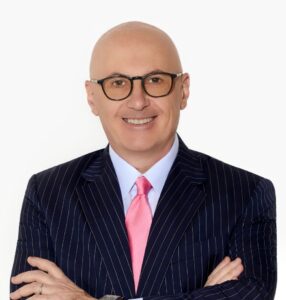
Michael Duben is a board-certified endocrinologist in solo private practice in Fairfield, Connecticut, and is affiliated with Bridgeport Hospital. He runs both Endocrinology of Fairfield County, a traditional insurance-based practice, and Restore Health, a cash-based functional endocrinology practice. He completed the Institute for Functional Medicine's training program.
He did his internal medicine residency at Mount Sinai and his endocrinology fellowship at Montefiore/Einstein, and was a clinical instructor in the Department of Endocrinology at Albert Einstein College of Medicine. He has practiced since 2003, with clinical interests in thyroid disease and thyroid cancer, osteoporosis and bone metabolism, parathyroid disease, pituitary disorders, and obesity and metabolic disease. He has prescribed glucagon-like peptide-1 (GLP-1) receptor agonists since the first one reached the market in 2005, and has lectured to practicing physicians on diabetes and thyroid management.
He designed and built the HIPAA-compliant AI-assisted clinical documentation system he uses in daily practice, without formal training in computer science, along with a range of other tools for his patients and his office. He shares updates on LinkedIn.
About 80 percent of a diagnosis comes from the patient's story. The electronic health record has no place to keep it. I learned the first half of that in my second year of medical school, in a physical diagnosis lecture…
About 80 percent of a diagnosis comes from the patient’s story. The electronic health record has no place to keep it.
I learned the first half of that in my second year of medical school, in a physical diagnosis lecture by the late Dr. Arthur Aufses Jr., chairman of surgery at Mount Sinai for 22 years and a man of extraordinary skill and intellect. In that lecture, he said that about …
In 2024, Medicare cut every physician's rates about 2 percent to fund a code that 3 out of 4 of them never billed. The cut was automatic. The code has to be claimed by hand. The code is G2211. CMS…
In 2024, Medicare cut every physician’s rates about 2 percent to fund a code that 3 out of 4 of them never billed. The cut was automatic. The code has to be claimed by hand.
The code is G2211. CMS calls it a visit complexity add-on. In plain words, it pays for office visits where you are the patient’s ongoing doctor, either as the continuing focal point for all their care …
I have spent nearly twenty-five years treating osteoporosis. The drugs have gone from oral and intravenous bisphosphonates to several classes with better efficacy and, mostly, better tolerability. Their reputation has gotten worse. Some of that is a jaundiced view of…
I have spent nearly twenty-five years treating osteoporosis. The drugs have gone from oral and intravenous bisphosphonates to several classes with better efficacy and, mostly, better tolerability. Their reputation has gotten worse. Some of that is a jaundiced view of the pharmaceutical industry, some the internet doing what the internet does. But a meaningful share comes from the government. The Food and Drug Administration (FDA) prints warnings its own trial …
Somewhere in a hospital right now, a physician is ordering a sliding scale of short-acting insulin to be given before a meal, at a dose set by the premeal blood glucose. Not a correction dose for hyperglycemia on top of…
Somewhere in a hospital right now, a physician is ordering a sliding scale of short-acting insulin to be given before a meal, at a dose set by the premeal blood glucose. Not a correction dose for hyperglycemia on top of a meal dose. The meal dose. Blood glucose before a meal describes what has already happened. It says nothing about whether the tray holds 20 g of carbohydrate or 90. …
The so-called deskilling of physicians is a red-hot subject in discussions of AI in health care. I hate the term "deskilling" just about as much as I hate the term "provider." It is shallow and smacks of the MBA PowerPoint…
The so-called deskilling of physicians is a red-hot subject in discussions of AI in health care. I hate the term “deskilling” just about as much as I hate the term “provider.” It is shallow and smacks of the MBA PowerPoint presentation. What is being lost is not some random skill. It is the physician’s core competence: the ability to synthesize a history of present illness and formulate a diagnostic and …