Subscribe to The Podcast by KevinMD. Watch on YouTube. Catch up on old episodes!
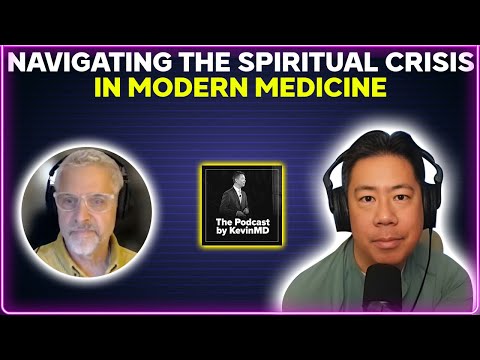
We’re joined by Dike Drummond, family physician and founder of TheHappyMD.com. Our discussion delves into the spiritual crisis facing employed physicians, where the idealism that once inspired them to pursue medicine clashes with the harsh realities of modern medical practice. Dike highlights the profound choice physicians make to be “light workers,” serving humanity in the battle against illness and suffering. However, many find themselves trapped in systems prioritizing profit over patient care, leading to burnout and a loss of purpose.
Dike Drummond is a Mayo-trained family practice physician, burnout survivor, executive coach, consultant, and founder of TheHappyMD.com.
He discusses the KevinMD article, “The spiritual crisis of the employed physician.”

Our presenting sponsor is Nuance, a Microsoft company.
Together, Microsoft and Nuance are leveraging their rich digital technology and advanced AI capabilities to tackle some of health care’s biggest challenges. AI-driven technology promises to revolutionize patient and provider experiences with clinical documentation that writes itself.
The Nuance Dragon Ambient eXperience, or DAX for short, is a voice-enabled solution that automatically captures patient encounters securely and accurately at the point of care. DAX Copilot combines proven conversational and ambient AI with the most advanced generative AI in a mobile application that integrates directly with your existing workflows.
Physicians who use DAX have reported a 50 percent decrease in documentation time and a 70 percent reduction in feelings of burnout, and 85 percent of patients say their physician is more personable and conversational.
Discover AI-powered clinical documentation that writes itself. Visit https://nuance.com/daxinaction to see a 12-minute DAX Copilot demo.
VISIT SPONSOR → https://nuance.com/daxinaction
SUBSCRIBE TO THE PODCAST → https://kevinmd.com/podcast
RECOMMENDED BY KEVINMD → https://kevinmd.com/recommended

ADVERTISEMENT
GET CME FOR THIS EPISODE → https://earnc.me/osevh6
Powered by CMEfy.
Transcript
Kevin Pho: Hi, and welcome to the show. Subscribe at KevinMD.com/podcast, get CME for this episode by clicking on the CME link in the show notes. Today we welcome back Dike Drummond. He’s a family physician and executive coach, founder of TheHappyMD.com. Today we’re going to talk about “The spiritual crisis of the employed physician.” Dike, welcome back to the show.
Dike Drummond: Thank you, it’s great to be back. And today we’re going to have a conversation about what I think is probably the most important thing that’s going on in the midst of our physician burnout epidemic, especially in the U.S., and especially among employed physicians in the U.S.
I’m calling it a spiritual crisis, because I believe that each of us, back in the day when we were deciding whether or not to go to medical school, should I go to medical school or go do anything else, you could have chosen any other career. But there was something that you saw and felt when you looked at yourself in the mirror, and you made two judgments. At the core there are two judgments.
Number one, have I got what it takes to make it through medical school? So that’s practical. Have I got the grades, have I got what it takes? But the second one is, all my friends are not doing this, I’m the only one who’s doing this, so it must be extraordinary. And there was some thought process that you would end up as a helper and a healer, someone who makes a difference in the world, someone whose job is more than just grinding out widgets, taking a paycheck, and heading off to the bar for another beer. It’s different. It’s a spiritual choice.
And I call it being a light worker. I always use that term, light worker. What do I mean? Well, at that point when you decided to go to medical school, you didn’t realize it at the time, but what happened was that you allied your professional life in service to the forces of light in the universe, as we battle specific forces of darkness. Now, you’re not the only light worker, there are lots of people who are light workers, but we battle the forces of darkness that come in the form of illness, suffering, death, and dying.
And we’re also putting ourselves on a playing field where we’ll lose every game we play. Everybody’s going to die. You’re going to die. It’s the human condition. And the challenge is, can you get enough meaning in your week, in your current job? Can you find enough meaning in caring for patients that you feel it’s worth it?
Because here’s the challenge I’m always working on with my clients. First of all, I have a position on the internet where if you search the words physician burnout, you’re going to find me. And physician burnout is a teachable moment, a point where people wake up and are in enough pain that they’re willing to consider changing their actions.
But we don’t focus on physician burnout. As soon as we identify that you’re burned out and you want to do something different, we switch to, what’s your ideal practice? In an ideal world, if you were the king of the forest, if you could write your own job description, what kind of patients would you be seeing, and what kind of things would you be doing, for what kind of money, what kind of schedule, what kind of team, what kind of organization, where in the world?
And what I find is that there’s a line between how we train doctors and their current tendency to almost all sign up as employees once they graduate. We train doctors as residents in a survival contest. There are two things you’re supposed to do in residency. There’s an educational objective, you’re supposed to be able to practice in your specialty when you graduate. And secondly, you have to survive the training process.
How do you do that? You color inside the lines. You do what people expect of you. You work harder than you should have to. You just follow orders. You’re a good resident.
And then when you get out, you say, I want a good job, I want a practice where I can make a difference. But you’re faced with a job description from an employer who is a capitalist organization, profit or nonprofit, it doesn’t matter, it’s about translating what you do into money. And what happens is, you say, I want to be a family doc, and the person who’s signing you up reaches into the cabinet behind their desk, pulls out a job description, and shows it to you. Boilerplate.
Did you play any role in that job description, in making it, in designing it, in creating it? No. What are the odds that that job description is focused right at what is your personal ideal practice description? What are the odds, by the way, that the answer to that question starts with the letter Z? Yeah. Zero.
So eventually, if you keep doing what your employer wants, and that’s it, you’re going to burn out.
Kevin Pho: So by definition, a lot of physicians who go into that employed position, that employed relationship with their employer, it’s inevitably going to lead to burnout, right?
Dike Drummond: And what it is, is a quid pro quo, which in legalese means, if you do this, I’ll do that.
What does the employer provide for you? Well, a whole bunch of things you don’t have to worry about. Facilities, staff, money, benefits, equipment, all that kind of stuff. They supply you with all of that. What do you supply? You’re going to supply your life force, in the form of your medical practice and your ability to communicate with your patients, the art of medicine.
And you tell me, is the quid pro quo fair? Is it a balanced equation? Because what I’m always trying to do is help people take the quid pro quo of their employment contract, which is usually pretty out of balance in favor of the employer, and turn it into, and this is the phrase I use, and this phrase actually works with your management leadership team, an equitable exchange of value. I feel like I’m getting back as much as I put in.
And it’s very rare these days for a physician to feel that it’s equitable. Ergo, the 63 percent burnout rate for American doctors. And by the way, 90 percent of current graduates are going into employment contracts.
It used to be, back in the day, let me just give you a snapshot in time, and I’m going to sound like a real old fogey, OK, but I want you to know this was normal 25 years ago. This was normal 25 years ago.
I came out of my residency program, I joined a 40 doctor multispecialty group, and I joined as a partner. Not only was I a partner in the organization, I was a partner in the real estate partnership. They owned the real estate that the group was housed in. And when I left the group I had two profit points. I sold my partnership, and I sold my share in the real estate partnership.
We had a CEO, but that CEO was controlled by the doctors who owned the organization. They worked for us. They followed our orders.
I was a family doc. I had an RN at my shoulder, the same RN for a decade, taking care of my practice, screening my calls, seeing my patients. I charted in a paper chart, and I guarantee you I didn’t spend much more than a couple of minutes in that chart after my last patient was gone. I don’t know that you could read my handwriting, actually. I failed that in medical school, you can read my handwriting.
And I got to control my schedule. I got to decide how many patients I was going to see, and on what kind of schedule. And my receptionists were in the front office. I could walk out and talk to my receptionist. We knew each other, because they also never turned over for 10 years, they had the same people.
Compare that to what’s happening right now. You’re an employee. You don’t own anything. You don’t have an RN. If you’re a primary care doctor, maybe you have an MA, but I’ve talked to lots of people who can’t even say they have an MA every day, much less the same MA. There’s no nurse to be seen, unless it’s some invisible nurse who’s running phone triage. You have no control over your schedule, the schedule’s boilerplate, and your patients are scheduled by people you’ve never met, in a call center that’s remote from your treatment facility.
I’ve never seen, by the way, a call center actually make doctors happy. For some reason it makes administrators happy. I don’t know how they measure the money they’re saving, but it’s always a disaster for the physicians when it’s implemented.
And you’ve got an EMR and an inbox and a patient portal and all that kind of stuff that has to be digitally put in, and you don’t have the support to do that. One of the interesting steps in the loss of autonomy that has caused the current burnout crisis is the implementation of the EMR in the first place. Back in the 2010s, the EMR doubled your workload, just overnight doubled your workload, and you were not staffed to meet that workload. So it doubled the work but did not increase the hands on deck. That’s another big piece of this.
So here’s what happens over time. Unless you’re able to defend your practice and find wiggle room in your current job description, so you can get that meaning that you seek, and it’s a spiritual urge, it’s a heartbreak when you can’t get it, unless you’re able to do that, burnout is basically inevitable. And over the course of the lifetime of a doctor, even under the circumstances I was in back in the 1990s, burnout is inevitable for doctors. I’ve never believed anybody who told me, well, I’ve never burned out. They’re just trying to chest bump me and tell me they didn’t need to be at the training, that they’re just here for the lunch, for the pre-lunch.
But what ends up happening, and this is what breaks my heart watching what happens on the internet when doctors in these big groups are posting escape fantasies, is that their heart’s been broken. They can’t see a way forward in their current career, and so they begin to say things like, I’ve got to have a side gig, I’ve got to get out of this, I should have never gone into medicine in the first place.
And what’s happened is, it’s not about their heart. It’s not about their urge. It’s not about their ability. It’s about the job grinding them down to the point where they second guess their light worker choice back at that fork in the road. And that breaks my heart.
Because I have six coaches with me at The Happy MD, we’ve coached thousands of doctors and trained 40,000 in live settings, and I know that almost without exception you can take your current job and find the wiggle room to feel that it is still an adequate expression of meaning and purpose for you in this lifetime. But you can’t simply be a good resident and stay inside the lines of the contract. You have to take back some of your autonomy.
How do you do that? Well, we’ve identified seven missing skill sets. These are things you were never taught in medical school and residency, because they weren’t required to graduate, but they are required once you graduate, to actually build a fulfilling life around the fact that you’re a doctor.
The first one is how to build your ideal practice description, and work a process to constantly be moving toward a more ideal practice, and how to recognize burnout when it’s there.
The second one is tools to get home sooner. We need to give you some specific tools so that you can get your work done more effectively and get home sooner, in most cases without working harder.
The third one is tools to build life balance. Specific things you do on the weekend, specific things you do to create structures that support more life balance, so that you get more recharge and more of your life back when you’re not at work.
The fourth one is how to be the eye of the storm at work. We teach a specific single breath technique to recenter yourself multiple times a day. It could be triggered by something as simple as turning a doorknob before you go into a room.
We teach you simple tools on how to lead your team more effectively, so you don’t have to carry all the load. Doctors are classic workaholics, and we never learn how to lead. We learn how to give orders and expect people to obey or comply, but we never learn how to coordinate the activities of the team, and there are some really simple things you can do that don’t come to doctors naturally and automatically.
Skills to manage your boss. This is probably the most important one for employed physicians. There are specific techniques and a specific checklist of activity that allow you to build a relationship of influence with your boss. And for most doctors in employed positions, you have multiple bosses up the chain of command from you, but I’m talking about your office manager, your CMO, your CEO if you need to. There’s a specific way, over time, to build a relationship where they trust you and listen to you, because you don’t act like all the other doctors who only see their boss when they’re going to whine and yell and scream and pound the table and accuse them of having manure for brains. You’re going to stand out from the rest.
But the ability to manage up and across the org chart, to get what you need for your ideal practice, nobody teaches that to us, and it’s probably the most vital skill. In our support communities, in our weekly coaching, probably 50 percent of what we talk about are crucial conversations with your boss, how you set yourself up for success, and how you speak in those conversations in order to get what you need.
And last, the seventh skill, and this is again something that is a huge hole in our medical education, is how to find an ideal job, your ideal job. How to take one jump to a new position that’s going to be at least a 70 percent match for your ideal job description, because I’m going to show you how to interview and make sure that that’s true.
It’s interesting, with our training, every single person who’s trained in this, I call it the ideal physician job search formula, and then our protocol for interviews, every single one has gotten an offer, every single time. But that offer is irrelevant, because it’s not about whether they offer you a job, it’s whether that job is a 70 percent match for your ideal job. You’re in the driver’s seat.
One of the big problems that doctors have, and one of the big things that sets them up for this heartbreak, is that you never learn how to interview for a job. Doctors’ seminal experience in job application was their application to medical school, and then their application to residency. And what do you do when you do that? You say, pick me, pick me, pick me. All you’re interested in is them picking you.
When you’re out in your practice, you don’t care whether they pick you. You want to know whether you would pick the opportunity that’s in front of you, because you’re comparing it to your ideal job description, and there’s a 70 percent match or more. Because if that’s not present, you would refuse the offer and go on to the next one.
Kevin Pho: So let me focus on one particular part that you said, in terms of the interaction that physicians have with their bosses. Tell us some specific things that they can do to build that relationship and stand out from the other physicians.
Dike Drummond: Oh yeah. It’s really, really easy, and here’s why. You don’t have a relationship with your boss. Your boss doesn’t have a relationship with you. We get too busy.
And here’s what’s going to become obvious just as I speak. Think about the last time you saw your boss in an interaction where they just showed up. It wasn’t scheduled, they just showed up, and they were stopping by your clinic. If your boss showed up unannounced, and your receptionist came back and said, your boss is in the waiting room, wants to see you between your patients, is that a good thing? Hell no. You’re in trouble. Because bosses get so busy that the only time they show up is when you’re in trouble.
So you don’t trust your boss, you don’t like your boss, because they’ve never carved out time to build a relationship with you. And they never will, because bosses are even more overwhelmed with the whirlwind of their responsibilities, probably, than frontline doctors are.
And if you were a boss, do you think a boss is happy to have a doctor in an appointment on their schedule, or a doctor show up in their office spontaneously? The answer is no, because doctors only show up to the boss when they’re pissed off, and they’re going to accuse the boss of being an idiot and question everything that they asked them to do.
So the only time that doctors and bosses meet with each other is in times of crisis. And if that’s the only time you meet with your boss, you don’t have a relationship. You have an ongoing range war, but not a relationship.
So what you have to do is this. First, who is the person you want to have influence with? Who is the person up the chain of command that is the point person for your request, for what you need for your ideal practice? Now, it may not be a physician, it may be your office manager, it all depends on how your organization is set up. But you need to be able to create a focus point on some individual.
Call them up and say this. Hey Chuck, you know what, I want to make sure that you and I stay on the same page, so I’m wondering, is there a way that you and I can meet, like once a month or so, just a cup of coffee, 15 minutes, just to make sure we’re pulling in the same direction?
Those metaphors are chosen specifically because they work. Stay on the same page. Pulling in the same direction. It may sound a little jaded, but it works.
And what you need to do is get the OK from that boss so that you can talk to their administrative assistant. The hardest part is getting your first appointment on their calendar, but once you’re on their calendar, you’re on their calendar. Now, what are they going to do? They’re going to cancel on you. But then you’re going to have a direct line to their administrative assistant, and you’re going to be rescheduling an existing appointment. It’ll be much easier to get the reschedule done. And you may have to reschedule several times.
But what happens is this. You stand out so quickly from the other doctors in the organization who show up mad and pointing fingers, that real quick, if you can figure out your boss’s favorite coffee drink, and you can sit down and ask them how you can help them reach the goals the organization has for them, stay on the same page, pulling in the same direction, your boss will very quickly look forward to your little visits as a break in their day. You’re going to be one of the good guys.
And when you get to five of these supportive interactions in a row, now, I said once a month, right, so it’s a campaign, it takes about six months. At that point in time this person now trusts you, sees you as somebody who stands out from the usual crowd of whiny doctors, and you can begin to make requests of that person, depending on what you need for your ideal practice.
And there’s a whole way of talking to them, a whole way of speaking to people in positions of authority, especially when what they’ve asked you to do is stupid, it’s hypocritical, it is a violation of your desire to take the best care of the patient, when they’re actually trying to enforce actions that are based upon profit rather than quality care. If you have this supportive relationship with this person, you can actually call them on it in a way that they are not insulted by, channeling the 1970s detective Columbo. We teach how to use the Columbo speech pattern to be able to hold your boss’s feet to the fire, have them take responsibility for hypocritical actions, in a way that they don’t find accusatory or abusive.
But here’s the interesting thing. In building trust, the ratio is five to one. You have to have at least five of these visits in a row in order to have trust with this person. Just really quick, do you build trust fast or slow? Slow. Do you lose trust fast or slow? Fast.
So if you do something where you show up mad and you pound your boss’s desk when you’re working this campaign, maybe it’s been seven visits in a row where you’ve had supportive meetings and they like you, you pound their desk once, you’re back to zero. You’re starting over, and the counter is at zero. You need five more.
So it’s actually, inside an organization, and by the way, doctors tend to not do these things, because doctors tend to not be in fraternities and sororities or go to business school. People in business school know all about this. They know how to manage bureaucracy. They know how to schmooze. We call it politics. It’s basically managing the relationships that your career is embedded in, in a way that gives you some influence. And it is a parallel track to all the activities of your practice. It’s something you have to do in addition to everything you need to do to be a good doctor.
Does that make sense? So it seems like unnecessary work, I shouldn’t have to do this. Well, if you don’t, you’re going to pay the price, and that price is loss of autonomy and burnout.
Kevin Pho: We’re talking to Dike Drummond, family physician, founder of The Happy MD. We’re talking about “The spiritual crisis of the employed physician.” Dike, as always, we’ll end with your take-home messages to the KevinMD audience.
Dike Drummond: What’s your level of satisfaction with your practice right now, on a 0 to 10 scale? I find people are acutely uncomfortable if that level is four or less, and doing pretty good if it’s six or more. Look at your number. Write it down on a piece of paper and look at it. How are you with your number? Do you want it to be higher than it is?
I can tell you, you can get higher. In our experience, 70 percent of the time, if you begin working with these new skills and develop a relationship with your boss, 70 percent of the time our people can recover to a satisfaction level of at least seven, 70 percent of the time, without changing jobs, even though you may think you have to get out of here now. Over time you can recover, 70 percent of the time.
And with our job search protocols, if you need to switch jobs, you’ll only need to do it once, and you’ll get a 70 percent match, because I won’t let you take a job unless it’s a 70 percent match for your ideal practice.
So if you are not as satisfied with your career as you would like to be, you do have the power to get the satisfaction you seek, and restore your faith in your original choice to become a doctor in the first place, even if you don’t know how to begin, because we can show you how to begin. We’ve been doing this for 14 years now, and the body of work is mature.
Kevin Pho: Dike, once again, thank you so much for coming on the show and sharing your time and insight.