Listen and followApple PodcastsSpotifyYouTubeMore apps · Browse all episodes
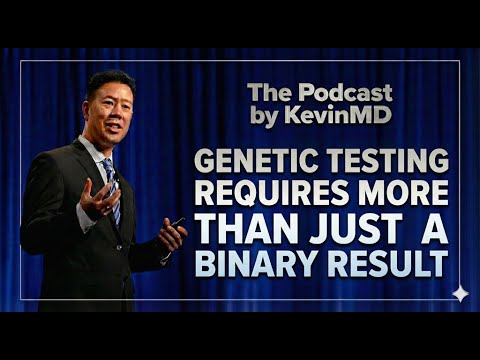
Fertility specialist Oluyemisi Famuyiwa discusses their article “Why carrier screening results are complex.” Oluyemisi explores the transition to “Genetic Carrier Screening 3.0,” a new era where expanded panels reveal hidden complexities that defy simple positive or negative interpretations. The conversation highlights how specific variations in genes like CFTR and SMN1 can lead to unexpected clinical consequences, such as male infertility or silent carrier status in spinal muscular atrophy. By examining the nuances of hemoglobinopathies and X-linked conditions, Oluyemisi explains why being a “carrier” often has direct health implications for the parents themselves, particularly mothers. This episode emphasizes the urgent need for expert interpretation and counseling to ensure patients truly understand the genetic information in their hands. Advanced science demands advanced communication to protect your family’s future.
Partner with me on the KevinMD platform. With over three million monthly readers and half a million social media followers, I give you direct access to the doctors and patients who matter most. Whether you need a sponsored article, email campaign, video interview, or a spot right here on the podcast, I offer the trusted space your brand deserves to be heard. Let’s work together to tell your story.
PARTNER WITH KEVINMD → https://kevinmd.com/influencer
SUBSCRIBE TO THE PODCAST → https://www.kevinmd.com/podcast
RECOMMENDED BY KEVINMD → https://www.kevinmd.com/recommended
Transcript
Kevin Pho: Hi, and welcome to the show. Subscribe at KevinMD.com/podcast. Today we welcome back Oluyemisi Famuyiwa, fertility specialist. Today’s KevinMD article is “Why carrier screening results are complex.” Yemi, welcome back to the show.
Oluyemisi Famuyiwa: Thank you so much, Kevin. It is a pleasure to be here.
Kevin Pho: I have to admit, when I read your article, I actually had to do a little bit of research myself because a lot of the things that you brought up are things I have not encountered since medical school and residency. Give us a little bit of context about why you decided to write the article, and then talk about the article itself.
Oluyemisi Famuyiwa: Nowadays everybody is getting genetically screened. The panel that we used to use way back when was 23 genes. Then it came up to 100-something genes, then 250. Now we are testing for 787-plus genes to get carrier status. Not only that, but the technology has rapidly advanced. We used to think of cystic fibrosis as either positive or negative. It was black and white. Now we know that it is not so fast. It is actually very nuanced, and it is creating a lot of anxiety for our patients and a lot of complexity in counseling them about the results.
Real physician voices, twice a week
Free, and one click to unsubscribe.
Kevin Pho: Now, are you talking about these commercial genetic screening tests that you could get on the internet or you see commercials for, or are these tests that physicians are prescribing?
Oluyemisi Famuyiwa: I don’t even go into the realm of commercial ones. These are the ones that we use in a clinical setting.
Kevin Pho: You are a fertility specialist. So how do you typically use these screening tests in your practice?
Oluyemisi Famuyiwa: In the old days, we used to say that if you were an Ashkenazi Jew, you test for this. If you were African American, you test for sickle cell. We now know that there is such a wide variability and society is so intermingled that that does not hold anymore. You would surprisingly find something that might be associated in a Caucasian population appearing elsewhere.
I had a Nigerian patient whose kids came up with a disease process after getting IVF done out of the country that I hadn’t even heard of. I had to go look it up. I thought: “What? You’re not supposed to have this.” We are seeing that in real life. I also had a patient whose husband’s screening came back as a silent carrier for SMA1. I thought: “What? What is that? How do I guide the patient?”
The patient will ask what this means and what they should do with these results. I usually recommend genetic carrier screening for both couples for that reason. You do not want to be blindsided with something you were not expecting at all. I think in 2025 that is almost inexcusable to have that happen.
Kevin Pho: So when you see a couple or patient for fertility, you routinely order these tests that test for several hundred genetic conditions.
Oluyemisi Famuyiwa: We routinely counsel them. I provide the information and I tell them these are the recommendations from the American College of Obstetricians and Gynecologists that screening is recommended. But I do not make it a do-or-die situation. I insist that you get the counseling. As an adult, you have the right to make your own decision. But the question is: Have you been given all the right information to make the appropriate decision?
Kevin Pho: Of those tests that are being tested for, give us examples of which ones would have the highest impact or the biggest repercussions for a couple.
Oluyemisi Famuyiwa: Absolutely. For instance, we talked about cystic fibrosis. It is autosomal recessive, meaning that if you have two of the defective genes, you have it. If you have just one, you are in the clear. We are finding out that you may be in the clear for the lung manifestations, but if you are a carrier, it can still show up in bad ways.
For instance, in gentlemen who have azoospermia, meaning no sperm, and they get sequenced, they may find out that they are a carrier for cystic fibrosis. The problem with the cystic fibrosis carrier status is that it is not black and white because it could manifest in very mild forms or also in severe forms.
In the very mild stage, they have no symptoms. In the moderate stage, they have blockage of the vas deferens and no sperm coming out. In some of them, they have a severe state where they may start to have some of the pulmonary effects. It all depends on which gene is affected, how much of it is affected, and what I think of as the dimmer switch.
In addition to having the 5T defect in your protein factory making the CFTR protein, there is also a dimmer meaning how severe it can be. So you have to get the full sequencing in order to be able to appropriately counsel them about their risks.
The other one is von Willebrand disease. We used to think it was an X-linked disease and it will show up in men. Women now have been found to have bleeding problems during pregnancy if they are a carrier, so they may need to be watched a little closer.
Now the one that is going to shock everyone is sickle cell. Sickle cell is very prevalent where I come from. I am originally from Nigeria. It was so bad that in Nigeria to get a marriage certificate, you need to go show them your sickle cell status. People were counseled about that and they said, “Well, if you are sickle trait, you are OK.” Not so fast. Some of the people who have sickle cell trait may actually have renal necrosis and they may be subject to sudden collapse during exercising. So there are slightly abnormal things that may happen.
Another one is G6PD deficiency. That is X-linked. So we thought if the man gets the inherited X, they get it because they only have one X. However, the women who are carriers may also have problems. Some of them may have sudden hemolysis if they are exposed to certain medications. If they eat fava beans, which is the one most people are familiar with, they may also go into a crisis with it. So there are very subtle changes from “you are affected” to “you are not affected” to “you may not be affected but there’s a nuance there.” Here are the things you need to watch out for so you do not fall victim to some of these things.
Kevin Pho: So you just mentioned four diseases, each with dozens of permutations. And you screen for hundreds of these diseases. So there could be literally thousands of possibilities. How can patients make sense of this and how do you guide patients through all this?
Oluyemisi Famuyiwa: You just hit on the number one conundrum: sometimes more may not be better. There are some companies out there saying we could screen up to 15,000 genes or whatever it is. I think going forward, this is where AI is going to come in because you are right. When we do this many number of genes, we are going to see some changes that we haven’t even heard of yet.
We see variants of undetermined significance. We ask: “What does this defect that we just found out mean? Is there an associated disease state with it? Or is this something we should be worried about?” Those are part of the problem that we haven’t fully solved. However, I think going forward some of these things are going to be fed into the AI machinery. Maybe the algorithm will be able to sort it out a little better for us going forward.
There is also a tendency in some places to look at polygenic risk scoring, although the American Society for Reproductive Medicine has come out and said there is no room for it in clinical practice. We look to see if this child is going to be at risk for disease X, Y, or Z. The problem with that is that we could start to use it in a wrong way.
If it is for a specific disease that could potentially be life-threatening, yes, it may have some use. But if we are just doing it because we want to create a superhuman, if you will, then you run into ethical issues. I agree with you that just as the field has exploded and given us a lot of actionable data, it has also exploded the need for proper genetic counseling and the complexity of the counseling needed to guide patients.
The long and short answer for what you asked me is that if I come up with some of these things that are not your simple cut-and-dried results, I usually get a detailed genetic counseling session for the patient to help them manage that information overload.
Kevin Pho: How available are genetic counselors? Is that a relatively specialized field? I know in my area sometimes it is a little bit difficult to get that. How often does that happen where you would have to refer patients over to a genetic counselor?
Oluyemisi Famuyiwa: Not very often. I am seeing a few here and there, so not very often. Although the companies that do this genetic testing and offer the multiple gene panels that we use especially already have a built-in genetic counseling company with their platform. So when the patient gets a result that flashes something is off, they automatically get a follow-up phone call from the genetic counseling company that says: “Hey, this is what we saw. Here are your risks.”
If they want more detailed counseling or maybe a close family member wants to know what that has to do with them, then that is when you go with specific genetic counselors that might need that. So to answer your questions, they are not readily common, but it depends on which company does the testing. A lot of these companies do have in-house counselors that we have availability to.
Kevin Pho: So I know that we are not referring to commercial genetic testing where people can just order it offline, but those are ubiquitous. I see ads for those all the time. Before talking to you, I didn’t get the sense of the amount of nuance and repercussions that could arise from them. Do you feel that patients aren’t getting the proper education when they’re seeing these commercials or clicking on some link online about the possible permutations and everything that could happen from these over-the-counter genetic tests?
Oluyemisi Famuyiwa: I would caution extreme caution. Do not do it as a cocktail curiosity. The biggest company that used to do that, 23andMe, went out of business recently. The difficulty with doing a test without a physician ordering it and being able to say “Here is the result, this is the next step” is that you are going to get this thing and they may or may not offer you any counseling. So now what you have done is you have bought a whole boatload of anxiety that I just cannot think would be very helpful for patients. So my encouragement is if you are really curious, then talk to your OB/GYN, talk to your internist, or see a reproductive specialist. I would go with the ones that we order which are medical-based because then I know how to triage it.
Kevin Pho: You mentioned about the possibility of AI sifting through all the results and giving the interpretations. As far as you know, are there any tools or anything down the pipeline that uses that?
Oluyemisi Famuyiwa: There are some companies out there who are working on it, but it is still in the very early stages. It has not been 100 percent widely accepted yet. I don’t know if you recall when CRISPR first came out and this one scientist in China genetically modified some genes in twins. Everybody was aghast asking what was the medical necessity and why would you do such a thing. He suffered some penalties for that.
But fast forward, now that we have heard about it, we know about it, and we have adopted it better. Now they are saying maybe there is some utility for it in certain disease processes like sickle cell that has a very specific modification to a gene. Can you fix that defect or correct that genetic material at the DNA level so that that person can live a normal lifespan? Those things are coming out.
What is fascinating is that we are talking about DNA here. Your DNA gets translated to RNA, and then your RNA is the blueprint that makes the protein. Now not only can you edit the DNA, some people have been talking about editing the RNA itself. Now you are going one step forward. You could edit the protein itself. So you could edit the transcriptome. We are going into proteomics and metabolomics. That may be where we are heading. I am sure when you and I sit down five years from now, God willing, we are going to have a whole different conversation because the technology is going to be much more advanced in the way AI is working.
I was reading a book today by the head of AI for Microsoft called The Coming Wave. The amount of data that this thing can handle and spit back out at us is just phenomenal. So I have no doubt whatsoever that AI is going to be able to interpret this. But the utility for AI is where I am curious. It will look at not just the genome or the DNA material. It will look at the transcriptome, the RNA, the protein, and the metabolites. It will also correlate it with the exposome. What are you being exposed to?
We know just because you have a gene doesn’t mean it is going to come out. It is also sometimes dependent on your exposome because that could give you post-translational modifications like histone modification or methylation that changes their output. So the DNA is there and it is not changed or mutated. The RNA comes out unchanged and unmutated. But then you have exposure that manipulates how they interpret the final product. That is where I think AI is going to take off.
Kevin Pho: We are talking to Oluyemisi Famuyiwa, fertility specialist. Today’s KevinMD article is “Why carrier screening results are complex.” Yemi, let’s end with some take-home messages that you want to leave with the KevinMD audience.
Oluyemisi Famuyiwa: The take-home message is that it is not black and white. It is not just about being a carrier, dominant, or recessive. It is a little bit nuanced. When you get this test, you need to be able to talk to someone who can break down the nuance.
We also have something called residual risk. Just because you came out negative doesn’t mean you are free and clear. It may simply mean that the testing that we have today is not capable of picking some salient points up. Maybe in five years it may refine where we get it. So we always caution patients that even though you are cleared, there is something called residual risk.
Kevin Pho: Yemi, again, thank you so much for sharing your perspective and insight. Thanks again for coming back on the show.
Oluyemisi Famuyiwa: Thank you so much for having me. My pleasure.
Listen and followApple PodcastsSpotifyYouTubeMore apps · Browse all episodes