I have the great honor and privilege of coaching medical students throughout their training. In the past week, several students have shared experiences that have stayed with me: On clinical rotations, some shared stories of being referred to only as “student one” or “student two,” their humanity quietly erased. Others described managing food and housing insecurity while carrying the financial burden of medical education. Still others, particularly students with darker skin tones, have been asked by patients to leave the examination room, simply because of how they look.
None of these students were confused about whether something was wrong. What they were unsure about was what to do with that knowing, especially in systems that reward endurance, deference, and silence.
Medical students and trainees are often told, explicitly or implicitly, that survival depends on compliance.
Keep your head down.
Don’t rock the boat.
Say the right thing at the right time.
Get through this stage, and then you can change the system.
It is a tempting bargain. And a familiar one.
The middle power of trainees
In a recent address at the World Economic Forum, Canadian Prime Minister Mark Carney described how systems persist not only through structural domination, but through the quiet participation of people who know better. He drew on Václav Havel’s famous essay “The Power of the Powerless,” which tells the story of a greengrocer who places a political slogan in his shop window, not because he believes it, but because it is safer to comply than to tell the truth.
Real physician voices, twice a week
Free, and one click to unsubscribe.
Medicine knows this story well.
We praise professionalism while tolerating cruelty.
We celebrate wellness while rewarding exhaustion.
We invoke equity while maintaining hierarchies that silence the most vulnerable voices.
Most trainees see the cracks early. The problem isn’t ignorance.
Medical students and residents occupy what Carney would call middle power in a broken system: not powerless, but not dominant. Embedded inside institutions shaped by forces they didn’t design, governed by metrics they didn’t choose, and evaluated by people whose values may not align with their own.
And yet, middle power is still power.
The mistake is believing that moral courage requires control. It doesn’t. It requires honesty.
Taking the sign out of the window
When systems are no longer aligned with our stated values, the most dangerous move is pretending otherwise. This is keeping the sign in the window.
For trainees, “the sign” can take many forms:
- Accepting dehumanization as part of training.
- Staying silent when policies harm learners or patients because “that is just how it is.”
- Performing resilience instead of naming moral injury.
- Calling it professionalism when what is really being asked is complicity.
Removing the sign doesn’t mean burning the system down. It means living in truth, even when that truth is uncomfortable, partial, or risky. It means staying present and curious when retreat would be easier.
This is where courageous conversation comes in.
Courageous conversation is not performative dissent, shouting into an echo chamber, or demanding purity in impossible and nuanced conditions. As Carney put it, it is values-based realism: principled and pragmatic at the same time.
For trainees, that can look like:
- Naming what you are observing without accusation: “I am noticing this feels misaligned with our stated goals.”
- Staying present when tension rises instead of shutting down or escalating.
- Asking questions that slow harm, even when you can’t stop it entirely.
- Choosing integrity over ease in small, repeatable ways.
Moral courage as a practice
This is my invitation to students, trainees, and clinicians alike: Courageous conversation is not about winning an argument or thinking you have the moral high ground. It is about witnessing. About refusing to let misalignment pass as routine simply because it is familiar.
Force is not the only way that harmful systems shift. They fracture when everyday people stop participating in rituals they privately know are false. In medicine, those fractures often begin quietly: a student who speaks up for a patient or a peer, a resident who names an unsafe dynamic, a team that chooses curiosity over disdain.
None of these acts are grand. All of them matter.
In my coaching work, I often encounter a myth in medical training: that if you can’t fix everything, you should say nothing; that if you don’t have institutional power, your only options are silence or martyrdom.
There is a third path.
Middle power is relational power. It lives in coalitions, shared language, trust in one another and oneself, and in communities of practice that help people stay grounded in their values, especially after a setback.
This is not naïve idealism.
Waiting until you have an attending title to practice moral courage is not a strategy. Habits of silence calcify. So do habits of truth-telling.
If you are a medical student or trainee, your power may feel small, but it is not nothing. You shape culture every time you decide how to speak, how to listen, and how to respond when something feels off. You are learning medicine, and you are also learning what you are willing to normalize.
Moral courage is not a single brave moment; it is a practice. One conversation, one question, one refusal to perform what you know is false.
This is how broken systems begin to change. Not all at once, but from the middle outward.
The goal is not to be fearless. The goal is to be honest about what you see, what you value, and what you can realistically influence right now. The goal is a practice of noticing.
Medicine will not be repaired by heroes alone. It will be reshaped by ordinary people who decide, again and again, to take the sign out of the window.
To stay human in systems that make it hard.
To speak with care.
To practice peace with a spine.
That work, too, is a form of healing. And a core clinical skill.
This article is discussed on The Podcast by KevinMD in the episode Silence isn’t neutrality: Why medical students can’t wait to find their voice.
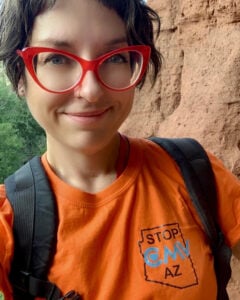
Kathleen Muldoon is a certified coach dedicated to empowering authenticity and humanity in health care. She is a professor in the College of Graduate Studies at Midwestern University – Glendale, where she pioneered innovative courses such as humanity in medicine, medical improv, and narrative medicine. An award-winning educator, Dr. Muldoon was named the 2023 National Educator of the Year by the Student Osteopathic Medical Association. Her personal experiences with disability sparked a deep interest in communication science and public health. She has delivered over 200 seminars and workshops globally and serves on academic and state committees advocating for patient- and professional-centered care. Dr. Muldoon is co-founder of Stop CMV AZ/Alto CMV AZ, fostering partnerships among health care providers, caregivers, and vulnerable communities. Her expertise has been featured on NPR, USA Today, and multiple podcasts. She shares insights and resources through Linktree, Instagram, Substack, and LinkedIn, and her academic work includes a featured publication in The Anatomical Record.