Listen and followApple PodcastsSpotifyYouTubeMore apps · Browse all episodes
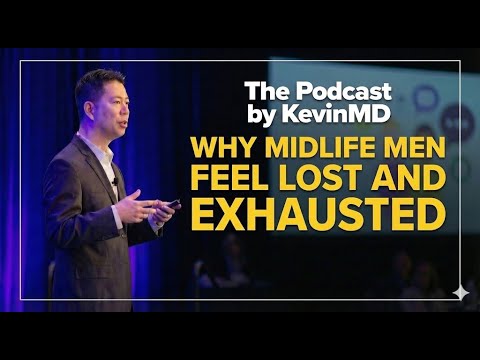
Emergency physician Kenneth Ro discusses his article “Why midlife men feel unanchored and exhausted.” Kenneth explains why men between 40 and 60 often visit clinics requesting hormone testing when they are actually suffering from a profound loss of identity and purpose. He distinguishes being unanchored from clinical depression and highlights how successful professionals like executives and veterans often face a silent crisis that standard medical metrics cannot measure. The conversation explores the need for physicians to look beyond biomarkers to address the existential erosion occurring behind closed doors. Medicine must evolve to help men rewrite their stories for the second half of life rather than just managing their decline.
Partner with me on the KevinMD platform. With over three million monthly readers and half a million social media followers, I give you direct access to the doctors and patients who matter most. Whether you need a sponsored article, email campaign, video interview, or a spot right here on the podcast, I offer the trusted space your brand deserves to be heard. Let’s work together to tell your story.
PARTNER WITH KEVINMD → https://kevinmd.com/influencer
SUBSCRIBE TO THE PODCAST → https://www.kevinmd.com/podcast
RECOMMENDED BY KEVINMD → https://www.kevinmd.com/recommended
Transcript
Kevin Pho: Hi. Welcome to the show. Subscribe at KevinMD.com/podcast. Today, we welcome back Kenneth Ro. He is an emergency physician. Today’s KevinMD article is “Why midlife men feel unanchored and exhausted.” Kenneth, welcome back to the show.
Kenneth Ro: Hey, thanks a lot, Kevin. It is great to be here.
Kevin Pho: All right. For those who didn’t get a chance to read this most recent article, tell us what this one is about.
Kenneth Ro: This one is something that I think is a real blind spot in medicine. We have a couple of blind spots. One is postmenopausal women and getting hormone therapy back from the black box just a few weeks ago. We missed an opportunity for treating millions and millions of women and alleviating their symptoms. That was a big swing and miss.
I think something that is very cogent and very applicable to both you and me, and women who love their men, is this transition that we go through from the age of 40 to 60. It has been mislabeled and clichéd as the midlife crisis. That is the problem that we have. It has just been poo-pooed in the public eye and also amongst us clinicians in medicine.
We think of some guy trying to intersect with his youth. He is going to get the sports car, he is going to divorce his wife, and he is going to get the 20-year-old girlfriend. That is all we think about. But when we really think about what a midlife transition is, we are not going to call it a crisis because it is so universal. It is something that we all have to go through. It is essentially almost like an Erikson stage, which he does mention.
But with the Erikson stages, we just tend to stop with children, and then we don’t really study what he talked about as we continued on.
Particularly as physicians, we are very focused on the first half of our lives. We get into medical school, we achieve, we perform, we work, we put in the hours, we put in our time, and we provide for our families. We are very comfortable in that role because that role is very defined for us. Then something happens five or ten years into practicing. It is subtle and insidious. You start getting older. You start feeling a little bit older. However, you don’t really have the framework, the blueprint, or the mentors to really tell you that or let you know that you are in the second half of your life. Potentially, this should be the best part of your life. They do call it the golden age, but then there are all those jokes about the golden age and what that entails.
My article covers several thoughts that I have been carrying around for a long time. Since we last spoke, I wrote a book called Prime: How to Win the Second Half. That is essentially what we are going through. As men, it is very critical. We have a culture where we are pretty ego-driven and very macho. We don’t want to talk about it. Anything that we feel in our body or any vulnerability is a weakness. So our mantra is: “You can sleep when you’re dead. Carry on. Push through. Let’s go. Get out of bed. Set an example for your kids and for your colleagues because you have to be tough.”
But what is the cost? If you look at men in their forties and sixties and look at every cause of morbidity, mortality, and death, that is where the number one cause of death, coronary artery disease, peaks. This often happens in a 40 or 50-year-old man who has probably had undiagnosed hypertension and metabolic disorders and basically doesn’t go to the doctor. Women get their colonoscopies, Pap smears, and mammograms. They are a lot more attuned to their bodies because their bodies are constantly changing, particularly when they hit menopause. There is much more attunement and awareness. We guys are more about denial. We brush it off, think it will go away, or assume it is just part of aging.
We don’t have a mechanism for men to really open up. I think a lot of that is two-sided. It is cultural, and it is also the way our health care system is set up. Culturally, we are talking about not getting older. We are talking about anti-aging. Youth is being pursued at the expense of all the benefits and privileges of aging. When you wake up in the morning, it is a privilege. If you wake up the next morning, it is even more of a privilege.
We have some thought leaders who have written some awesome books, such as Arthur Brooks, on how we go from fluid intelligence to crystallized intelligence. As you get older, you recognize patterns better, which makes you a better doctor. You become wiser theoretically because you have made more mistakes. You learn from those mistakes. You certainly learn from a mistake much more than you learn from success.
I think culturally we are in a place where making mistakes is taboo. Do no harm. Kathryn Schulz is one of my favorite authors who wrote a fantastic book called Being Wrong. It completely changed my mindset on how our culture is and how we really inflate the negative. Our brain is Teflon for good things and Velcro for the bad things. That is our survivalistic brain. We need to be more Teflon, obviously.
In the health care system itself, the way we have been taught to document and treat focuses on illnesses. What is our first intake form for any patient? It is the history and physical. There is no room for social history. With electronic medical records, the past social history is a box. It is usually a prepopulated box that we don’t even look at.
What we know about men is that there is a deeper layer. A man will come in to see a doctor not because he wants to, but because there is a question. He feels off. Our language amongst men is that we are going to talk about test results. We are not going to talk about your past history, any past traumas, or any psychosocial ramifications of how you may be feeling or your identity or your mindset. We are going to talk about testosterone. We say: “Oh yeah. Okay. See my testosterone is low. That explains everything. Thank God. Thanks a lot, doc. Put me on some testosterone and I will get out of your way.”
The problem with that is the cost that we talked about before: heart attacks and strokes. Literally, men are dying because they haven’t been given a container to open up. We criticize guys for being too stoic, and not stoic in the sense that we are talking about all the great things of Stoicism, but just not opening up. Amongst guys, there is this “man code” and a “man card” that you carry that might be taken away from you if you start maybe listening to your wife or listening to some of those symptoms that you have had for a long time and actually seeing a doctor.
It really strikes me being an ER doctor for 35 years. Usually, my first question when I see a man present is: “Why are you here? What got you here?” You can think that there are so many times where this gentleman had heartburn and just decided it would go away. So what made it different today? They might say: “Oh, it lasted longer and I got sweaty.” You can really start tuning in. I think a lot of it is just getting back to the art of medicine and the art of listening because 93 percent of communication is nonverbal. Intuition, gestalt, gut feeling, and micro-expressions. Where do we put that on the H&P? There is no place for that. We are missing a complete and very important component of being able to bring men out of the shadows and really talk about issues that are really in their thought processes 24/7. That is kind of what my article was about. We as physicians have a unique opportunity to tap into that. Does it take 15 minutes? Do we turn into therapists? Do we talk about their father and their mother relationship? Not at all. All we need to do is give that extra one to two minutes.
Real physician voices, twice a week
Free, and one click to unsubscribe.
Kevin Pho: There is that worsening phenomenon we always read about, the loneliness epidemic as men get older. Men tend not to make new friends in contrast to women. I think that plays a big part in terms of the psychosocial aspect that is affecting men as they age. Talk more about that loneliness epidemic that sometimes you see that maybe even brings them to the emergency department.
Kenneth Ro: It is killing us. It is killing guys. Scott Galloway has a nice book out, Notes on Being a Man. He talked about the difference when women’s husbands pass away. They actually become happier and they live longer. The converse is not true. When a man becomes a widower, he just falls off the cliff. The difference between life expectancy between a widow and a widower is just staggering. It is one to two years for a man and maybe seven to eight years for a woman after their partner passes away.
Men need relationships more than women do because women are naturally oxytocin-bonded. They will naturally reach out and feel the power and get the support and the scaffolding from other women and support groups. For men, that is a taboo. You need to be able to handle it yourself. If you are not, then we are going to take away your man card.
Loneliness is killing us. Where do we put loneliness on the H&P? It is not in the review of systems. You can probably put it down in their psychiatric history, but it is not psychiatric. It is just good common sense that we should really be more attuned to. In these days with less stigma on mental health and more awareness of how important close relationships are for our overall well-being, the conversations that we are having about health in general are changing for the better. Slowly but surely. We are still very time-constrained. You look at your EMR and you are not going to really have a place to put the components that make the most difference.
Kevin Pho: You mentioned that in the emergency department sometimes it doesn’t take necessarily that much longer to uncover some of these issues. You said a few extra minutes. What kind of questions do you ask them to uncover this?
Kenneth Ro: Absolutely. One big, open question is: “So when was the last time you really felt fully alive and fully engaged in what you do?” I will ask the gentleman what he does for a living or ask him about his kids or his grandkids. I ask: “When was the last time you actually got down on the floor and played with your grandkids?”
That gives me a couple of things. That gives me kind of an existential quick question as to where he is in the process of maybe looking at himself from an aging point of view. Then number two, that gives me more of a physical parameter of where he is. If he is laying on the ground playing with his grandkids, he is doing pretty well. But if he says, “Oh, I am just sitting on my chair and I am letting them climb all over me,” then that tells me another thing too.
That kind of opens up a portal where now your patient-physician relationship is more personal. It is not transactional anymore; it is relational. I think that is huge. We are so good on the science. Kevin, the patients come in and they have already done their research. In the ER, I call it “Google-itis.” It is not an ICD-10 code, but it should be. They have done their research. They have looked at ChatGPT. They have already diagnosed themselves. But what they really haven’t done is had that deeper conversation with themselves and asked: “Where is this abdominal pain, headache, back pain, or chest pain really coming from?”
They justify their ER visit by a physical symptom. But look deeper, and the physical symptom is a manifestation of something that is a lot deeper, such as loneliness. I will talk to the patient and ask: “Is this an anniversary or something? Maybe your parent passing away?” Invariably they say: “Yeah, this is an anniversary of my younger brother passing away.” That is telling. When you can get that sort of depth in your interview quickly, I think that changes the game dramatically. Then you build up trust. Then you build up rapport. Then a guy who is just waiting to open up to somebody gushes everything out. It is astounding when you see that. It is such a surprise every single time. It is like he has been this clamped hose just waiting to spill this out, and he just hasn’t been given the opportunity.
Kevin Pho: Asking that question “What makes you feel alive?” can uncover some of these issues that men face as they age. Of course, you wrote a book on the second phase of life. Briefly tell us some of the things that you are doing specifically to prevent some of the issues that we are talking about today as you get older.
Kenneth Ro: The book itself is more of a background story because I am really into storytelling. I think that is how we connect as people. You tell me your story, I will tell you mine, and then we will know each other better. But there is an actual method that I used over a 10-year period where you can call it biohacking, optimization, or an “N of one” experiment. I really cut through the noise and tried to figure out what worked for me and what didn’t work for me.
Through all that research, I came to the conclusion that everybody is an individual. What works for somebody isn’t going to work for somebody else. How can we test it? How can we track it? I have finally found some test parameters and some very cutting-edge people that have created companies that actually look at mitochondrial oxidative stress, for example. They look at cortisol levels fluctuating throughout the day. We can manage that from a medical point of view.
I am now transitioning from the ER into a precision medicine practice. We talked about this about five months ago. What I am trying to do is be very proactive, but I am trying to ask the right questions. I am trying to get to the core and the gut of what a man really feels about himself. Where did this come from? What were his lived experiences? Essentially, what sort of operating system are you on right now? This is something that you built up in your twenties and needs to be thrown out like dial-up AOL. A lot of times it is: “You are 20 and this is the mindset, and you are going to carry that mindset until you are 60.” Guess what? That needed an update a long time ago.
Let’s talk about what is going to update the way you think, the way you react, and your thought process. We talk about the default mode network. That just needs to be completely modified and updated. What really happens over time is this feeling that is so satisfying that you and I both get when we talk to a patient. When the patient gets that “aha” moment and says: “Wow, you know something? He really gets me. He really knows what I am talking about.”
It is so satisfying and fulfilling. In the ER, I was fulfilled in a lot of different ways. But now that I am practicing one-on-one precision medicine, that is what fulfills me. When I ask myself the question “What makes me feel alive?” that is what makes me feel alive. I am connecting with somebody on a very deep level—somebody who hid himself behind all this wall and all this armor, and he is finally revealing himself to me. He is feeling confident, and we are getting somewhere with this. I am getting to know somebody on a very deep personal level. That is so satisfying to me.
Kevin Pho: We are talking to Kenneth Ro, emergency physician. Today’s KevinMD article is “Why midlife men feel unanchored and exhausted.” Ken, let’s end with some take-home messages that you want to leave with the KevinMD audience.
Kenneth Ro: Let’s just take the stigma out of the midlife crisis. Let’s look at it with the lens of how men feel about aging and let’s all take this journey together. Health is a team sport. We are talking about a man who is stuck in an old mindset. Let’s get us guys back to something that is more productive, more meaningful, more purposeful, and that is going to leave a legacy. We want to be better husbands, better fathers, better grandfathers, and we want to be better mentors for our students, our medical students, and our residents coming up behind us. Let’s get away from achievement and let’s get into meaning and purpose.
Kevin Pho: Kenneth, thank you so much for sharing your perspective and insight. Thanks again for coming back on the show.
Kenneth Ro: Always a pleasure, Kevin. Hope to see you soon.
Listen and followApple PodcastsSpotifyYouTubeMore apps · Browse all episodes