Listen and followApple PodcastsSpotifyYouTubeMore apps · Browse all episodes
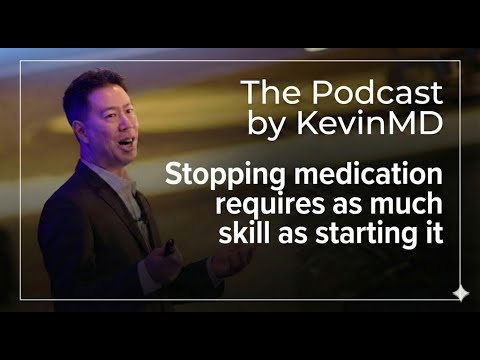
Nationally recognized psychiatrist, internist, and addiction medicine specialist Muhamad Aly Rifai discusses his article “How deprescribing in psychiatry offers a path to safer care.” Muhamad explores the growing movement to reduce unnecessary medications in mental health care, a practice that has long been established in geriatrics but is now gaining traction in psychiatry. He describes the “prescribing cascade” where side effects are treated with more drugs, leading to patients feeling trapped in a cage of routine and chemical dependency. The conversation highlights the critical importance of having an exit plan for every prescription and distinguishing between withdrawal symptoms and relapse. Muhamad advocates for a culture shift where clinicians are empowered to stop interventions when harm outweighs benefit, ensuring that medicine remains a tool for healing rather than a permanent burden. Learn how a disciplined approach to deprescribing can restore patient agency and rebuild trust in the medical system.

Partner with me on the KevinMD platform. With over three million monthly readers and half a million social media followers, I give you direct access to the doctors and patients who matter most. Whether you need a sponsored article, email campaign, video interview, or a spot right here on the podcast, I offer the trusted space your brand deserves to be heard. Let’s work together to tell your story.
PARTNER WITH KEVINMD → https://kevinmd.com/influencer
SUBSCRIBE TO THE PODCAST → https://www.kevinmd.com/podcast
RECOMMENDED BY KEVINMD → https://www.kevinmd.com/recommended
Transcript
Kevin Pho: Hi, and welcome to the show. Subscribe at KevinMD.com/podcast. Today we welcome back Muhamad Aly Rifai, psychiatrist, internist, and addiction medicine specialist. Today’s KevinMD article is “How deprescribing in psychiatry offers a path to safer care.” Muhamad, welcome back to the show.
Muhamad Aly Rifai: Thank you for having me to talk about this timely and important topic about deprescribing in psychiatry and the general deprescribing movement that is happening in the country. I want to give the perspective from psychiatry and talk a little bit about the medical field and what has been going on.
Kevin Pho: All right. Why did you decide to write this article? Then tell us about the article itself for those who did not get a chance to read it.
Muhamad Aly Rifai: As a psychiatrist who has been in practice for more than 25 years, I have seen how the field of psychiatry works. As a board-certified internist, I have seen how we have basically learned how to add medications. We can, for example, add one for sleep. We can add one for nausea to treat the side effects of another medication. If one medication causes weight gain, we add another medication to help with the weight gain. If antidepressants cause any side effects, we can add other medications. We have basically developed a vicious cycle of adding medications, and polypharmacy just became the norm in our society.
Not until a few years ago did I just start challenging the status quo and starting to deprescribe in terms of my medications and my patients. I started offering that choice to patients and talking to patients and to family about what is going on, why their loved one is on so many medications, and why they are on so many medications. Basically, I started a planned and supervised reduction or stopping of medications that is safe, involves informed consent, and is evidence-based. I think that the changes that we are seeing also in the health care system in the last year or so give more credence to that movement because one in five or even one in four Americans are on psychotropic medications. We need to try to see how we can help them with that.
Real physician voices, twice a week
Free, and one click to unsubscribe.
Kevin Pho: In your article, you use the term “prescribing cascade” that describes exactly what you are talking about when more drugs are added to treat side effects of other drugs. How did it get to be this way? Why is it so easy for physicians to just add on medications? Why did we come to this point?
Muhamad Aly Rifai: I think a big part of it was that patients demanded it. We got into this cycle where we wanted to appease patients. Patients were unhappy, for example, if they came into a visit expecting an antibiotic and they did not get an antibiotic, or if they came into a visit and they had a complaint and they did not get a medication. I think medication became the purpose of the medical visit while counseling, lifestyle management, and talking about other things took a step to the side. Basically all we did was just prescribe medications. At least that is true in my field, in psychiatry. We just became prescribers of medications. We left therapy for the counselors and basically just had 15-minute medication checks and prescribed medications. Not until the last 10 or 15 years did we decide that we could also employ other treatment modalities, and we are doing that right now as I have talked about in the past. But definitely we just became internists, psychiatrists, neurologists, and other specialties that just prescribed medications.
Kevin Pho: Other than the obvious fact that patients generally do not want to take so many pills, so many medications, especially psychotropic medications, can lead to obvious patient harm as well, right?
Muhamad Aly Rifai: Absolutely. They experience side effects, and then what happens is we give them other pills and other medications to fix the side effects of the first medications. When you talked about a cascade, it is like a downhill slope where the result is not positive for the patient.
I think what really kind of gave it to me was one of my mentors when I was at the National Institute of Mental Health at the NIH, Dr. Ezekiel Emanuel. He is a medical ethicist and he is an oncologist. He came out with a piece where he said that if he is above the age of 75, he no longer wants any aggressive treatments. He wants no antibiotics, no codes, and no cancer treatments. If he had lived to the age of 75 and he had a happy life, he just wants no medications and just limited treatments.
A lot of clinicians asked: “What is he thinking about? This is nonsense.” But there are people who just congratulated him for that because a lot of patients heard that from a leader in the medical field, a medical ethicist who just says enough is enough. We just have to figure out that at one stage we really cannot just keep prescribing pills. The average elderly person above the age of 65 in the United States is on about five or six medications. So we really need to figure out how we can help our community and our patients with deprescribing, and specifically with psychotropic medications.
Kevin Pho: So tell us what kind of advice you have for physicians to determine whether they are in the midst or just starting one of those prescribing cascades you are talking about. How does a physician even know that has become an issue?
Muhamad Aly Rifai: You can see it with just the routine continuation of prescriptions when somebody is on five, six, or ten medications, and when there is no identification of why this medication is being prescribed or the long-term outcomes of this medication being prescribed.
An example is actually from my daily practice. A few days ago I had a patient who is 75 and she is on a cholesterol medication. I know you had talked with another physician about how cholesterol medications are being overprescribed. She is 75. Her cholesterol is borderline, but she is on a cholesterol medication. I inquired to the patient: “Why are you on this medication? Do you know why?” She said it was just started by her primary care doctor. Well, this is an additional medication. She is also on a lot of psychotropics which we are trying to taper off.
When I put the question to the patient and she challenged her primary care doctor, the primary care doctor said, “Well, let’s look at your cholesterol.” So they checked the cholesterol and said, “Well, it is borderline elevated. Maybe some diet changes. Let’s stop the cholesterol medication and see what happens.”
These just are medications that get put on and just get forgotten. There is no reevaluation. It is not just an afterthought. We should ask: What is this medication achieving? What is a cholesterol medication going to do long-term for somebody who is 75? The benefits are going to be seen in five or ten years, and she would be 85 at that time.
Thinking about long-term medications should be part of every session when we see our patients. We should ask that question of the patient. If you are unhappy about being on so many medications, think about what each medication achieves for you. I have had patients who said, “I want to stay on this medication. I don’t want to discontinue this medication.” Or patients who say, “Well, I don’t know what this medication is doing for me, and maybe if we try to taper off safely and try to deprescribe, that would be good.” I think those are very important questions to ask for our patients.
Kevin Pho: So are there any specific classes of medications where you have to be a little bit careful in terms of deprescribing and maybe warrant a little bit of a slow taper rather than stopping? Tell us the specific medicines where we just have to be a little bit more careful in stopping.
Muhamad Aly Rifai: With all psychotropic medications, such as antidepressants, anti-anxiety medications, mood stabilizers, and antipsychotic medications, you really have to be careful. You really have to dig deep into why the person is on the medication, what the diagnosis is, and how long they have been on this medication. Are you going to anticipate any withdrawal symptoms when you try to taper off these medications?
Sometimes when patients are on these medications long-term, they may experience very painful withdrawal symptoms. Some of these withdrawal symptoms may actually be life-threatening. So if somebody is on benzodiazepines, for example, long-term, that taper process is very prolonged and can sometimes be very difficult for the patient. It sometimes needs a lot of attention from the physician.
With mood stabilizers and antidepressants, sometimes you taper off antidepressants that patients have been on long-term and they are OK. We think even sometimes 50 percent of patients will be OK if you taper off an antidepressant. The other 50 percent may experience some withdrawal symptoms. Some of them may experience relapse in their depressive symptoms. It may need additional medications or other medications, or they may need other treatment modalities such as psychotherapy or transcranial magnetic stimulation. So there are other treatment modalities other than medications. But in terms of psychotropics, we need to be very careful with that.
The other very important group of patients is pediatric patients. Deprescribing in pediatric patients also needs a lot of attention and focus, especially with mood stabilizers and antidepressant medications because children are on medications but their brains grow. Their diagnoses basically change sometimes. They outgrow some of their symptoms. A very careful evaluation is very important so we can deprescribe some of these younger kids and adolescents of medications that maybe have been started when they needed them, but now they have outgrown the need for these medications. They need a more in-depth assessment of their needs for psychotropic medications.
Kevin Pho: Let’s talk a little bit more about the pediatric population. More and more of them are being diagnosed with things like ADHD and are on medications for that. I am seeing more younger patients on various psychotropic medications. What has the trend been over the last few years and within the psychiatric community? What is the thought about deprescribing some of these pediatric patients and getting them off some of these medications?
Muhamad Aly Rifai: I think there is a great momentum. We are seeing in scientific journals, and I referenced in the paper in the American Journal of Psychiatry, that they have started talking about deprescribing both for adults and kids. We are basically at a precipice because if we do not control this kind of escalating cascade of prescribing, we are just going to start causing more harm than benefit to our patients.
Now I talked in my blog that there are patients that will tremendously benefit from medications. So I would not deny somebody, a kid with ADHD who is on stimulants and whose school performance accelerates and who is able to function better with a stimulant. That is a life-sustaining medication. So that is not somebody that I would deprescribe.
But somebody who maybe has had some outbursts or some depressive symptoms and was placed on medication long-term without ever having a trial to see how they would do off medications is different. There should always be a conversation about the diagnosis, how they did on medications, and the risks and benefits of medications. This involves a discussion with the family. Sometimes the family would say: “Our loved one, our kid, did very well on these medications. We want him to continue on this medication because the benefits are really significant.”
Then there are medications where you put a kid on and there is really no significant benefit from the medications. Those are the ones that you would target with deprescribing. Always, whenever the kid is on a medication for longer than one year, there needs to be a reevaluation of why they are on the medication and whether we can take them off the medication.
Kevin Pho: So in both populations, whether it is the pediatric population or the adult population, it sounds like we need a conversation with whether it is the pediatric patient’s family or the patient themselves regarding whether they even want to deprescribe in the first place. Some patients I talk to do not want to fix what is not broken, and they just want to continue being on however many medicines that they are on. But I think, like you said, it starts with a discussion in terms of why they are on a medicine, whether they are happy with a regimen, and whether they in fact want to deprescribe in the first place.
Muhamad Aly Rifai: I think it is very important because we basically need to start having these conversations. These conversations are not being conducted in exam rooms between physicians and their patients. Just medications are being renewed with really no set benefit from these medications.
Sometimes compliance is an issue. We are thinking that the patients are on medications. If a patient is on more than seven or eight medications, there is a strong likelihood that they are not compliant with some or the majority of these medications. So that should be also part of that discussion. Are they being compliant with medications or are these just medications on their records that they are not taking? We need to discuss whether we should start deprescribing with these medications.
So this should be a conversation with every patient that we see. Why are they on these medications? Can we see if we can taper off some medications? If the patient says, “I like these medications, they are helping me, they are life-sustaining,” that gets documented. If there are adverse effects to these medications, you try to manage these adverse effects.
Kevin Pho: We are talking to Muhamad Aly Rifai, internist, psychiatrist, and addiction medicine specialist. Today’s KevinMD article is “How deprescribing in psychiatry offers a path to safer care.” Muhamad, let’s end with some take-home messages that you want to leave with the KevinMD audience.
Muhamad Aly Rifai: I think we need an upgrade in terms of how medications are prescribed in America. Deprescribing really offers a disciplined way to reduce harm, restore agency to our patients, and rebuild trust between patients and physicians. The work starts in the room between the patient and the physician.
I call on my colleagues: please start this conversation with your patients about their medications. I think we need to start this conversation in America. I think the events that are happening around us in terms of the current administration are a good roadmap to being able to help our patients be on less medications and live a healthy life.
Kevin Pho: Muhamad, thank you so much for sharing again your perspective and insight. Thanks again for coming back on the show.
Muhamad Aly Rifai: My pleasure. Thank you.
Listen and followApple PodcastsSpotifyYouTubeMore apps · Browse all episodes