Technologies differ not merely in their complexity, but in the breadth of what they enable humans to do. As their capabilities expand, so too does their influence on how we perceive and interact with the world. A stick is a simple technology with relatively few uses. Compare it to the saddle, which allowed humans to harness the power of the horse, communicate with it, direct it, and ultimately reshape transportation itself. The saddle did far more than make travel easier; it changed humanity’s relationship with distance. Artificial intelligence represents another leap altogether. Its capabilities are expected to diffuse across virtually every domain of human activity. If previous technologies altered our relationship with specific aspects of reality, AI may increasingly reshape how we perceive, interpret, and engage with reality itself.
Marshall McLuhan argued decades ago that every technology is an extension of the human body or mind. Yet every extension comes with a paradox. Technologies that amplify the function of an organ may eventually diminish our reliance on that same organ, a phenomenon he famously described as “auto-amputation.” The wheel, and later the automobile, dramatically extended our ability to travel while simultaneously contributing to increasingly sedentary lifestyles and widespread physical deconditioning. Emerging evidence surrounding cognitive offloading, automation bias, and digital dependence suggests that aspects of McLuhan’s insight may also apply to our cognitive faculties.
Does this mean that cognitive decline is the inevitable price of artificial intelligence? I do not believe so.
The automobile offers a useful analogy. Many people drive every day yet remain physically fit because they deliberately exercise the muscles that modern transportation no longer requires. The technology did not determine the outcome; human behavior did. AI presents us with a remarkably similar choice.
Real physician voices, twice a week
Free, and one click to unsubscribe.
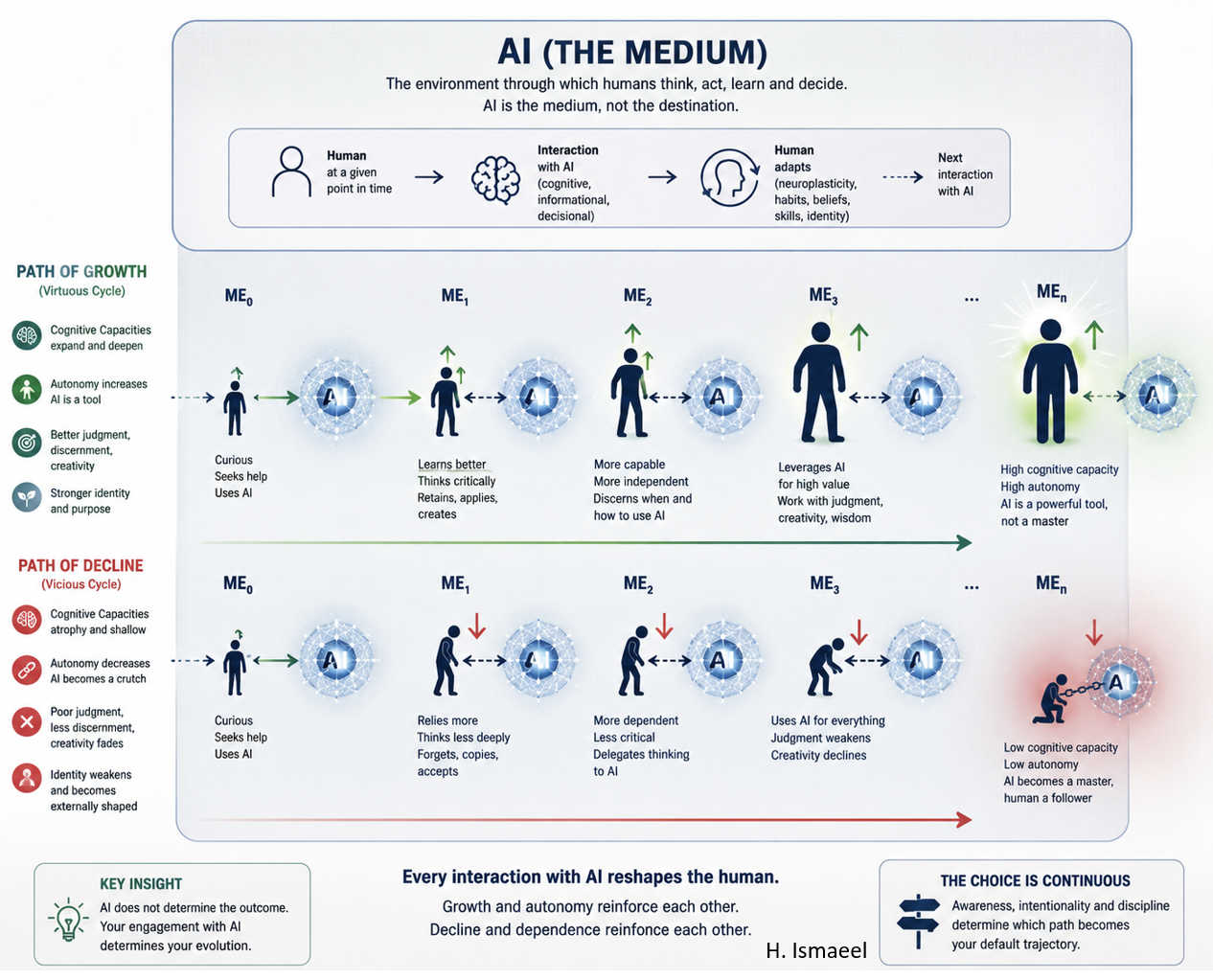
Every interaction with AI follows a deceptively simple sequence:
me → AI → ME
The first “me” is the person approaching the technology. The final “ME” is the person who emerges after interacting with it. The question is whether that final self is larger or smaller than the one who began the interaction.
One path leads toward cognitive enhancement. We continue exercising critical thinking, preserve our capacity to evaluate the validity and quality of AI-generated outputs, and use AI to challenge rather than replace our reasoning. By harnessing the brain’s lifelong neuroplasticity, AI becomes a catalyst for stronger judgment, deeper understanding, and greater creativity. The final “ME” is enlarged, not because AI thought for us, but because it enabled us to think better.
The alternative path is more subtle. We gradually relinquish our autonomy, become less critical of AI-generated answers, delegate larger portions of our reasoning, and slowly weaken the very capacities that distinguish human intelligence: discernment, creativity, judgment, and wisdom. At some point the relationship quietly reverses. AI no longer functions merely as a tool that we use; it becomes the medium through which we increasingly think.
Social media offers an important warning. Used intentionally, it remains a useful communication tool. Used passively, it becomes an environment that shapes attention, relationships, and even one’s perception of reality. Recent scholarship has associated excessive social media engagement with rising anxiety, distorted social comparison, and the phenomenon described as the “anxious generation.” The concern was never simply the technology itself. It was what happened when the medium began reorganizing human cognition and behavior.
Artificial intelligence has the potential to become a far more pervasive medium than social media because it does not merely mediate communication; it increasingly participates in reasoning, memory, creativity, and decision-making. If AI becomes the environment within which we routinely think, its influence on future generations may be considerably deeper than that of any previous digital technology.
This suggests that protecting cognition should become a deliberate societal objective rather than an afterthought. Just as public health eventually recognized the importance of preserving physical fitness in an age of mechanized transportation, the age of artificial intelligence may require an equivalent commitment to preserving cognitive fitness. Critical thinking, independent judgment, creativity, reflection, and moral reasoning may become capacities that must be intentionally exercised rather than incidentally maintained.
The future of AI, therefore, may not ultimately be determined by algorithms alone. It may be determined by the millions of small decisions made every day by people who unknowingly repeat the same sequence:
me → AI → ME
Whether that final “ME” becomes wiser, more capable, and more autonomous (or more dependent, passive, and diminished) may become one of the defining questions of this century.
Hussain Isma’eel is a cardiologist and head of cardiology at Aman Hospital in Qatar, with subspecialty training in cardiac imaging from Harbor-UCLA Medical Center and the Cleveland Clinic. He holds an academic affiliation with the University of Balamand.

He has more than a decade of experience in health care leadership, quality improvement, and artificial intelligence. He holds a postgraduate diploma in applied health care economic and technology evaluation from the University of South Wales and a Lean Six Sigma certification in health care from Emory University.
Isma’eel is the cofounder of HEALTECH and SOLVIT, where he leads the development of AI-powered health care solutions. His work spans cardiovascular imaging, health care operations, AI implementation, and digital health innovation. He has authored numerous scientific publications, holds patents in AI applications for cardiovascular medicine, and is actively engaged in advancing the safe, ethical, and effective integration of artificial intelligence into clinical practice and health care systems.
He shares updates on LinkedIn.