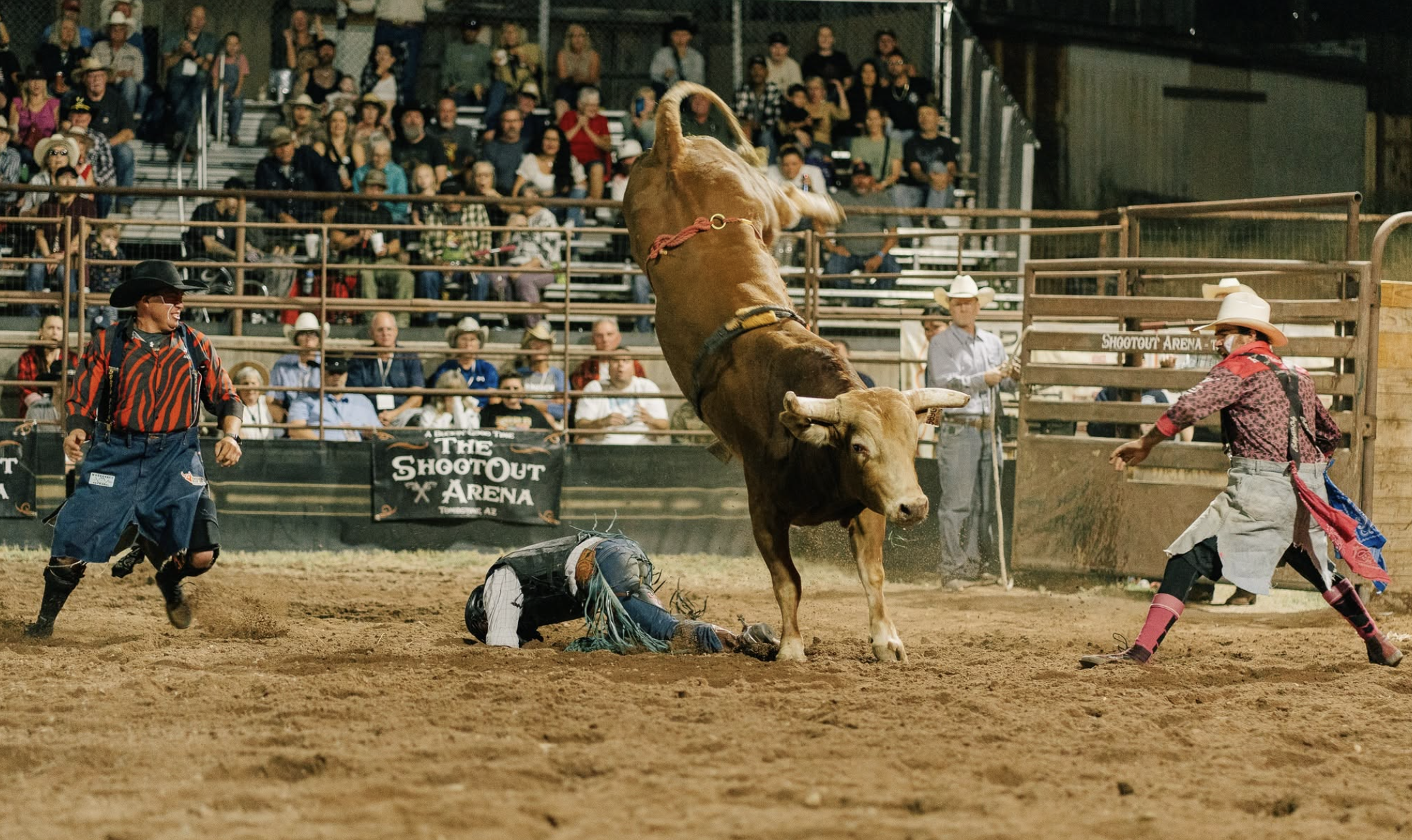
It was our first night at a bull riding event, Shoot Out Arena in Tombstone, Arizona, an August night, and I had no idea yet what any of this actually looked like up close.
We were sitting beside the chutes in the VIP section. The rider gave the nod, the gate swung open, and the clock started. Bull and rider came out together already bucking. Two seconds. Three. Then he was thrown, and for a moment all we could see was dust and a rider on the ground.
What happened next moved fast. The bullfighters pulled the bull’s attention and gave him room. He got up, climbed the fence, waited until the bull was clear, then climbed down holding one arm against himself and walked to the back of the chutes.
Old habits do not turn off just because you are a spectator. Years of standing on sidelines train you to watch how an athlete moves before they know anyone is watching, how they carry weight, what they protect, what they do not trust. I watched him peel his shirt off with one arm, the other pinned close. That told me plenty before anyone said a word.
Real physician voices, twice a week
Free, and one click to unsubscribe.
Then EMS arrived. They did exactly what they were trained to do. They checked his blood pressure, pulse, oxygen saturation, asked the right questions, and offered transport. He sat scrolling his phone, barely engaging. He was not being rude. He had simply been here before. He knew what this was and what it was not. What it was: emergency protocol. What it was not: treatment for the thing that was obviously wrong.
His shoulder was out.
A dislocated shoulder is not a heart attack. It is not the kind of injury EMS is designed to definitively treat behind the chutes of a rodeo arena. They asked whether he wanted transport. He said no. He signed the form declining. They packed up their bags and left, every box checked and the actual problem untouched.
He asked another rider to buy him a beer, liquid courage. He chugged it, then looked at a nearby telephone pole and worked through his next plan: shove his own shoulder back into place against something solid, since as far as he knew, nobody else was coming to fix it.
A family member traveling with me turned and said, “You have to do something. You know you can help him.”
I asked security to relay a question: Would he let a sports medicine physician take a look? He nodded. The gate opened. Thirty seconds later the shoulder was back in.
That was the night I stopped seeing bull riding as spectacle and started seeing it as a sports medicine problem hiding in plain sight.
What stayed with me was not the reduction itself. It was what the night exposed. Emergency standby was there for catastrophe. But the injuries that happen almost every event, dislocations, sprains, wrist injuries, knee pain, the things that do not need a hospital but absolutely need someone who knows what they are looking at, belonged to no one.
Most of what I treated was predictable once you understood what the ride demanded. Bull riders squeeze hard through the knees to stay centered while pivoting back through the hips to absorb the buck. That combination produces a familiar list: medial knee pain, gluteal dysfunction, SI irritation, and wrist injuries from the one hand locked to the rope. Staying on for eight seconds looks chaotic from the stands, but biomechanically it is not chaos at all. It is leverage, force, repetition, and tissue being asked to hold far more than most people realize.
The riders had already built their own system because no other real system existed. They taped each other. They shared advice. Many had been raised in cattle ranching or veterinary worlds where self-reliance was simply how life worked. They did not like going to the ER. It was expensive, often unhelpful for the kind of injuries they had, and many felt judged when they showed up there in the first place. So they handled what they could themselves.
The older riders had a phrase for the whole philosophy: cowboy up. People hear that and imagine recklessness. What I saw was something more complicated. It was not bravado for its own sake. It was what happens when a group of athletes learns that if they do not absorb part of the cost themselves, nobody else is coming.
Most of these riders carry no insurance. Entry fees can run fifty dollars a ride. There is no team physician, no training room, no built-in rehab infrastructure, no system quietly absorbing the cost of injury in the background.
When riders were willing to come to my clinic, we treated them at no cost. PRP is an expensive treatment even for patients with resources, but in this population it made clinical sense. These were not men with ordinary wear and tear. They were breaking tissue down through overuse, training, repeated impact, and repeated return. If we were going to help them heal meaningfully, we had to offer something more than sympathy and a ride to the ER.
One of the sharpest contrasts in that world was this: Every bull is evaluated by a veterinarian after each ride, and each bull rides only once a night. The riders do not have that luxury. Depending on the event, they may ride more than once, stacking their odds against the same body over and over again.
The bull gets evaluated. The rider signs a form.
Medicine likes to imagine itself as something that happens inside buildings, governed by protocol, with the right box checked at the right moment. Sometimes the box gets checked exactly right, and the patient still needed something nobody in the room was trained to see.
Bull riding is not outside medicine. It is one of the places medicine should know how to stand.
Ann Lebeck is a family medicine and sports medicine physician, founder of BodyQore LLC, and a locums physician in urgent care and sports medicine. Her clinical background includes complex musculoskeletal pain, regenerative medicine, and military medicine. She served as a civilian sports medicine physician with the U.S. Army at Fort Huachuca, Arizona.
Lebeck writes about clinical reasoning, the body, and what modern medicine misses on Substack and KevinMD, where her essays examine institutional accountability to vulnerable patients, the toll of time constraints in primary care, the diagnostic harm of stopping too soon, and life as a physician on a COVID-free island. She is the author of the 2025 Zenodo preprint “Platelet-rich plasma for a Morel-Lavallee lesion,” and has a manuscript under review with Arthroscopy, Sports Medicine, and Rehabilitation. She shares updates on LinkedIn.