Friday nights are loud.
The student section is impossible to miss. Faces painted in school colors, homemade signs held high, voices already hoarse before kickoff. The marching band fills every pause with music while parents and grandparents search the field for familiar jersey numbers. I hardly notice any of it.
By the time the crowd begins finding their seats, I’ve already been watching the players, not their passes or their tackles, but them. Who is stretching differently than last week? Who asked to be taped before the game who didn’t need it last Friday? Who finishes a sprint, hops off one foot to take the force through the other leg, maybe limps for a step or two, and then recovers as though that little movement never happened? But I saw it. I’m not watching the game the way everyone else is. I’m watching the people who are playing it.
Sometimes an injury announces itself before the opening kickoff. Sometimes it waits until the fourth quarter. Either way, my week is only beginning.
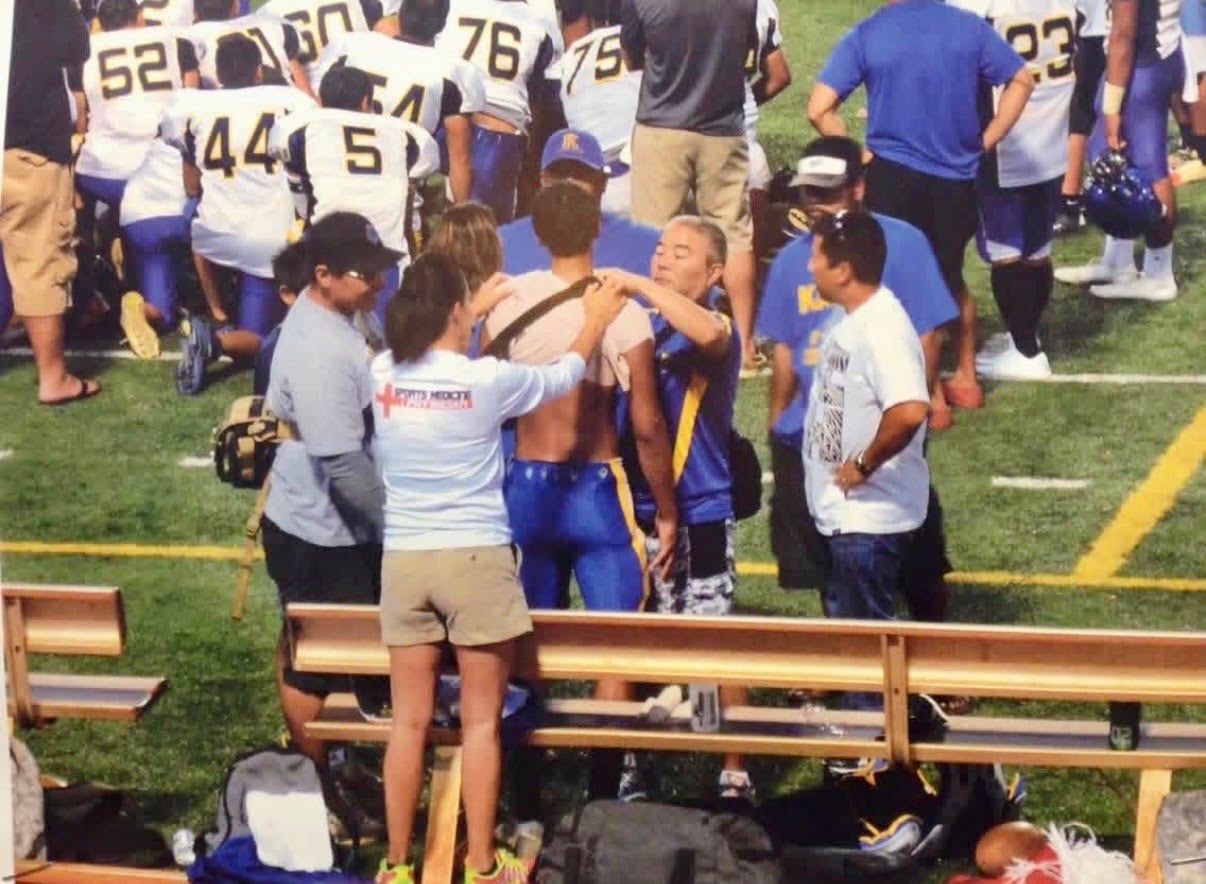
When an athlete goes down and the referee blows the whistle, the athletic trainers are already moving onto the field. Most of the time, I stay on the sideline because I know what they’re doing and I trust them. But I don’t take my eyes off them. If they need me, a subtle tap on the top of the hat or the head is all I need to see. Sometimes I don’t need the signal because I saw what happened: the collision, the twist, the way the athlete landed, or what happened when he tried to get back up.
Real physician voices, twice a week
Free, and one click to unsubscribe.
If what I saw concerns me, I’m already moving. And I don’t walk onto the field. I jog. Sometimes that field seems awfully long.
By the time I reach the athlete, the athletic trainer has already started the assessment and tells me what happened and what they’ve found. I get close to the athlete so he can hear me, talk to him, and examine him. Maybe it was a collision. Maybe he twisted something or fell. Maybe two players hit him at the same time. Just because he tells me his ankle hurts doesn’t mean I only look at his ankle. When someone is in that much pain, sometimes they can’t separate one area of pain from another.
So I take my time. We don’t rush this. It takes as long as it takes.
Most of the time, after a few minutes, we can safely help the athlete off the field. I finish my assessment on the sideline, the athletic trainer takes over, and I go back to watching the game. But before that athlete leaves Friday night, he has a plan. He knows what to do over the weekend, what we’re watching for, and when he needs to come back. He knows where he’s going Monday: back to the training room.
By the time I arrive Monday evening after leaving my sports medicine practice, the athletic trainers have already been dealing with these athletes all day. They know who is doing fine, who is already back at practice, and who isn’t progressing the way we hoped. I don’t need to examine every athlete we saw Friday night. I trust the athletic trainers to tell me who I need to see.
Those are usually the athletes whose return to play is still in question, the ones for whom we need to make a decision or give the coach some idea of what the week may look like. Our athlete from Friday night may still be on crutches with his ankle in a controlled ankle motion (CAM) walking boot. The trainer has already asked how his weekend went and looked at the swelling and bruising. Now I want to hear it from him.
How did the weekend go? Did he take anything for the pain? Did he stay in the boot? Did Mom or Dad take him to urgent care or their own doctor? If they did, that’s fine. I don’t care. I just want to know.
Were X-rays taken? What did they show? Then I examine him again. How much swelling is there now? Did he develop bruising? Where is he tender?
What can he do today that he couldn’t do Friday night? What still can’t he do? Sometimes the trainer and I look at that ankle Monday and both know there’s a pretty good chance this kid isn’t playing Friday. But I don’t need to ruin his whole week on Monday. “Let’s see what tomorrow looks like.” And probably one of my most common answers in medicine is, “It depends.” It does.
If we’re dealing with a swollen ankle, I’ll tell him, “Your job is to get that swelling down.” The trainer has a job. I have a job. The athlete has one, too. And if he can’t run because of his ankle, the rest of his body doesn’t get the week off. Put him on the bike. Get him in the pool. Keep working his upper body. I’m not going to let him lose his conditioning because his ankle is injured.
Then the athletic trainers carry the rest of the week. They’re doing the rehabilitation. They’re seeing him during his free period. They’re at practice. They see what happens when he starts running again, when he has to stop, cut, and change direction.
I may not see him again until Friday. If he progresses and does well at practice, he may be ready to play. Most of the time, we already have a pretty good idea by then. But there are always a few game-day decisions. And those kids want to play badly.
By the time I arrive Friday, he’ll tell me he’s ready. He’ll tell me it really doesn’t hurt that much. He may try very hard to convince me because he doesn’t care if he’s hurt. He wants to play football.
That’s where I push him: “I’m not worried about your pain.” That usually gets his attention. You play football. You were tackled by a 200-pound lineman. You’re probably going to hurt. What I need to know is whether you have the strength and function to protect yourself and do your job out there.
If I’m testing ankle strength, I’ll have him push hard against my hand. And when I say hard, I mean it. I may have him stand on that leg and hop twenty times because I don’t care only about the first hop. I want to see what happens at fifteen, eighteen, and twenty, when that ankle is getting tired. Does it stay strong, or does it start to give?
He isn’t going to be tested tonight by an examination table; he’s going to be tested by another football player. And if that ankle is going to collapse, I would much rather find out here than watch it happen at the 20-yard line.
Then comes the question from the coach: “Can he play?” That’s where the pedal meets the metal. Sometimes my answer is no. Sometimes it’s yes, but with limitations. And sometimes my answer is simply, “Yes.”
Three letters, but there is a whole week behind them. That yes means I saw what happened Friday night. I examined him Monday. The athletic trainers worked with him all week. I know how he did at practice, and I just pushed him hard enough to make sure he can protect himself out there. It isn’t a promise. It’s a medical judgment.
The lights come on again, the student section is loud, the band is playing, and the athlete I’ve been thinking about all week jogs onto the field. This is the guy I’m watching. I watch his first cut, his first tackle, and the first time he plants that injured foot without thinking about it. I’m watching how naturally he moves, whether he trusts the ankle, and whether fatigue starts to change the way he moves. The crowd sees Friday night’s game. I see an entire week.
And then another whistle blows. The athletic trainers are already moving onto the field. Another athlete. Another assessment. Another plan.
And before he leaves that night, he’ll hear me say it: “I’ll see you Monday.”
Ann Lebeck is a family medicine and sports medicine physician, founder of BodyQore LLC, and a locums physician in urgent care and sports medicine. Her clinical background includes complex musculoskeletal pain, regenerative medicine, and military medicine. She served as a civilian sports medicine physician with the U.S. Army at Fort Huachuca, Arizona.
Lebeck writes about clinical reasoning, the body, and what modern medicine misses on Substack and KevinMD, where her essays examine institutional accountability to vulnerable patients, the toll of time constraints in primary care, the diagnostic harm of stopping too soon, and life as a physician on a COVID-free island. She is the author of the 2025 Zenodo preprint “Platelet-rich plasma for a Morel-Lavallee lesion,” and has a manuscript under review with Arthroscopy, Sports Medicine, and Rehabilitation. She shares updates on LinkedIn.