The most important moment of a medical appointment usually happens at the very end, with a hand on the doorknob. Every physician knows the moment. The visit is over. The official reason for it (the refill, the checkup, the cough) has been handled. And then, as she reaches for the door, the patient pauses. “Actually, there’s one more thing.”
In thirty years as an OB/GYN, I have learned that the one more thing is almost always the real thing. It’s the reason she made the appointment, the truth she spent the entire visit deciding whether to say out loud. The refill was the cover story. The doorknob is where the secret lives.
An exam room is one of the last true confessionals in American life. Close the door and something changes in the air. People tell physicians things they have never told a spouse, a sister, a priest. Not because we’re wise, but because the room promises that what’s said here stays here, and that nothing said here will be met with shock. Whatever it is, we’ve heard it before.
So, they tell us. Affairs and paternity. Addictions kept for decades under the noses of loving families. Pregnancies no one knew about, and pregnancies that ended before anyone could know. Things done to them when they were young, carried so long that the silence has fused to the bone.
Real physician voices, twice a week
Free, and one click to unsubscribe.
The most dangerous secrets are the ones kept out of fear. The bruise explained a little too quickly, with a story a little too polished. The teenager who answers every question except one. The woman who waits until her husband steps out to take a call, then speaks fast and low, watching the door.
The silences have a texture. Any physician who practices long enough learns to hear them: a negative space in the conversation, the shape of the thing not being said. We’re trained to read what’s absent, the symptom not mentioned, the question not asked, the eye contact that breaks at one particular topic. The chart records what she said. It has no column for what she didn’t.
Suspense doesn’t come from what characters do. It comes from what they don’t say.
Every crime novel is, at its core, an economy of withheld information. The writer knows something the reader doesn’t. One character knows something another doesn’t. The tension on the page is simply the distance between what is known and what is spoken, and the reader turns pages to close it. The moment everything is said out loud, the story is over.
Real life runs on the same engine; it just runs slower. A secret kept in fiction is a plot. A secret kept in life is compound interest. The affair not confessed shapes thirty years of a marriage. The abuse not reported shapes the next victim’s odds. The symptom not mentioned, the lump, the bleeding, the fear, shapes a prognosis. In the exam room I have watched what silence costs when the bill finally comes due. It is always more than the truth would have cost on the day it was first withheld.
That’s why the exam room made me a suspense writer rather than a memoirist. The stakes I saw there weren’t abstract. Silence has a body count.
When I finally sat down to write a novel, people assumed I’d mine my career for procedures: the jargon, the technical authenticity, the way an OR sounds at 2 a.m. Some of that is in the book, because readers can smell a faked detail a chapter away. But the emotional truth came from the doorknob. From every woman who tested the air before deciding whether it was safe to speak. And from the harder question that haunts any physician who has practiced long enough: What happens to the woman who does speak, who finally says the true thing out loud, and isn’t believed?
Because that is the cruelest cost of silence. It isn’t only that women are afraid to talk. It’s that they have learned, often correctly, what talking gets them. The systems meant to protect them (hospitals, courts, families, churches) have a long tradition of hearing a woman’s testimony and calling it exaggeration, hysteria, confusion, or spite. And medicine, for all its good intentions, quietly rewards the silence: A patient who doesn’t complain is “doing well,” and a visit without a disclosure ends on time.
Silence isn’t a character flaw. It’s a rational response to a world that has taught women the price of speech. Every patient who hesitated with her hand on my doorknob was doing a calculation. That calculation is what I wanted to write about. Not the medicine. The arithmetic of whether the truth is safe.
Fiction, it turns out, offers something the exam room never could. In the exam room I could only receive the secret. I couldn’t follow it home and watch what it did at the dinner table. I couldn’t trace it back to its origin or forward to its consequence. Confidentiality, the very thing that made the telling possible, also meant the story ended at my door.
On the page, I can follow the secret all the way. I can give it a beginning, a cost, and, because I’m the one holding the pen, a reckoning. The women in my novel get what my patients so rarely got: the chance to be heard all the way to the end. And the reader gets to feel, for three hundred pages, what it’s like to know something and not be believed.
People ask why a doctor would turn to crime fiction, as if it were a swerve. It isn’t. It’s the same work continued by other means. For thirty years I listened to what women were afraid to say. Now I write it down.
The silence was always the story. I just needed a genre that knew what to do with it.
Renda Knapp is an obstetrician-gynecologist who has called Homer, Alaska, home since 2016. She brings three decades of experience to her practice and to her role as medical director of the OB/GYN department, and she is especially passionate about maternal health, hormone therapy, and gynecologic surgery. She earned her medical degree and completed her residency at the University of South Florida and is board-certified in obstetrics and gynecology.
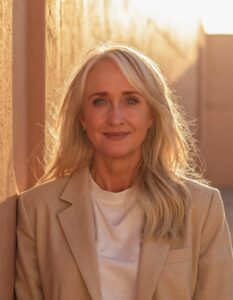
Knapp believes in compassionate care that meets women where they are. Even after thirty years in practice, she still considers it a privilege to be in the room when a baby takes their first breath. She also offers women’s hormone and health coaching through Dr. Renda’s Healthy Life.
Raised in Ohio and educated in Florida, Knapp is also a published fiction author and co-owns a peony farm in Homer with her husband, Dr. Edson Knapp. Together, they are the parents of seven adult children and grandparents of eight. She shares updates on Instagram and Facebook.