Edward Anselm is a board-certified internist with a long-standing focus on public health, tobacco control, and preventive care. He earned his medical degree from the Chicago Medical School at Rosalind Franklin University and completed his internal medicine residency at Montefiore Medical Center in New York. Over the past three decades, Dr. Anselm has served in senior leadership roles across clinical, corporate, and managed-care settings, including chief medical officer positions at HIP Health Plan of New York, FidelisCare, and Health Republic Insurance of New York.
Recently retired from his role as medical director at Aetna, Dr. Anselm continues to teach at the Icahn School of Medicine at Mount Sinai as a clinical assistant professor. His current work focuses on strengthening reimbursement pathways for tobacco cessation and preventive services, helping clinicians integrate evidence-based care that improves patient outcomes while supporting practice sustainability. His research has been published in the American Journal of Accountable Care, the American Journal of Preventive Medicine, AJPM Focus, and Health Affairs Forefront, including articles on tobacco control in accountable care, underbilling of cessation services, and the financial and quality benefits of treating tobacco use as a clinical priority.
Dr. Anselm’s educational and policy work is shared through EdwardAnselmMD.com and The Anselm Nicotine Prescription, with professional updates available on LinkedIn.
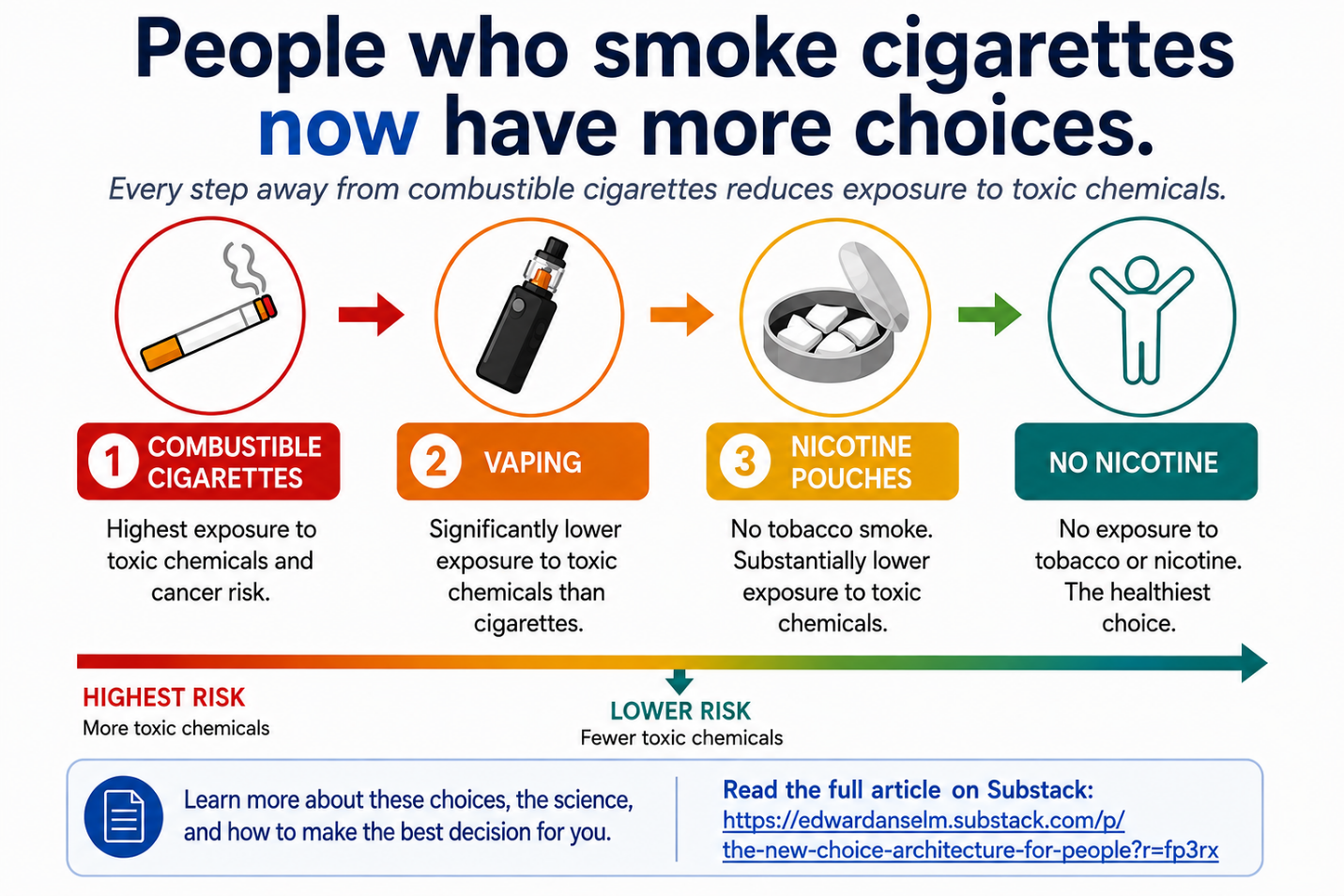
Until recently people who smoke cigarettes were presented with a simple choice: continue smoking and worsen the risk and severity of tobacco-related disease or make another quit attempt. The doctor would ask, “Do you believe that you are ready to quit smoking?” Both doctor and patient would be relieved when the answer was “no.” The doctor was given back some valuable time …
Read more…
Tobacco harm reduction changes the talk with your doctor
Anyone who uses social media is likely to encounter messages about tobacco harm reduction. This information comes from multiple sources with varying and overlapping agendas. At one end of the spectrum, the World Health Organization and most public health authorities emphasize the risks associated with nicotine in all forms. Their primary concern is preventing nicotine initiation among adolescents and young adults, thereby reducing future tobacco-related disease. At the other end …
Read more…
What’s missing from the tobacco harm reduction debate
Modern medicine can transplant organs, cure hepatitis C, and deploy artificial intelligence to read radiology scans. Yet one of the most effective life-saving interventions in clinical medicine, treatment for tobacco dependence, is still delivered inconsistently. More than 28 million Americans continue to smoke cigarettes. Evidence-based treatments are widely available, inexpensive, and highly cost-effective. But across health systems, physicians rarely deliver them in a systematic way. By every measure, physicians are …
Read more…
Improving tobacco treatment in clinical practice
Treatment of people who use tobacco is different. Most treatments given to patients are reasonably successful, but cigarette smokers who are trying to quit will make multiple attempts before they remain abstinent, sometimes as many as twenty. Within hours of stopping, nicotine users can begin to experience withdrawal symptoms which include craving, anxiety, irritability, and restlessness that continue to increase and can rapidly be relieved by another cigarette.
Some people trying …
Read more…
Learned helplessness and self-efficacy in tobacco treatment
If a new disease emerged and killed this many people, everyone would be talking about it. This death rate has been constant over the last decade, despite the declining prevalence of cigarette smoking. The decline in prevalence is, for the most part, due to reduced adoption of smoking by teenagers, and younger smokers have been shifting to vaping. The prevalence of smoking among older, poor, less well-educated, and rural populations …
Read more…
Tobacco treatment neglect: Why 25 million smokers are left behind
Health insurers have failed in their promise to deliver quality and value to the taxpayers, providers, employers, and their subscribers.
If you find a wasteful government program, isn’t there an obligation to foster a public discussion about it? Physicians for a National Health Plan (PNHP) has developed an analysis that reveals the waste in allowing private health plans to manage Medicaid medical services. According to PNHP, returning management of medical services …
Read more…
Health insurance waste: Why eliminating the middleman saves billions
As major public health agencies such as the Centers for Disease Control and Prevention (CDC), the Department of Health and Human Services (HHS), and state health departments face reductions in scope and resources, a unique opportunity arises for health insurers to take a leading role in improving public health, while also enhancing their own reputations and financial sustainability.
Consider tobacco use, the leading cause of preventable death in the United States, …
Read more…
Putting health back into insurance: the case for tobacco cessation
It was Christmas Eve 2005, and the health plan was closing at 3 p.m. By 4 p.m., the nurses, doctors, pharmacists, and support staff who handled utilization management for HIP Health Plan were already on their way home. My usual role at the health insurance company involved creating quality profiles for physicians caring for our roughly 1 million members. But that afternoon, I was covering hospital admissions so colleagues could …
Read more…
Home for Christmas: a physician’s tale of prior authorization