Subscribe to The Podcast by KevinMD. Watch on YouTube. Catch up on old episodes!
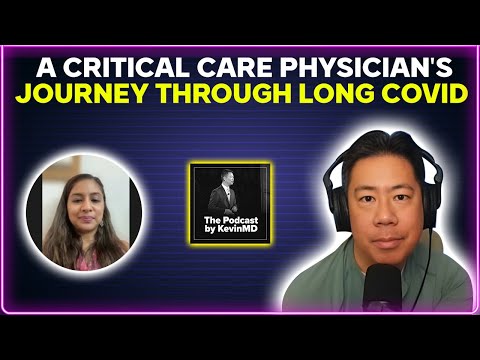
Join us for an insightful podcast episode featuring Sonali Mantoo, a critical care physician, as she shares her personal journey through long COVID. From her experience on the pandemic frontlines to navigating the complexities of long COVID symptoms, Sonali offers unique perspectives on resilience, coping strategies, and the importance of support for those affected by this challenging condition.
Sonali Mantoo is a critical care physician.
She discusses the KevinMD article, “Critical care physician battles long COVID with hope and grit.”

Our presenting sponsor is Nuance, a Microsoft company.
Together, Microsoft and Nuance are leveraging their rich digital technology and advanced AI capabilities to tackle some of health care’s biggest challenges. AI-driven technology promises to revolutionize patient and provider experiences with clinical documentation that writes itself.
The Nuance Dragon Ambient eXperience, or DAX for short, is a voice-enabled solution that automatically captures patient encounters securely and accurately at the point of care. DAX Copilot combines proven conversational and ambient AI with the most advanced generative AI in a mobile application that integrates directly with your existing workflows.
Physicians who use DAX have reported a 50 percent decrease in documentation time and a 70 percent reduction in feelings of burnout, and 85 percent of patients say their physician is more personable and conversational.
Discover AI-powered clinical documentation that writes itself. Visit https://nuance.com/daxinaction to see a 12-minute DAX Copilot demo.
VISIT SPONSOR → https://nuance.com/daxinaction
SUBSCRIBE TO THE PODCAST → https://kevinmd.com/podcast
RECOMMENDED BY KEVINMD → https://kevinmd.com/recommended

ADVERTISEMENT
GET CME FOR THIS EPISODE → https://earnc.me/WscWNu
Powered by CMEfy.
Transcript
Kevin Pho: Hi, and welcome to the show. Subscribe at KevinMD.com/podcast, and get CME for this episode by clicking on the CME link in the show notes. Today we welcome Sonali Mantoo. She is a critical care physician. Today’s KevinMD article is “Critical care physician battles long COVID with hope and grit.” Sonali, welcome to the show.
Sonali Mantoo: Thank you, Kevin.
Kevin Pho: We’ll talk about your article in a little bit. First off, briefly share your story and journey.
Sonali Mantoo: So I am an ICU physician. I was born and brought up in India. I moved to the United States to do my residency in internal medicine, followed by a fellowship in critical care and then simulation education. For most of my time in the United States I’ve spent it in New York City, briefly in St. Louis, in Connecticut.
And the pandemic front lines was an exciting experience. I actually served in Mumbai with MSF, or Doctors Without Borders, because I was on a sabbatical in India during that time. And then for the second wave of the pandemic I was in New York City working in my job on the front lines, when I got COVID, probably two and a half years after the pandemic first started. And this is after four shots of the vaccine, so I had two of Covishield in India and two of the Pfizer in New York, and still managed to get Omicron, and then got stuck with long COVID.
Kevin Pho: All right, so you talk more about that story in your KevinMD article, “Critical care physician battles long COVID with hope and grit.” So tell us about your experience with COVID. When you initially got infected, how did it feel, and what did it feel like as it transitioned into long COVID?
Sonali Mantoo: I honestly just had mild COVID, which felt very much like the flu. I was at home with mostly normal vital signs, just a low grade fever, very fatigued though. And one was isolated, but living in New York City, everything comes to your doorstep. I was so tired that I would even get my morning coffee delivered, that’s how bad it was. And then I had this hacking cough, so I wouldn’t even get on the phone, didn’t feel like even watching TV, so I was sleeping most of the day. Never had the need to go into the hospital, I just had an urgent care visit.
I was 41 at the time, I’m 43 now, and fairly fit, doing yoga and dance, and an active doctor in an academic institution. So I was confident that I would get over it pretty quickly. Until I couldn’t even stand to shower, I had to sit down to wear my clothes, and I was breathless trying to make a cup of tea. And I started freaking out, like, did I come down with myocarditis or pericarditis?
Actually I probably wasn’t as worried, because of the thick brain fog, but my colleagues were, because I wasn’t really able to come in to work. And when I did, I would see a patient and then lie down, and then see a patient and lie down. Somehow sitting didn’t give me the same feeling of being rested. And then when there was a code blue I would sit down to run the code, and then I was like, this is not sustainable. So then I went for an extensive workup, and maybe a couple of weeks in was diagnosed with long COVID.
Kevin Pho: So tell me about that workup. You weren’t getting better, you said that you wouldn’t feel rested unless you lie down, you’re running codes sitting down. So tell me what happened next. What kind of doctor did you go to, what kind of workup did you undergo?
Sonali Mantoo: So lucky for me, obviously I have access to the best resources. I was immediately plugged in with a cardiologist, a pulmonologist, heads of departments. And I guess the initial suspicion was I had some cardiac issue, because I was actively struggling to maintain some level of endurance. I couldn’t even walk 10 or 20 feet without being short of breath and fatigued, and for someone as fit as me that was an alarming sight to even watch. So I took my hiking pole as a walking stick.
And so they did the usual, they did an echo, they did a CT angio to rule out pulmonary embolism, a DVT study to rule out an acute clot, and then just basic lab panels. And everything, absolutely everything was normal, except for a slightly high D-dimer, which of course isn’t very indicative of anything, except that I had an acute infection recently.
So after a lot of discussions, and there had been a recent study called the MICHELLE trial which had suggested 10 milligrams of rivaroxaban, an anticoagulant, for so-called young athletic individuals who were stuck with this debilitating form of long COVID. And we all thought long COVID was associated with people who were elderly, hospitalized, on the ventilator, on life support, and this was a relatively new phenomenon, to have somebody who was functionally independent at baseline. I wasn’t sick enough to be admitted to the hospital, but I wasn’t well enough to really function on my own.
So they started the rivaroxaban, and I did make an incremental improvement with a lot of tweaks in my lifestyle. So by that I mean everything came to my house. I used to live alone and I would order everything, I stopped socializing. I very carefully compensated for it. I would go to work but then I wouldn’t take the stairs ever. For rapid response, my colleagues knew that somebody had to show up before me. I wouldn’t do any procedures, I would just sit down and instruct the fellows. So it was a fair amount of compensation to look normal. And that lasted for six months before I went on disability.
Kevin Pho: So at what point did you realize that you couldn’t work with your condition?
Sonali Mantoo: So six months into this initial phase I did make an improvement, and even managed to take a flight and go to California for a holiday, which was probably not advisable at the time because it wore me down, and I was exposed to COVID there, unfortunately, again. And so when I came back to New York, which I managed to, once again that reexposure completely set me back to square one. So I had contracted Omicron in January, and then by August I felt exactly like how I felt in January.
So then the repeat workup was done, echo, DVT study, pulmonary embolus rule out, same exact results. But this time I was seen by the long COVID research group at Sinai, and that to me was a huge blessing, because it’s run by a group of physiotherapists who have made this their specialty. And when I went in to see them, when I could, because most of the time it was all telehealth and virtual visits, I was tested positive for POTS, the postural orthostatic tachycardia syndrome. And that was the first time I actually had any tangible evidence of an objective abnormality. So my heart rate just spiked to 140 on standing, so clearly I wasn’t able to stand, and that explained why I had to keep lying down between patients.
And then I was introduced to terms like dysautonomia, and ME/CFS, or myalgic encephalomyelitis and chronic fatigue syndrome, that happens in post viral cases, and it can last for years, but they do get better, and it’s very debilitating. And something called PEM, so post exertional malaise, which is extremely different from fatigue, like one just crashes after a period of overexertion.
So my whole trip to California, being exposed to COVID again, just dialed it back to square one. And I still went to work, even though my doctor told me, you have to file for disability. I didn’t believe her. And then when I was at work on an ICU shift, I was breathless, and I tried to use oxygen and it did nothing for me. I was surprised, because my saturations were 99 percent and I was breathless, and I was like, this can’t be in my head, because I physically can’t move. It was like a resistance to movement. So that was the end of that. That was September 2022, and I haven’t been back since.
Kevin Pho: So tell me about the time period between September 2022 and now. Have you made any noticeable improvement, are you getting worse, has your improvement plateaued? How are you now compared to that time?
Sonali Mantoo: Definitely better. And the misleading part of this so-called invisible disease is, one tends to look and sound normal. So over a video call I’m often told how great I look, or how much of a discrepancy there is between my symptoms and the way I present. But one has to be with me during a normal day to see how long I take to perform ADLs, or activities of daily living, like taking a shower, brushing my teeth.
The way the recovery was explained to me is that it’s a sinusoidal curve, so it comes and goes, very much like an autoimmune relapsing remitting condition. There will be flare-ups, and those flare-ups can be brought on by infection, a period of overexertion, and then you’ll be set back.
So I would say definite progress, no doubt about it. Just not able to sustain that progress long enough to be able to either live by myself or go to work, and to me those are the two hallmarks of complete recovery.
Kevin Pho: Are you still seeing a long COVID clinic?
Sonali Mantoo: Yes, absolutely. I have a slew of doctors, but the main providers who really have seen me through the whole spectrum of this long COVID, one is a long COVID clinician, he heads the long COVID clinic in New York City, and then I have a rehabilitation physician who also sees a lot of long COVID.
Kevin Pho: And as we’re speaking today, in the beginning of April 2024, are there any proven treatments that help with long COVID?
Sonali Mantoo: A million dollar question. Pacing. If you’re looking for pharmacological treatment, no, the answer is no, none. Everything is experimental, and I’ve been through so many of these experimental treatments, one after the other. I try to do one thing at a time so I can tell whether it’s making a difference or not.
We have learned a lot from SARS and MERS, and those who are left with debilitating ME/CFS, POTS, post viral sequelae syndrome, or from other viruses like Lyme disease or anything else, how to manage ME/CFS and live with it. But treatment wise, to my knowledge, rest, pacing, physiotherapy, and really tweaking your lifestyle to just adapt to a new baseline, if you will.
Another thing long COVID has done is it has brought up any latent, dormant conditions that you might be susceptible to. So if you had a predisposition to cardiac issues or hypertension or rheumatoid arthritis or some other genetic issues, then chances are you probably have to rule out the presence of those, get tested for them. And that’s what I did, because my initial symptoms were terrible joint pains, and then I have a family history of rheumatoid arthritis. So I had to go through all that to make sure it’s nothing but long COVID. And even just being in my 40s, I had to make sure it wasn’t coronary disease or onset of something else.
Kevin Pho: Now, when you talk to your clinicians today, what kind of prognosis are they giving you? What can you expect going forward?
Sonali Mantoo: Well, I’m told I have a really good chance of making a full recovery based on the progress I have made in the last 24 months of long COVID, with a very fit baseline and sustained motivation and a hell of a lot of support from my loved ones, and of course my access to resources, which I know makes me a very privileged long COVID patient.
The first time I saw a long COVID specialist, he told me, you could very well live like this for the rest of your life. And I was gasping for air at the time, holding my walking stick, and I told him, that’s not a very nice thing to say to somebody who’s struggling. And he’s like, well, I just need you to be prepared for the worst.
The thing is, I don’t think anyone has enough data to say either way. And I’ve learned a lot from my peers, so long COVID patient experts are just as useful, if not more, than the clinicians that I’m seeing, because they are speaking from experience.
And my biggest source of hope and inspiration is a 25-year-old male long COVID survivor who I met a few months ago, and he’s running half a marathon now. He contracted long COVID back in 2020 when there wasn’t even a term for it, and went through the whole rigmarole of going through tests and experimental treatments. And he’s studying artificial intelligence in Belgium, but he sounded more like a doctor than anyone else I have met. And just seeing his progress, I get it, he’s 20 years younger than me, but I just felt that there are people who make that kind of progress, and my hope is that I will too.
Kevin Pho: Now, by sharing your story and perhaps clearing up any misconceptions about long COVID, what are some of the messages that you want viewers to come away with after hearing your story?
Sonali Mantoo: Long COVID is real. Real. Please believe people who tell you they’re not able to articulate exactly how they feel, or they feel under the weather and they can’t put a word to it or adequately explain their symptoms.
Because, I don’t want to compare it to mental health, but just like how mental health faces this sort of disbelief because you can’t really show a shoulder fracture sling to garner the same kind of empathy and compassion, long COVID is very similar. Unless you spend a whole day with somebody who’s going through long COVID.
I am often asked this question by my own loved ones who are there for me, what do you do all day, Sonali? I’m like, my day is filled with being an ICU physician and still running a household and going out and having a social life and keeping in touch with all my friends and family, maintaining good relationships and traveling. My day is still busy. It’s just that everything is done at a much slower pace, very deliberately, very mindfully.
And this is coming from someone who has relentlessly pursued wellness practices, just given my life experience in my profession, and therefore I’m able to keep my head above water and even speak to you on this podcast. If I’m speaking to you now, continuously able to engage over a Zoom call, it means I have used oxygen, rested, saved up my spoons of energy in order to make this conversation happen. So please don’t underestimate, to whoever is watching this, the amount of work that goes into saving up before we make an appearance in any social setting.
Kevin Pho: We’re talking to Sonali Mantoo. She’s a critical care physician. Today’s KevinMD article is “Critical care physician battles long COVID with hope and grit.” Sonali, we’ll end with your take-home messages to the KevinMD audience.
Sonali Mantoo: Just be kind to each other. We are all fighting battles that we know nothing about, especially someone sitting right in front of you. And so keeping an open mind and being flexible and just being good to each other goes a long way.
And thank you for doing what you do, because before I made the decision to even move to the United States I was introduced to your blog, and I’ve been following it for very many years, and it has given me a lot of hope, direction, guidance, and validation, from the time that I was trying to become a resident and today when I’m trying to share my story as a patient. So thank you.
Kevin Pho: Well, thank you for sharing your story and your perspective and insights, and thanks again for coming on the show.