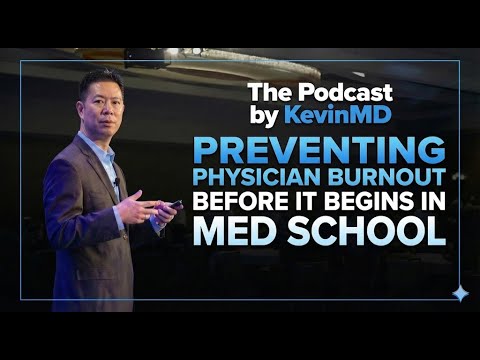
Subscribe to The Podcast by KevinMD. Watch on YouTube. Catch up on old episodes!
Urologist William Lynes discusses his article, “Teaching medical students what it is really like to be a physician.” He confronts the tragic reality of physician burnout and suicide, arguing the culture of overwork is bred into medical training from day one. William proposes a critical shift in medical education: a continuous course led by practicing physicians to teach students that maintaining their own mental health is essential to providing excellent clinical care. He shares his powerful personal story of learning this lesson “too late,” urging for systemic change to address physician mental health before it becomes a crisis. Learn why prioritizing clinician well-being is the most important lesson medical schools are failing to teach.

Our presenting sponsor is Microsoft Dragon Copilot.
Microsoft Dragon Copilot, your AI assistant for clinical workflow, is transforming how clinicians work. Now you can streamline and customize documentation, surface information right at the point of care, and automate tasks with just a click.
Part of Microsoft Cloud for Healthcare, Dragon Copilot offers an extensible AI workspace and a single, integrated platform to help unlock new levels of efficiency. Plus, it’s backed by a proven track record and decades of clinical expertise, and it’s built on a foundation of trust.
It’s time to ease your administrative burdens and stay focused on what matters most with Dragon Copilot, your AI assistant for clinical workflow.
VISIT SPONSOR → https://aka.ms/kevinmd
SUBSCRIBE TO THE PODCAST → https://www.kevinmd.com/podcast
RECOMMENDED BY KEVINMD → https://www.kevinmd.com/recommended
Transcript
Kevin Pho: Hi. Welcome to the show. Subscribe at KevinMD.com/podcast. Today, we welcome back William Lynes. He is a urologist. Today’s KevinMD article is “Teaching medical students what it is really like to be a physician.” William, welcome back to the show.
William Lynes: Yeah. Thank you, Kevin. Thank you for having me back.
Kevin Pho: All right. Tell us what your latest article is about for those who didn’t get a chance to read it yet.
William Lynes: Basically, it addresses the prevention of burnout by an educational program in medical school. Burnout is a major problem in America. It contributes to the decline in the quality of health care. Of course, we have an attrition rate of physicians which is really of epidemic proportions. I believe that we need to address this by education in medical school.
The term burnout was coined first by Herbert Berger in 1977. It is interesting because he was a psychologist who, while he had a private practice, was also active in free clinics in the New York area. He described what he called a syndrome, and he called it burnout. It is probably likely that he was talking about himself actually. He talked a lot about emotional exhaustion. Since that time, the definition of burnout has expanded a little bit to three pillars of diagnosis, which would be emotional exhaustion, depersonalization/cynicism, and the third being a lack of personal accomplishment.
There have been a lot of studies that have looked at that across America. Really, like I said, it is an epidemic problem. Over 50 percent of physicians have some element of physician burnout. Tragically, it begins in training; there is a very high incidence of it in training. It is a mental illness, basically. It results in suicide and suicidal ideation very, very commonly.
Most people are familiar with the 300 to 400 suicides per year in the physician community. People have said that is like a Boeing 747 going down every year, or it is basically one physician suicide per day. But we do not really know about the number of suicide attempts in terms of reputable statistics because suicide attempts in general are traditionally underreported. But you could do a quick calculation of what you would expect in terms of suicide attempts by taking the number of suicides (400) and multiplying it by the number of suicide attempts per suicide in studies just in general. I put that number at about 50. So if you multiply 50 times 400, you get 20,000 suicide attempts predicted per year across the United States. That means 2.5 percent of all physicians will be predicted to attempt suicide annually. I think that just gives you an idea of the magnitude of physician burnout.
Now, what do you do about it? Well, right now, we are doing things like having mental health access and so forth for physicians. But if you take my case, those things were really too late for me. Beginning in 1998, I had two catastrophic medical illnesses (I am bipolar). I was forced back into the middle of burnout. By the time I really knew I had a problem, accessing mental health and other things that were available to me was really too late.
As I look at it, I think that really medical students need to be educated about the risks of the profession that they are going into. This is from the standpoint of: “If you want to take excellent care of patients, you need to take excellent care of your own mental health.” I believe that because of the magnitude of the problem, we are looking at needing an institutional commitment to education, and I believe it should begin in medical school.
Kevin Pho: One of the interesting things that you wrote about in your article was that this continuous course of mental well-being needs to be taught by practicing physicians rather than mental health experts alone. Why do you make that distinction?
William Lynes: I always look back at my own experience. For example, I went to the University of Texas Medical Branch in Galveston, and they did a really good job in educating me in the mechanical things of medicine. But if they had occasionally said: “Well, you need to think about your own mental health,” and maybe even had a class, and it was taught by intellectuals, I am not sure I would have appreciated exactly what they were talking about.
No, I think that the practicing physician who is down in the trenches, who really knows about what we are talking about, needs to lead the discussion. Maybe they don’t give all the lectures or all the information. Maybe they invite guests from the therapeutic world, from the psychiatric world, from professorships, and so forth. But that is why I really believe, from my standpoint, that is who I would have listened to.
Kevin Pho: So what would that look like in terms of the curriculum? So rather than having it be an elective or a once-in-a-while thing, you recommended being part of the core continuous curriculum. Right?
William Lynes: I do. I think that it is such a major problem that we need to commit our resources to it. I think it needs to be a significant chunk of the medical school curriculum. Basically, you need to take care of your mental health or you are not going to be able to practice medicine correctly. I believe it needs to be running throughout the entire clinical years of medical school. I think that the basic sciences years maybe have a little introduction, but during the clinical years, I think that it should be a course.
I am not sure it should be required. I do not think there should be grades associated with it, but it should be available really on a frequent basis. In Galveston, we had a course that ran for several years on medical ethics. That was good. I needed an introduction to it, but I am not sure I needed a continuing course on that. I think we do need a continuing course that really introduces people to what the risks are of the profession that they want to go into.
Kevin Pho: In your article, you mentioned that a common thread for burnout is overwork. Why do you think medical culture is so resistant to changing that one core factor?
William Lynes: Well, I think that by the time you get into medicine, you are sort of bred almost culturally. When you think about it (again, I go to my own experiences), by the time I was in college, I was dedicated to spending every single minute that I could trying to prepare and trying to get into medical school. So I was an overworker even before I went to undergraduate, but I certainly was as an undergraduate. Then, of course, you want to get into medical school, so you overwork. You want to get a residency, so you overwork. Once in residency, it is sort of built into the system, and then that spills over into your practice.
I think we are all open to having people who aren’t overworkers, but the problem is it is sort of the people who come to the profession. I do not know what you do to turn off that. Even though I am retired now, I cannot turn it off very well. So yeah, it is a problem, but I think it is the common thread. I think burnout is a big umbrella. I think every person who has physician burnout is different. But I think a common thread—perhaps I have never seen a study, but I bet you find out—is that the great majority of people with physician burnout are overworkers. So it is sort of the common thread, and it would be nice to be able to treat that common thread. I think education is really the only way to do that.
Kevin Pho: If there was a core curriculum in medical school to address burnout, tell us some of the components or content that it would have to have.
William Lynes: Again, I think it should be led by practitioners in my area. They certainly were very, very open to instructing medical students, so I think that they would be available to do it. I think they need to introduce the concept of burnout: first of all, what it is, what the risk factors are, and why you are at risk for this. Then talk about some of the underlying causes such as substance abuse, family issues, and the fact of overwork, which certainly would be a big part of it.
Talk about what the preventative strategies are in terms of access to mental health therapy, in terms of being a well-rounded person, exercise, nutrition, and things like that. Then the bottom line is to just throughout the course be talking about the fact that if you want to be an excellent clinician, you need to take excellent care of your own mental health. So I think that there is a lot that could load this course throughout the clinical years of medical school.
Kevin Pho: We are talking to William Lynes. He is a urologist. Today’s KevinMD article is “Teaching medical students what it is really like to be a physician.” William, let’s end as we always do with some take-home messages you want to share with the KevinMD audience.
William Lynes: I think that we have a problem with health care in America just in general. We are spending more than any other developed country and we are getting less results. I think a big component of it is that we have a mentally ill workforce, and that mental illness is termed physician burnout.
I think that we should be willing to commit a large chunk of financial resources and time to preventing that. I think that the way to do that is by education that begins in medical school, and it is an institutional commitment. It would basically teach medical students that in order to be excellent clinicians, you need to take excellent care of your mental health.
Kevin Pho: William, thank you again for sharing your perspective and insight. Thanks again for coming back.
William Lynes: OK, Kevin. Thank you.