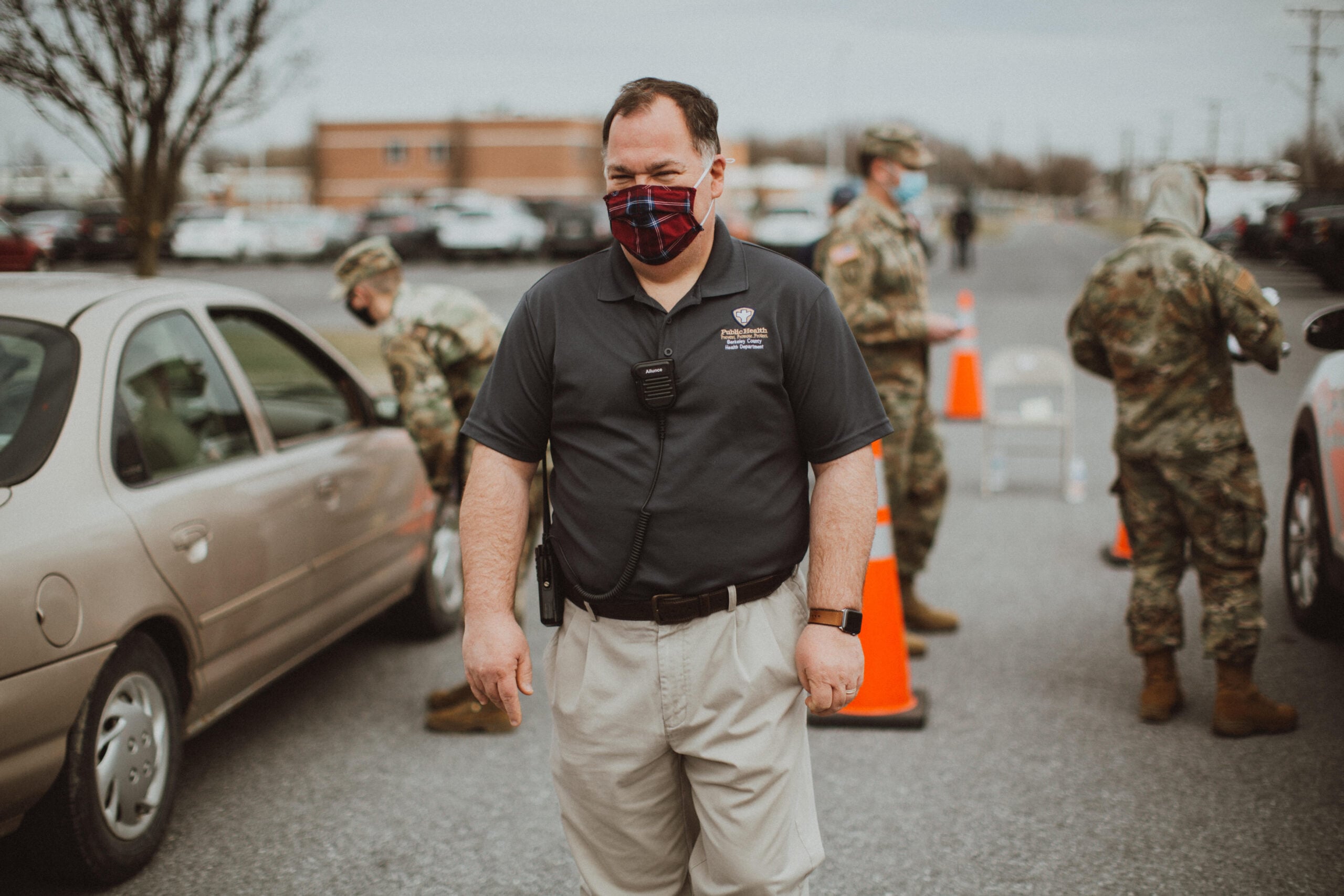
Standing in the middle of the parking lot of the Berkeley 2000 Recreation Center in February 2021, Molly Humphreys, in a single frame, captures an important moment in the public’s collective health, though it can be easily missed if we don’t pause and absorb its significance. In the chaos of 2025, it would be careless to not linger on this image.
A masked man greets the viewer and, without close viewing, it is easy to overlook who he is, what he is doing, and why he matters. In the background, three soldiers are also wearing masks and, while it is obvious this photograph is taken somewhere in America, generic orange traffic cones and asphalt do not differentiate which state this is. Cars in the parking lot are blurry and could be parked in my state, or yours.
In many ways, our subject, Bill Kearns, could be pedestrian, were it not for the radio hanging from his polo shirt which, on further inspection, says “Public Health.” He is standing in front of a STOP sign and, out of view, cars are lined up to receive COVID-19 vaccines inside a building hidden just out of frame.
Public health is unrivaled in how it has improved the daily lives of American citizens in the past century, the one that included victories in WW2 and, eventually, the Cold War. It is easy to, incorrectly, assume that, given its track record within our living memory, public health improvements are automatic, and not subject to change.
The 1906 Pure Food and Drug Act made it illegal to misbrand or adulterate food and was strengthened in 1938 with the Federal Food, Drug, and Cosmetic Act, which expanded the FDA’s ability to regulate food additives. Today, safe food can be found in grocery stores across the land with labels listing ingredients, manufacturer, and expiration dates.
Fluoride found its way into public drinking water beginning in Grand Rapids, MI, in 1945, and markedly decreased tooth decay and loss. Improvements to water sanitation drastically reduced typhoid and cholera, which had been common infections at the beginning of the twentieth century. With passage of the Highway Safety Act of 1966, safer roads and automobiles carried American families on the interstate highway system, providing freedom to explore this amazing country. The charming concept of the “road trip” has occupied a beloved space in the American psyche ever since.
Between 1900 and 1999, maternal mortality in the U.S. fell (get this) by a staggering 99 percent as public health improved hygiene, nutrition, access to care, and improvements in technology for pregnant women and their newborns. Without public health, would tobacco have been identified as a major threat to the public? In 1925, Americans consumed 1086 cigarettes per capita, a decade when tobacco advertisements encouraged us to “Reach for a Lucky Instead of a Sweet” so that we could “keep a slender figure.” Can you even imagine?
Safer workplaces and the reduction of infectious disease did not happen by accident. Public health officers, working mostly at the local level, have provided stewardship over lifesaving antibiotics and screening programs for a multitude of diseases, from TB to breast cancer. Most of this work is out of the view, but all of it has been for the public’s benefit.
Bill Kearns and the 167th West Virginia Air National Guard behind him were key players in a community vaccination event organized by the Berkeley and Morgan County Health Department during the COVID-19 pandemic. The success of this event was the result of a century of progress, one built on public-private partnerships and focused on community wellbeing. Countless organizations came together to protect the public during a time of international crisis. Campaigns like this one are a reason why many regard this country as great.
This is a series about Molly Humphreys and her impact on healthcare as the principal photographer for Healthcare is Human, a storytelling project based in Martinsburg, WV. Healthcare is Human can be found on social media and Humphreys’ commercial portfolio by searching for Piccadilly Posh Photography.
Ryan McCarthy is an internal medicine physician.