In 1983, The Outsiders featured Robert Frost’s “Nothing Gold Can Stay” and, augmented by Francis Ford Coppola’s cinematic genius, it planted a seed, one I was unaware of at the time.
Nature’s first green is gold,
Her hardest hue to hold.
Her early leaf’s a flower;
But only so an hour.
Then leaf subsides to leaf.
So Eden sank to grief,
So dawn goes down to day.
Nothing gold can stay.
The poem and the refrain “stay gold, Ponyboy” ignited a chemical reaction, one without much light or heat, silently inside me.
Tough, neighborhood boys, these outsiders grew into leading men and their high cheekbones dominated my 1980s childhood, and early adulthood in the 1990s. We met in an Oklahoma town, but Dillon, Swayze, Cruise, and Macchio became insiders in my West Virginia life. Karate Kid, Top Gun, and (my personal favorite) Kathryn Bigelow’s slick and glossy 1991 Point Break, these men were fighter jet pilots, mastered karate, slept with amazing women, and robbed banks dressed as Ronald Reagan. And all of them had been affected by the same poem, a fact that gave me permission to do the same.
Real physician voices, twice a week
Free, and one click to unsubscribe.
In 1989, Dead Poets Society featured poetry, this time spoken by Robin Williams’ character, John Keating. More than any singular poem, Mr. Keating embodied a radical literary ethos to boys at the exclusive Welton Academy. Tearing apart books was sacrilege perched on top of bravery and it gave me ambiguous feelings. I was not brave (then or now) and while I wanted to stand and shout “My Captain,” I identified with the characters who were too scared to participate. Keating’s gobsmacking edict: “What will your verse be?” How, exactly, was I supposed to do this?
As I made my vague teenage pledge to carpe diem, my life was swallowed whole by calculus, chemistry, biology, and physics. I flipped endless notecards, read thick textbooks, and, in the process, poetry and literature were shoved to the bottom of my battered L.L. Bean backpack. I lived in an analog age and my attempt to get into medical school was without the aid of tutors or YouTube videos. My quixotic quest to understand the Krebs cycle made me too busy to notice that my body absorbed Mr. Keating’s advice where it mingled with Robert Frost.
The crash
In 2002, I received my medical degree and, when my first son, Isaac, was born the following year, I was buckled into a family-sized roller coaster. Two other children, Liam and Eliza, followed and this doctor-father-family ride surged up one year and down another, so rapidly that much of it blurred. That is, until COVID-19 arrived in January 2020, when my life flew off the tracks, hung in midair for the briefest of moments, and crashed in the parking lot.
At that fraught moment, I was an internal medicine doctor on the frontline of a global pandemic in Martinsburg, West Virginia. For reasons that I can’t explain, I called photographer Molly Humphreys and invited her to help me document COVID-19 in our community. When she bravely said yes, I then approached radio producer Kym Mattioli, who was also keen to contribute. Together, we formed Healthcare is Human (HIH) and our goal was to tell first-person health care stories with photography and interviews.
In 2022, poet Renée K. Nicholson joined our team and shortly thereafter wrote “Doctor, Doctor” based on a black and white Humphreys photo, one in which I cradle a COVID-19 vaccine vial in my hands.
You’ve seen them: the hearts,
fingers curved and thumbs straight–
the vials in the Doctor’s hands,
a heart, cleaved in two, pierced.
What does Doctor see?
The worn mask has been hopelessly
cleaned, used until the using
makes it useless. When Doctor gets
to eat an apple a day, will he get a taste
response, or is that gone too? The hand heart steady–
what if Doctor is just a person, with a job,
with kids, hope, a spouse, a mortgage,
fears, a dog to run, earbuds
full of showtunes and podcasts. This Doctor
Is everydoctor. In a cosmic instant,
he watches the world tumble to the ICU tune:
whirs and chirrs and beeps and clanks,
symphony by the suffering. But we all
suffer and no one knows that better. Doctor, heal
me and perhaps also be healed. Hypnotic
stare, decoding a message through safety goggles
fogged, the soft pad of good-soled shoes
on linoleum, green-tinged fluorescents
overhead, in the day-night, or night day.
Who can tell? Time’s a concept
all used up. Message in a bottle:
Doctor, don’t despair. Just look. Daffodils
raise their bright yellow heads
even as you leave, dead hour in the dark,
heart-hands clasped around the steering wheel,
Instinct guiding you home.
Finding meaning in the verse
“What does Doctor see?” is a question I had, in one form or another, asked myself for 20 years and failed to answer. Nicholson’s poem beautifully expresses my long-held beliefs about the chaos of American health care. Embedded in the “symphony by the suffering,” I had failed to appreciate that the “chirps and whirrs” in the Berkeley Medical Center were a metronome marking the days of my life. What was this job doing to me? I yearned to understand my life’s arc, but I never took the time or created the space to reflect. That is, until Nicholson examined my medical career and assembled a yard sale of quotidian details that, once exposed, they were unavoidable, unrelenting, and unforgettable.
“What if Doctor is just a person, with a job” is the line that cracks me open, articulating my desire to shed the mantle of being a problem-solver, medical-fixer, counselor, social worker, and diagnostician. These weighty roles had swallowed me to the point that I was an emotional hostage to my patients. Was I a worker bee who buzzed around my small town, exclusively to solve their problems? For decades, I was too scared to demarcate firm boundaries, but Nicholson provides the agency for me to recognize that I am a regular, imperfect man, one who sings show tunes off-key, drives to work, and returns home to care for children and walk a dog.
“Doctor, heal me and perhaps be healed.” Reciting these words over and over I am encouraged to measure my life not through the lens of work but rather one of meaning. To acknowledge my own humanity (and be okay with it) is liberating. Primed by a youthful dose of Robert Frost and a teacher who assigned me homework, my cells were ready to receive Nicholson’s beautiful poem.
“Doctor, Doctor” lingers inside my cells, the ones worn ragged by the excessive vigilance required for raising children, a fact doubly true for health care, a “system” beyond my understanding. These words reside in my subcutaneous tissues as if they had been precisely injected with a needle. Under my skin, this poem acts like a literary helicase enzyme, changing my DNA, restoring pieces damaged by work, family, pandemic, grief, loss, life. I receive it as a man, one who could be found anywhere, healed by words. If I ran into Mr. Keating today I would share with him my observation about how funny life really is. After more than 30 years, in a pattern that seems familiar, I did not end up finding my own verse after all. A poet and her verse found me.
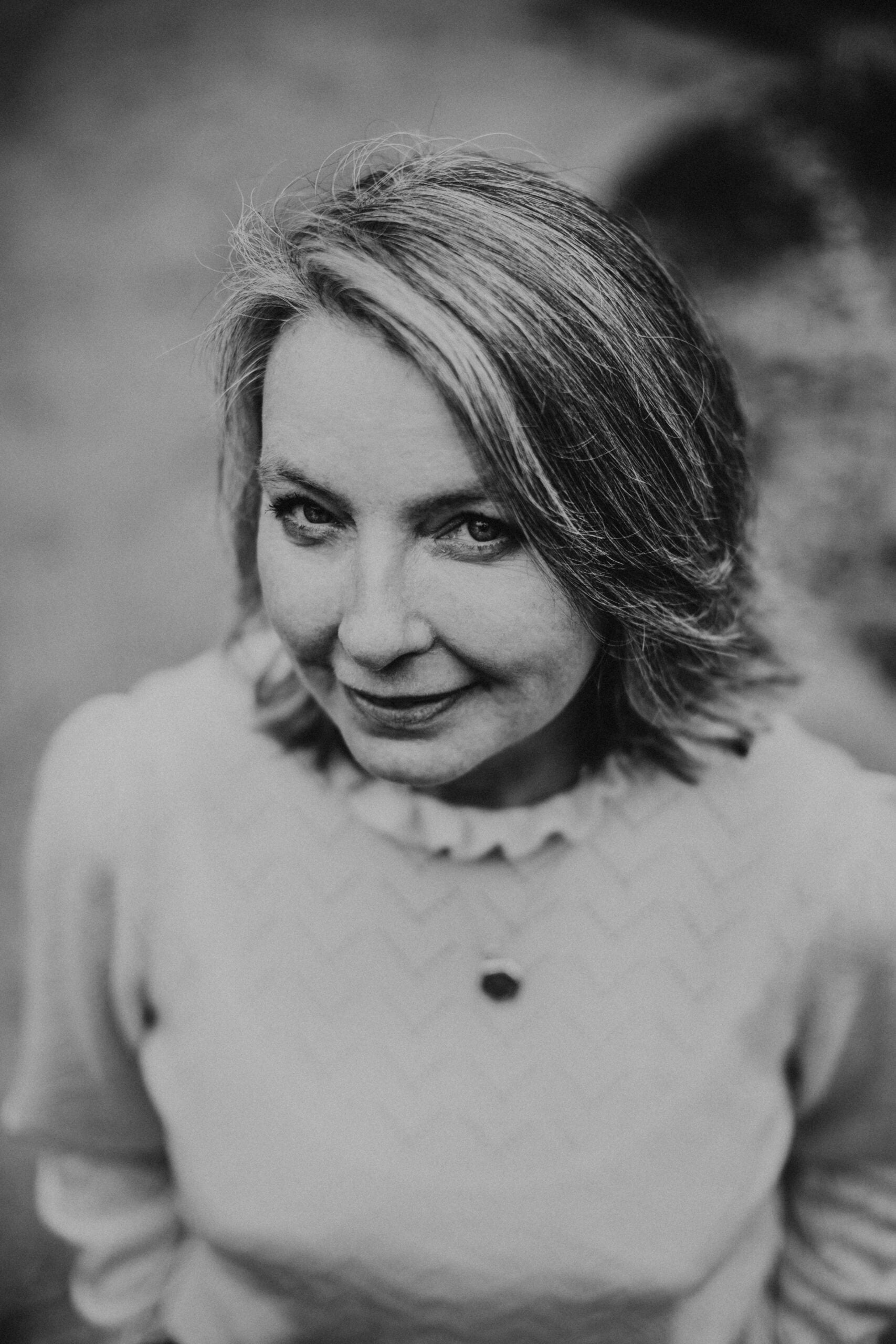
This article is part of an ongoing series about the photography of Molly Humphreys and her impact on health care. Renée K. Nicholson was photographed in 2022 in Morgantown, West Virginia, around the time she wrote “Doctor, Doctor.” Her latest collection of poetry, Feverdream, is inspired by health care and arrives in 2026.
Ryan McCarthy is an internal medicine physician.