Skip to content
  • About
  • Contact
  • Contribute
  • Book
  • Careers
  • Podcast
  • Recommended
  • Speaking
  • All
  • Physician
  • Practice
  • Policy
  • Finance
  • Conditions
  • .edu
  • Patient
  • Meds
  • Tech
  • Social
  • Video
    • All
    • Physician
    • Practice
    • Policy
    • Finance
    • Conditions
    • .edu
    • Patient
    • Meds
    • Tech
    • Social
    • Video
    • About
    • Contact
    • Contribute
    • Book
    • Careers
    • Podcast
    • Recommended
    • Speaking

Why developmental and behavioral pediatrics faces a recruitment collapse

Ronald L. Lindsay, MD
Physician
December 14, 2025
Share
Tweet
Share

For two months I have staged testimony, written op-eds, and amplified coalition voices about the collapse of developmental and behavioral pediatrics (DBP). This piece is an epilogue, a reckoning with a specialty that once held promise but now clings to aspirational posters instead of actionable reform.

The poster problem

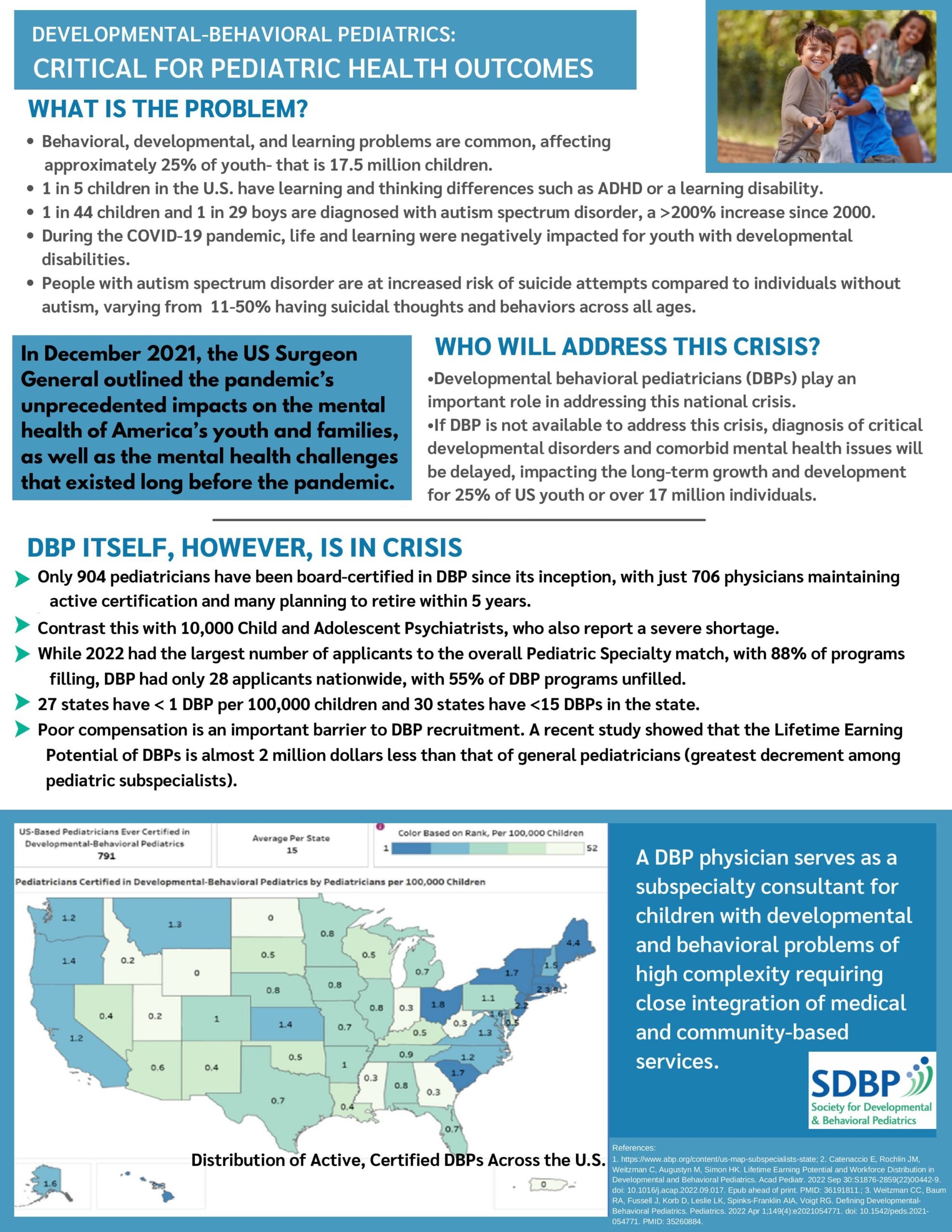
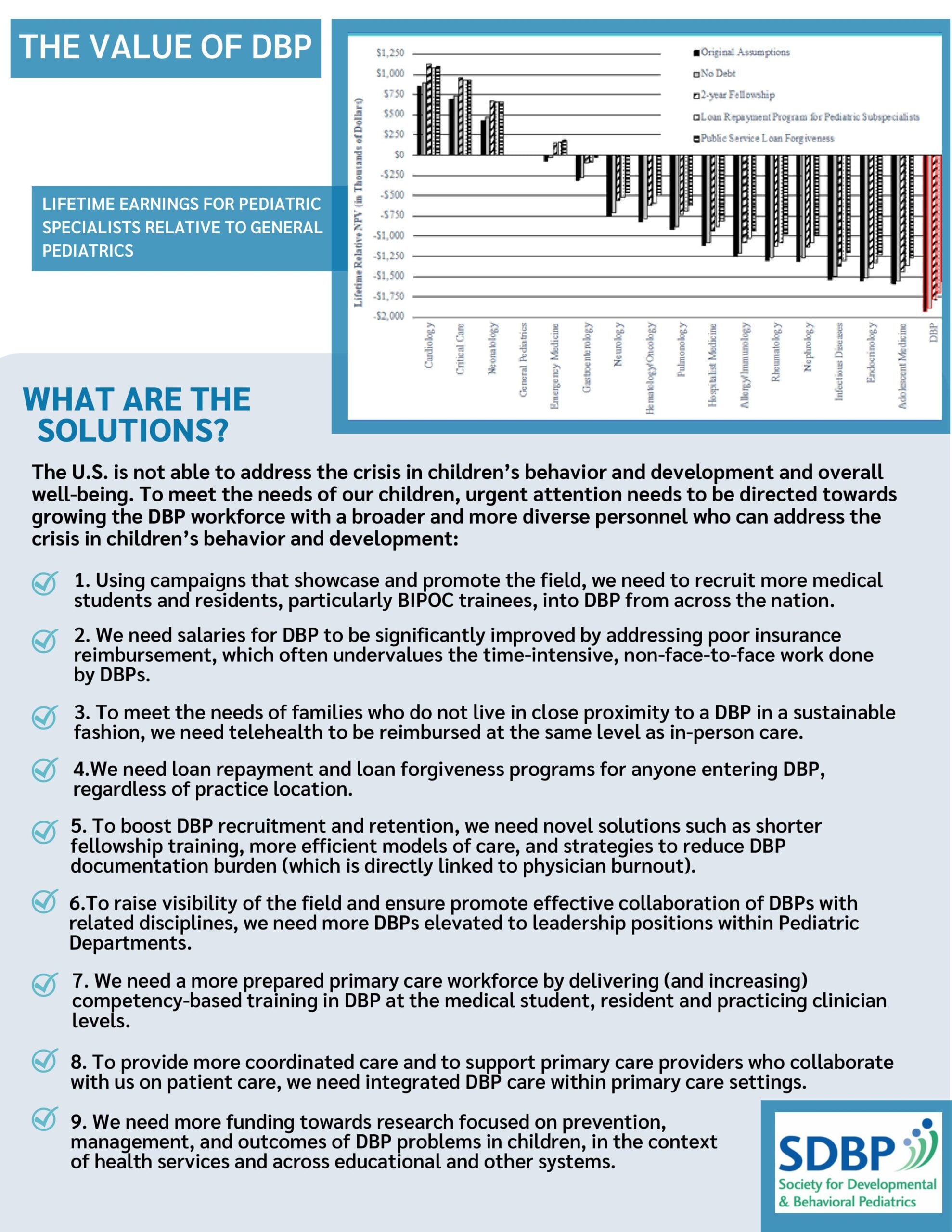
The Society for Developmental and Behavioral Pediatrics (SDBP) recently circulated a flyer titled Critical Outcomes in DBP. Page 2 lists “Solutions” to the recruitment crisis: recruit more BIPOC trainees, elevate DBPs into leadership, improve reimbursement, shorten fellowship training, expand telehealth parity, and increase research funding.

On paper, it looks hopeful. In reality, it is tone-deaf. These are slogans, not strategies. Posters, not pipelines.

The flyer itself admits the truth: DBP has the lowest “lifetime relative net present value” (NPV) of any pediatric subspecialty, nearly $2 million less than general pediatrics. That is not just a statistic. It is a deterrent. Why would any graduate, especially one from a disadvantaged background, choose a disadvantaged field? Cardiology, critical care, and neurology offer higher pay, stronger prestige, and clearer pathways to leadership. DBP offers lower pay, higher burnout, and weaker institutional support.

That is why the flyer belongs in the text of this discussion, because it illustrates the gap between rhetoric and reality. It should not be tucked away as decoration. It is evidence.
Leadership without action

This collapse is not new. DBP once had a seat at the leadership table of the American Academy of Pediatrics (AAP). James M. Perrin, Judith S. Palfrey, and Benard P. Dreyer (all DBP physicians) served as AAP presidents. Their tenure could have been transformative. They could have addressed reimbursement inequities, pipeline fragility, and institutional invisibility. Instead, they did squat.

Leadership presence without leadership action is theater. It gave DBP visibility but no leverage.

I contrast this with leaders outside DBP (Toni Eaton, Howard Pearson, Joel Alpert) who were not DBP specialists but appreciated DBP issues. I knew them well, through training programs and the Children with Special Health Care Needs task force. They understood the stakes. They respected the field. Yet even their advocacy could not overcome the inertia of a specialty unwilling to fight for itself.

My own path

I completed a two-year DBP fellowship. But before that, I had four years of practical experience in the United States Air Force. That frontline training gave me operational clarity: DBP needed structural fixes, not slogans.

When I applied for a LEND program, I did not submit a poster. I submitted an actionable plan: funded, interdisciplinary, measurable. LEND programs work because they are structured, resourced, and accountable. They recruit trainees by offering real incentives, not aspirational rhetoric.

That is the difference between action and aspiration. Between command and theater.

The pipeline illusion

In 2022, only 28 applicants nationwide applied to DBP fellowships. More than half of programs went unfilled. That is not a pipeline; it is a drip. Posters will not fix that. Loan forgiveness might. Reimbursement parity might. Funded interdisciplinary programs like LEND certainly will.

But slogans alone will not.

ADVERTISEMENT

The SDBP flyer’s “solutions” are tone-deaf because they ignore the economics. They ask BIPOC graduates (often carrying heavier debt loads) to enter a field with the worst financial outlook in pediatrics. That is not equity. That is exploitation disguised as diversity.

Why I stayed, why I still speak

I did not enter this field to get rich. I entered because I had both a calling to do something, and the gifts to get it done. For years, I carried that calling through fellowship, through service in the Air Force, and through practice. Eventually, I burned out and took early retirement.

I am comfortably settled now because I was prudent with money. But I never left the arena. I remain in the arena still, even as my body cannot keep pace with my mind in advocacy.

That is why I write. That is why I speak. Because DBP deserves better than posters. Families deserve better than slogans. Children deserve better than tone-deaf leadership.

And because when history records this era, it should not say that DBP collapsed without witness. It should say that some of us remained in the arena, calling for action when others settled for aspiration and inaction. I shall remain in the arena as long as my body and the good Lord allow me to bear witness.

Ronald L. Lindsay is a retired developmental-behavioral pediatrician whose career spanned military service, academic leadership, and public health reform. His professional trajectory, detailed on LinkedIn, reflects a lifelong commitment to advancing neurodevelopmental science and equitable systems of care.

Dr. Lindsay’s research has appeared in leading journals, including The New England Journal of Medicine, The American Journal of Psychiatry, Archives of General Psychiatry, The Journal of Child and Adolescent Psychopharmacology, and Clinical Pediatrics. His NIH-funded work with the Research Units on Pediatric Psychopharmacology (RUPP) Network helped define evidence-based approaches to autism and related developmental disorders.

As medical director of the Nisonger Center at The Ohio State University, he led the Leadership Education in Neurodevelopmental and Related Disabilities (LEND) Program, training future leaders in interdisciplinary care. His Ohio Rural DBP Clinic Initiative earned national recognition for expanding access in underserved counties, and at Madigan Army Medical Center, he founded Joint Base Lewis-McChord (JBLM) CARES, a $10 million autism resource center for military families.

Dr. Lindsay’s scholarship, profiled on ResearchGate and Doximity, extends across seventeen peer-reviewed articles, eleven book chapters, and forty-five invited lectures, as well as contributions to major academic publishers such as Oxford University Press and McGraw-Hill. His memoir-in-progress, The Quiet Architect, threads testimony, resistance, and civic duty into a reckoning with systems retreat.


Prev

Valuing non-procedural physician skills

December 14, 2025 Kevin 0
…
Next

Why senior-friendly health materials are essential for access

December 14, 2025 Kevin 0
…

Tagged as: Pediatrics, Psychiatry

Post navigation

< Previous Post
Valuing non-procedural physician skills
Next Post >
Why senior-friendly health materials are essential for access

ADVERTISEMENT

More by Ronald L. Lindsay, MD

  • A physician’s tribute to his medical technologist wife

    Ronald L. Lindsay, MD
  • Why true leadership in medicine must be learned and earned

    Ronald L. Lindsay, MD
  • Blackballing in medicine: a physician’s story

    Ronald L. Lindsay, MD

Related Posts

  • How medical students can handle vaccine hesitancy in pediatrics

    Adam Zbib
  • Behavioral health providers face challenges in value-based care

    Martin Lustick, MD
  • The government should establish a Youth Behavioral Health Advisory Council

    Mitchell Berger, MPH
  • Why aren’t more pediatricians leaning into rural health?

    Mick Connors, MD
  • A transformative year for GME recruitment: How the process has changed forever

    Jason Reminick, MD, MBA

More in Physician

  • Physician leadership communication tips

    Imamu Tomlinson, MD, MBA
  • Valuing non-procedural physician skills

    Jennifer P. Rubin, MD
  • The life of a physician on call

    Yelena Feldman, DO
  • Why physician business literacy matters

    Kelly Bain, MD
  • A physician’s tribute to his medical technologist wife

    Ronald L. Lindsay, MD
  • Does medical training change your personality?

    Arthur Lazarus, MD, MBA
  • Most Popular

  • Past Week

    • Why feeling unlike yourself is a sign of physician emotional overload

      Stephanie Wellington, MD | Physician
    • The U.S. gastroenterologist shortage explained

      Brian Hudes, MD | Physician
    • Physician leadership communication tips

      Imamu Tomlinson, MD, MBA | Physician
    • A leader’s journey through profound grief and loss [PODCAST]

      The Podcast by KevinMD | Podcast
    • How online parent communities extend care

      Jorge Rodriguez, MD | Physician
    • The inconsistent academic peer review process

      V. Sushma Chamarthi, MD | Physician
  • Past 6 Months

    • Direct primary care in low-income markets

      Dana Y. Lujan, MBA | Policy
    • The flaw in the ACA’s physician ownership ban

      Luis Tumialán, MD | Policy
    • Patient modesty in health care matters

      Misty Roberts | Conditions
    • The Silicon Valley primary care doctor shortage

      George F. Smith, MD | Physician
    • California’s opioid policy hypocrisy

      Kayvan Haddadan, MD | Conditions
    • A lesson in empathy from a young patient

      Dr. Arshad Ashraf | Physician
  • Recent Posts

    • Physician leadership communication tips

      Imamu Tomlinson, MD, MBA | Physician
    • Why senior-friendly health materials are essential for access

      Gerald Kuo | Conditions
    • Why developmental and behavioral pediatrics faces a recruitment collapse

      Ronald L. Lindsay, MD | Physician
    • Valuing non-procedural physician skills

      Jennifer P. Rubin, MD | Physician
    • How genetic testing redefines motherhood [PODCAST]

      The Podcast by KevinMD | Podcast
    • The life of a physician on call

      Yelena Feldman, DO | Physician

Subscribe to KevinMD and never miss a story!

Get free updates delivered free to your inbox.


Find jobs at
Careers by KevinMD.com

Search thousands of physician, PA, NP, and CRNA jobs now.

Learn more

Leave a Comment

Founded in 2004 by Kevin Pho, MD, KevinMD.com is the web’s leading platform where physicians, advanced practitioners, nurses, medical students, and patients share their insight and tell their stories.

Social

  • Like on Facebook
  • Follow on Twitter
  • Connect on Linkedin
  • Subscribe on Youtube
  • Instagram

ADVERTISEMENT

ADVERTISEMENT

  • Most Popular

  • Past Week

    • Why feeling unlike yourself is a sign of physician emotional overload

      Stephanie Wellington, MD | Physician
    • The U.S. gastroenterologist shortage explained

      Brian Hudes, MD | Physician
    • Physician leadership communication tips

      Imamu Tomlinson, MD, MBA | Physician
    • A leader’s journey through profound grief and loss [PODCAST]

      The Podcast by KevinMD | Podcast
    • How online parent communities extend care

      Jorge Rodriguez, MD | Physician
    • The inconsistent academic peer review process

      V. Sushma Chamarthi, MD | Physician
  • Past 6 Months

    • Direct primary care in low-income markets

      Dana Y. Lujan, MBA | Policy
    • The flaw in the ACA’s physician ownership ban

      Luis Tumialán, MD | Policy
    • Patient modesty in health care matters

      Misty Roberts | Conditions
    • The Silicon Valley primary care doctor shortage

      George F. Smith, MD | Physician
    • California’s opioid policy hypocrisy

      Kayvan Haddadan, MD | Conditions
    • A lesson in empathy from a young patient

      Dr. Arshad Ashraf | Physician
  • Recent Posts

    • Physician leadership communication tips

      Imamu Tomlinson, MD, MBA | Physician
    • Why senior-friendly health materials are essential for access

      Gerald Kuo | Conditions
    • Why developmental and behavioral pediatrics faces a recruitment collapse

      Ronald L. Lindsay, MD | Physician
    • Valuing non-procedural physician skills

      Jennifer P. Rubin, MD | Physician
    • How genetic testing redefines motherhood [PODCAST]

      The Podcast by KevinMD | Podcast
    • The life of a physician on call

      Yelena Feldman, DO | Physician

MedPage Today Professional

An Everyday Health Property Medpage Today
  • Terms of Use | Disclaimer
  • Privacy Policy
  • DMCA Policy
All Content © KevinMD, LLC
Site by Outthink Group

Leave a Comment

Comments are moderated before they are published. Please read the comment policy.

Loading Comments...