Listen and followApple PodcastsSpotifyYouTubeMore apps · Browse all episodes
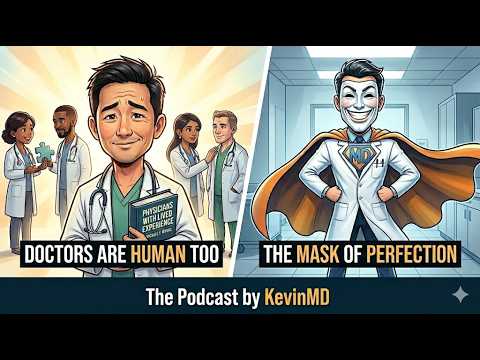
Professor of clinical psychiatry Michael F. Myers discusses his book Physicians With Lived Experience: How Their Stories Offer Clinical Guidance and the article “Breaking the silence: mental health and racism in medical school.” The conversation highlights the journey of Dr. Chris Veal, a Black gay physician who overcame a seven year depression and the trauma of losing five family members to COVID 19. Michael explores the intersection of academic pressure and systemic racism, detailing how a phone call to his godmother saved Dr. Veal from suicide. The discussion outlines Dr. Veal’s brave decision to publish his story in Academic Medicine despite warnings that it might hurt his career. Discover how authenticity and vulnerability can transform clinical practice and save the lives of others.
Partner with me on the KevinMD platform. With over three million monthly readers and half a million social media followers, I give you direct access to the doctors and patients who matter most. Whether you need a sponsored article, email campaign, video interview, or a spot right here on the podcast, I offer the trusted space your brand deserves to be heard. Let’s work together to tell your story.
PARTNER WITH KEVINMD → https://kevinmd.com/influencer
SUBSCRIBE TO THE PODCAST → https://www.kevinmd.com/podcast
RECOMMENDED BY KEVINMD → https://www.kevinmd.com/recommended
Transcript
Kevin Pho: Hi, and welcome to the show. Subscribe at KevinMD.com/podcast. Today we welcome Michael F. Myers. He is a professor of clinical psychiatry and he is the author of the book “Physicians With Lived Experience: How Their Stories Offer Clinical Guidance.” There is an excerpt from that book on KevinMD. Michael, welcome to the show.
Michael F. Myers: Thank you very much, Kevin. I am happy to be here.
Kevin Pho: All right, so let’s start by talking about your book and the excerpt itself. What led you to write it in the first place?
Michael F. Myers: OK. This is a book that has been brewing for quite a while, actually quite a few years. But I really began to focus on it in earnest over the last four years. Where it comes from is the fact that I have always been very moved by fellow physicians or medical students who have gone public with their stories of living with or being treated for a psychiatric illness.
As you know, Kevin, we live in a world where there is a fair amount of stigma, including the medical world. So I see these individuals as movers and shakers and pioneers in this area. Even though it has been going on for quite a while, there have been more people sharing their stories over the last five years or so.
Kevin Pho: That is wonderful to hear. One of the things I do on KevinMD for the last 20 plus years is to humanize physicians and allow them to show their vulnerability. They write articles, they appear on this podcast, and they share their stories. We need to let the public know that physicians are human too. We are more than just our degrees. Now, how did you find these physicians to interview?
Michael F. Myers: OK, so I have been collecting stories over the years. The ones that are published often appear in JAMA’s “A Piece of My Mind.” That is where I get a lot of them. I also find them in the New England Journal of Medicine and the British Medical Journal. Every so often you will see stories in the Washington Post, the New York Times, or the Australian press because this is a global book. I interviewed doctors from all over the world for this. So I just started collecting them and then I made the decision to reach out to them. I was already reaching out to them when I first read the stories to just thank them for writing their story and to tell them that they really help a lot of people who are struggling in silence. For many of them, Kevin, I circled back sometimes after many years to see if they would be interested in being interviewed for my book.
Kevin Pho: So are there any common themes that you picked up from interviewing all of these physicians regarding why they decided to share their story and some of the lessons learned from doing so? Any common themes that connect them?
Michael F. Myers: Thank you. Yes. That is a great question. Yes, indeed. One of the most common themes had to do with the fact that the individual was often feeling a little bit better or was recovered or recovering, and they learned of someone dying by suicide. It may not even be someone they knew in medicine. They just had this feeling that this has got to stop and that we have to speak out about this. They are aware that a lot of physicians delay getting help or don’t get any help at all. Some of those individuals do end up taking their lives. So that was a motivating factor for a number of people to go public with their story.
There is another theme that came through, and that had to do with correcting misconceptions about what illnesses are. For instance, with depression, so many physicians who have experienced it will say: “I thought I understood depression until I experienced it myself.” What they realize is what a real medical illness this is. They really felt medically ill. Then they of course describe a number of neurovegetative symptoms of depression, but they also talk about how important their treatment was. That is often a combination of medication and good psychotherapy that brings them back to their resting state or perhaps even to a new normal. So that was another theme.
The third theme had to do with fighting stigma. They really want to get that out there. As you mentioned earlier about humanizing medicine, this levels the playing field. Another theme was gratitude. Some of these individuals felt that they were the lucky ones because they actually got help and are feeling better. They have known too many in medicine who have not gotten help and are no longer with us.
The final theme would be those who have said that going public has really made them a different person. They have received emails or calls from strangers all over the world who have been so grateful for them sharing their story. It has helped those strangers, with some of them going off and getting care themselves for the first time. I can’t tell you how many said they received notes from strangers that said: “Your story saved my life.” That is pretty powerful.
Kevin Pho: Now, as we know, the culture of medicine, less so today but traditionally, has been loath to allow physicians to show vulnerability. When you talk to some of these physicians, how difficult was it for some of them to initially share their story and be vulnerable, because that is not something the culture of medicine traditionally encourages?
Michael F. Myers: Exactly, Kevin. That is a great question because for most of them it might have appeared that they just decided they were going to do this. Most of them did think about it quite a lot. A lot of them discussed it with their loved ones and their family members and got mixed opinions. Sometimes they discussed it with colleagues and friends, mentors, or their therapists. The ones that got pushback retreated for a while.
But then if that feeling didn’t go away, they realized something else. Actually, that brings me to another point. Some of them felt duplicitous. I heard this from psychiatrists, Kevin. They said: “Here I am a psychiatrist looking after patients day after day, and I am taking antidepressants myself. Why can’t I disclose this?” They do this not to make their story their patients’ story, but just to say: “Look at this, I get it. I know what you are struggling with. I too have been there.” That sort of thing. The ones who have been able to do that have just really felt that it has enhanced what we call in our field the therapeutic alliance, what you could call the doctor-patient relationship. Their patients actually have high regard for them for being so honest, again without flipping the scales so that the doctor becomes the patient. It just has to do with their human approach.
Kevin Pho: That is fascinating. So by showing vulnerability and sharing their story, in some cases that allows them to have a stronger connection with the patients that they see every day.
Michael F. Myers: That is right. Yeah. And the other thing about this, Kevin, as you probably know because more and more physicians probably come on your show talking about self-compassion, is that it wasn’t a term that was really in our lexicon five years ago. So it is relatively new. When people first heard of that, they thought doctors with self-compassion must be narcissistic or selfish, or just thinking of themselves. It is not about that at all. It is really about treating yourself with the same kind of love or compassion that you treat others, including your patients. We have now found with some studies that physicians with a higher level of self-compassion actually have a lower incidence of burnout and other types of illnesses. It really helps them be very authentic physicians with their patients. Because they are really taking care of themselves, it enables them to do better work.
Kevin Pho: So let’s talk about this excerpt that was posted on KevinMD. It is titled “Breaking the silence: mental health and racism in medical school.” It highlights the story of one Dr. Chris Veal. So tell us about that story for those who didn’t get a chance to read that excerpt on KevinMD.
Michael F. Myers: Sure. I chose Chris Veal’s story because it is so powerful. When I first read about him, he was somebody else that I reached out to because it was in a publication. It really explained the magnitude of his depression. He was a medical student really struggling and getting into academic difficulty. He was developing suicidal thoughts. As a Black man in medicine at a medical school that had very few Black students, he felt almost responsible for his race or his ethnicity as well. So obviously he felt terrible about this.
Fortunately, he reached out to his godparents, who could tell he was in trouble. They helped him. He took a break from medical school and they got him some care. He started feeling better. When he got back to the school is when he decided to speak about this openly. He really wanted to touch upon racial assaults or microaggressions, those things that affect our minority students, especially our students of color, and identify them. By speaking out like that, he also spoke as an openly gay man. He spoke about some of the homophobic slurs and things that he had experienced while a student. So there is a lot of educational material in his piece.
He published it when he was a resident and has received nothing but positive feedback. He has done a lot of volunteer work, including some work with the Dr. Lorna Breen Heroes Foundation. The other thing too is that he made a short videotape that they use at the University of Vermont for incoming medical students to basically speak about the humanness of our students and tell them: “We are here for you.” He is now a primary care physician, I believe, in the Chicago area. So that is why I wanted to highlight his story. His depression wasn’t just a biological shift. There was a lot of sociocultural stuff going on that lowered his mood.
Kevin Pho: Now reading that excerpt, you get the feeling that he felt that his academic issues carried a burden beyond his own career because he was one of the few, if only, Black students in medical school.
Michael F. Myers: Exactly. That is right. The dean was one of the first people that called him when he read the story and was just so proud of him for speaking out like that. He has had that kind of support now from a lot of people. He is really carving out, as far as I know, a nice primary care practice serving the needs of many marginalized patients.
Kevin Pho: Now the response to him sharing his story was positive, as you said. But initially, that wasn’t always the case. I think that he had some discouragement in terms of sharing the story at first before publishing it in a medical journal. Is that correct?
Michael F. Myers: Yes, that is right. Not just Chris, but a number of other individuals I spoke to, especially students, experienced this. Their mentors who discouraged them from publishing their stories were definitely well-intentioned, but they said: “Look, take that piece out of your personal statement in your application.”
In medical school, I think of Dr. Michelle Silver, who is featured in the book. She wrote a wonderful piece in the New England Journal of Medicine about personal statements not really being very personal because she talked openly about having recovered from an eating disorder. She was well and she wanted to explain what that was like and how that had made her a more empathic physician. As she was applying for residency, she was discouraged from including something in her personal statement there as well. When I reached out to her and interviewed her, I found she has gone on to do a lot of work in narrative medicine and speak openly again about the humanness of all of us who study medicine. So as I say, mentors may be well-intentioned, but the point is that if the person reaching out to you is pretty certain that they want to do this, then really give them your support.
Kevin Pho: Yeah. Now, do you feel that there is a cultural shift when it comes to authenticity? Because now we have social media and today’s medical students grow up on platforms like Instagram and TikTok, where being authentic resonates with the audience. Has medicine come to embrace the authenticity of this new cohort of doctors? What was traditionally frowned upon is now better accepted. What do you think?
Michael F. Myers: Yes. It is a work in progress, but it is moving quickly in a very encouraging way. I know that Dr. Bill Lyons has been on your show before. He is someone that I have known for some time. He and I have done a couple of podcasts together and he is featured in the book. Jessi Gold is a woman who is very out there on social media. She was also very gracious in being interviewed for my book. What I wanted her to speak about was the hesitancy that she wrote about in a piece on social media regarding how she had been very open about getting psychotherapy, but was reluctant to disclose that she was taking medication. So it was sort of like another little piece of stigma. Writing about it freed her up to be able to just do that and get that out there. She is a woman who is so amazing and has a huge following. The work that she does makes her a beacon. These are individuals who are making it easier for other people coming along.
I think it is making it easier too for the older folks, say of my generation, who are the ones who are very cautious about this. They feel: “Look, in my day, you would never disclose anything like this.” First of all, you might not get into a program, but then secondly, you could be ostracized just for being human.
Kevin Pho: Getting back to Dr. Veal’s story, his candor definitely played a role in terms of the residency match process, right?
Michael F. Myers: Absolutely. That is right. Those are things that training directors and those who interview candidates for residency are noticing as they read more of these stories and actually meet the individuals, some of whom are now on their faculties. These are individuals who speak out. This does not take away from their professional role as an academic teacher, as a researcher, or as a therapist. These are just facts and parts of their personality. Younger people can look to older people as their role models in a much more broad-based way. So that is why this is all very exciting, and that is why I am hoping that this book gets attention. It really is my way of honoring and thanking so many medical students and physicians across the globe for this gift.
Kevin Pho: We are talking to Michael Myers. He is a professor of clinical psychiatry and we are talking about his book “Physicians With Lived Experience: How Their Stories Offer Clinical Guidance.” There is an excerpt from that book on KevinMD. Michael, let’s end with some take-home messages that you want readers to come away with after reading your book.
Michael F. Myers: OK. One of the biggest take-home messages, and I have learned this actually from so many of these folks that I interviewed, is how important it is for you to thank them. Even the ones who have gotten emails were so surprised. They thought: “God, not only did I not expect anyone to read it, but I never thought anybody would write me.” For those who put their story out there, that is even more so. Just a thank you reinforces that they made the right decision by putting it out there and spilling the beans, so to speak. So that is really one of the major ones. Really thank them. These are our colleagues and they are just making it so much easier for others. It could be us in our hour of need where we would then remember that they did this and think: “I am going to speak openly too about my struggle with alcohol,” or something like that.
Kevin Pho: Michael, thank you so much for sharing your perspective and insight. Thanks again for coming on the show.
Michael F. Myers: Thank you, Kevin. It was great to be here. Take care.
Listen and followApple PodcastsSpotifyYouTubeMore apps · Browse all episodes