Every research mentor eventually faces a difficult question: What, and who, will continue when the work is no longer theirs to carry forward?
We often speak about mentoring, yet the dilemma of mentorship is rarely addressed directly. Perhaps it lies at the intersection of responsibility and uncertainty. Mentorship is often imagined as guidance freely given, with apprenticeship unfolding naturally. In modern academic life, however, the laboratory is shaped not only by ideals of teaching and discovery but also by the realities of limited time, constrained funding, and the persistent pressures of sustaining research. Although these dilemmas often unfold in research laboratories, their consequences extend far beyond them, shaping the culture of academic science and the training of biomedical researchers, and perhaps future physician-scientists. Mentorship in academic life is rarely linear. It often unfolds in both directions at once. A new tenure-track professor may still be mentored by senior colleagues even as they begin mentoring students of their own. In that overlapping space, expectations and responsibilities accumulate quickly.
A significant portion of a young tenure-track faculty member’s time, often during the most demanding stage of an academic career, is devoted not only to advancing research but also to establishing a laboratory culture, supervising students, writing grants, and navigating institutional expectations. Mentoring becomes both an obligation and a privilege, yet also a quiet balancing act. The limited support provided by a start-up package can be exhausted quickly. New students may be present, but they often carry their own commitments, teaching responsibilities as graduate assistants, along with full course loads. In many cases, start-up funds are insufficient to support a full-time technician or postdoctoral fellow. Similar constraints apply to senior professors, although they may have learned to navigate them through program grants, established collaborations, or endowed structures. In such an environment, mentorship is rarely purely interpersonal; it is also institutional.
Even the physical structure of laboratories has undergone quiet transformation. They are no longer consistently individualized domains identified with a single faculty member’s name and stewardship. Increasingly, institutions have adopted modular configurations, with shared core facilities designed to serve multiple investigators at once. Space is often requested or allocated according to funding levels, active grants, and the number of students engaged in particular lines of inquiry. This arrangement marks a subtle but meaningful departure from the earlier tradition in which laboratory space was granted to new faculty and, in many cases, remained a stable extension of their intellectual life for the duration of their careers. The laboratory, once perceived as a relatively fixed personal sphere, now appears more provisional, shaped by shifting resources, collaborative demands, and institutional priorities. In this way, the physical environment of mentorship quietly mirrors the broader realities of continuity, adaptation, and impermanence that define academic life.
Real physician voices, twice a week
Free, and one click to unsubscribe.
At the same time, funding agencies themselves have begun to recognize that mentorship cannot be treated as an informal or incidental feature of research life. Concerns about the variability of postdoctoral training experiences have led organizations such as the NIH to formalize expectations through structured mentoring plans. These frameworks acknowledge a reality long understood but seldom articulated: Effective mentorship requires deliberate attention to independence, professional development, authorship practices, and the long-term continuity of ideas. They reflect a broader shift: Mentorship, once assumed to arise naturally in laboratories, now requires explicit structure and accountability. Orientation, career guidance, participation in proposal writing, and the cultivation of communication and teaching skills are no longer seen as optional acts of generosity, but as integral components of research training. The very existence of these expectations reflects a broader institutional realization, namely, that scientific continuity depends not only on funding projects, but also on stabilizing the human relationships through which knowledge is transmitted.
Over the past two decades, the NIH has also invested in formal initiatives designed to strengthen mentoring across the biomedical workforce. The Institutional Development Award program, through mechanisms such as INBRE and COBRE, has invested billions of dollars since 2000 to build research capacity and support students and early-career investigators in historically underfunded states. The National Research Mentoring Network was established to provide structured mentoring, grant-writing guidance, and career development support for early-career investigators, particularly those from underrepresented backgrounds. More recently, the AIM-AHEAD consortium has extended mentoring into emerging fields such as artificial intelligence and data science, with an emphasis on broadening participation in health-equity research. Together, these initiatives reflect a growing recognition that mentoring must be cultivated intentionally across multiple stages of the scientific career pipeline.
Even within such structures, when a student is beside me, the distance is relieved. They are often the first observers, close to the workbench in a way I no longer am. They draw me back into the immediacy of the experiment, helping me notice what might otherwise escape attention. I suspect this is one of the quiet challenges of being an established professor: Pressed for time and surrounded by responsibilities, we push students forward while carrying a private doubt born of our distance from the bench. At times it is the mentor, not the student, who lives in a past reality, when methods were simpler and the know-how more rudimentary. The student, in that sense, becomes the one who quietly teaches us again.
The history of research offers many reminders that discovery often begins with careful observation at the bench. Students sometimes perceive anomalies before their broader significance becomes clear, their observational acuity briefly outpacing interpretation, not because mentors lack insight, but because distance from the bench can delay recognition. Such moments point to a related truth: The laboratory itself is far less fixed than we often assume. The discovery of superoxide dismutase, for example, emerged from work by Joe McCord, then a doctoral student with Irwin Fridovich, well before the wider implications of reactive oxygen species were fully appreciated in the pathophysiology of numerous diseases. Similarly, in the late 1950s, Subba Rao noted unexpected borohydride consumption during alkene reductions, an insight that later informed the hydroboration-oxidation chemistry developed by H. C. Brown.
Mentorship in such moments is not defined solely by the mentor’s guidance; it also depends on the attentiveness of the learner. Classical Indian philosophical traditions capture this dynamic through the analogy of markaṭa-nyāya. In this image, the infant monkey clings to its mother while observing her movements. The mother moves freely, yet the young one must hold on and gradually learn through proximity and effort. Understanding arises not only through instruction but through attentive imitation. The laboratory often mirrors this arrangement: Students remain closest to the bench, noticing small irregularities, gestures of technique, and habits of reasoning that cannot always be conveyed through formal explanation alone.
Laboratory continuity is often more fragile than we imagine. Most laboratories, even those associated with Nobel-recognized work, eventually become something else, occupied by different people and new questions, unless deliberately preserved as historical spaces. I sometimes ask incoming students where they believe the laboratory resides. Many instinctively gesture toward the benches, instruments, and the visual order of the room. Over time, a deeper realization emerges: A laboratory is defined less by its physical surroundings than by the ideas carried into it, and what we see is only a temporary material expression. If an idea is sound, the absence of a particular facility need not halt its progress. One may collaborate across a campus, move between institutions, or even cross national boundaries to pursue the work. The eventual detection of gravitational waves, achieved a century after Einstein’s original prediction through global collaboration, reminds us that scientific continuity depends less on rooms or buildings than on shared imagination, persistence, and trust across minds.
If ideas travel across space, they are nonetheless carried by people. Laboratories, however, do not function through mentors and junior students alone. Established professors often depend on senior students or postdoctoral researchers who serve as intermediaries within the group. Initially, this arrangement may resemble the collaborative ethos of a Montessori classroom, where learning is shared and guidance naturally diffused. Over time, however, it may evolve into something less benign: informal hierarchies, subtle boundary-setting, and at times unintended exclusion. One contributing factor may be insecurity. Intermediaries may sense a threat to their standing when confronted with emerging talent and feel pressure to demonstrate their indispensability. Under such conditions, mentorship can gradually assume managerial or supervisory characteristics rather than remaining a purely intellectual or educational exchange.
Some mentors recognize this dynamic and may sympathize with the senior student or postdoctoral fellow placed in such a position. In response, they may begin extending authorship on student-driven publications, as acknowledgment of time invested and as support for professional advancement. Over time, however, this well-intentioned practice can yield unintended consequences. The intermediary may gradually lose a sense of intellectual ownership, shifting from independent inquiry toward the coordination and management of manuscripts. In such environments, authorship risks drifting from intellectual attribution into mere academic currency.
At times, intermediaries, particularly postdoctoral fellows, may gradually lose a clear sense of time, postponing the transition toward independence. The reasons are rarely simple. Familiarity and professional comfort may play a role, as may the unspoken anxieties that accompany transitions toward autonomy. In such circumstances, frustrations can accumulate quietly, sometimes manifesting in subtle assertions of authority within the group. In such settings, this can create a kind of Janus-like dynamic: one orientation directed upward toward the professor, marked by deference and loyalty, and another directed toward more junior members of the group. By this stage, subtle tensions or patterns of exclusion may begin to surface within the laboratory. Yet intervention is rarely straightforward, as such dynamics can be deeply intertwined with group stability and working relationships.
Despite these distortions, mentorship remains central to academic life. Many mentors, particularly in later career stages, carry a quiet question of continuity. Ideas are not meant to conclude with a single career, and we hope that the seeds we have sown will continue to grow. This uncertainty may help explain why some mentors remain active well into advanced age. Longevity can be inspiring, yet endurance alone does not guarantee succession. Most professors advise many students, yet only a few may ultimately carry forward a particular line of inquiry. Still, the longing persists: to witness continuity and to see ideas taken up and transformed by another mind. Even amid substantial investments in mentoring initiatives, continuity resists simple solutions. A mentoring legacy is never purely individual; it remains inherently collective. Mentorship rarely collapses through dramatic failure; more often it erodes subtly over time. Structures matter, but so do the climates that form within laboratories. Continuity depends as much on laboratory culture as on formal design. In that sense, the seeds we sow are inseparable from the conditions in which they are asked to grow.
Suggested readings
- Abbott BP, Abbott R, Abbott TD, et al. (LIGO Scientific Collaboration and Virgo Collaboration). 2016. Observation of gravitational waves from a binary black hole merger. Physical Review Letters 116:061102; 116:131102.
- Brown HC. 1979. From little acorns to tall oaks, from boranes to boranes through organoboranes. Nobel Lecture in Chemistry, December 8, 1979.
- Einstein A. 1916. Näherungsweise Integration der Feldgleichungen der Gravitation. Sitzungsberichte der Königlich Preußischen Akademie der Wissenschaften (Berlin), 688-696.
- Fridovich I. 1995. Superoxide radical and superoxide dismutases. Annual Review of Biochemistry 64:97-112.
- Fuhrmann CN. 2016. Enhancing graduate and postdoctoral education to create a sustainable biomedical workforce. Human Gene Therapy 27:871-879.
- McCord JM, Fridovich I. 1969. Superoxide dismutase: an enzymic function for erythrocuprein (hemocuprein). Journal of Biological Chemistry 244:6049-6055.
- Radhakrishnan S. 1927. Indian Philosophy, Vol. 2. London: George Allen and Unwin.
- Sorkness CA, Pfund C, Ofili EO, et al. 2017. A new approach to mentoring for research careers: the National Research Mentoring Network. BMC Proceedings 11(Suppl 12):22.
Rao M. Uppu is professor of environmental toxicology and chemistry at Southern University and A&M College in Baton Rouge, Louisiana, where he has served since 2002. He is also an adjunct professor of chemistry and pathobiological sciences at Louisiana State University.
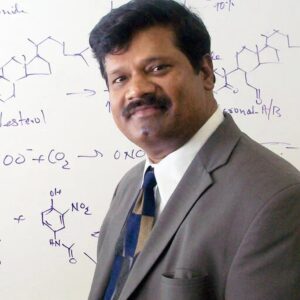
Trained in biochemistry, physical organic chemistry, and free radical chemistry, his research spans bioanalytical methods, biomarker discovery and validation, chemical toxicology, environmental chemistry, computational genomics, reactive intermediates, and the molecular mechanisms of disease. His scholarship is indexed on ORCID, ResearchGate, and Google Scholar.
Dr. Uppu is a Fellow of the American Association for the Advancement of Science (AAAS), the Royal Society of Chemistry (RSC), the Royal Society of Biology (RSB), the Royal Society of Medicine (RSM), the Royal Society for Public Health (RSPH), and the Academy of Toxicological Sciences (ATS).
In addition to his scientific research, he writes reflective essays on scientific culture, mentorship, peer review, ethics, and the human dimensions of academic life. He shares updates on LinkedIn.