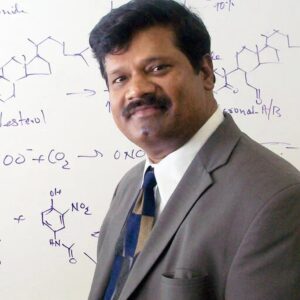
Rao M. Uppu is professor of environmental toxicology and chemistry at Southern University and A&M College in Baton Rouge, Louisiana, where he has served since 2002. He is also an adjunct professor of chemistry and pathobiological sciences at Louisiana State University.
Trained in biochemistry, physical organic chemistry, and free radical chemistry, his research spans bioanalytical methods, biomarker discovery and validation, chemical toxicology, environmental chemistry, computational genomics, reactive intermediates, and the molecular mechanisms of disease. His scholarship is indexed on ORCID, ResearchGate, and Google Scholar.
Dr. Uppu is a Fellow of the American Association for the Advancement of Science (AAAS), the Royal Society of Chemistry (RSC), the Royal Society of Biology (RSB), the Royal Society of Medicine (RSM), the Royal Society for Public Health (RSPH), and the Academy of Toxicological Sciences (ATS).
In addition to his scientific research, he writes reflective essays on scientific culture, mentorship, peer review, ethics, and the human dimensions of academic life. He shares updates on LinkedIn.
For many years, peer review has been an expected but largely invisible part of academic life, undertaken quietly, without compensation, and often without formal recognition. In my experience, peer review requests now arrive almost weekly, often competing with teaching, mentoring, and administrative responsibilities. While not all are accepted, many are taken on out of a sense of professional obligation, even when time is limited. This work has been sustained by …
Read more…
Paid peer review is overdue in academic publishing
One of the most difficult moments in scholarship is deciding when a piece of work is ready to leave the desk of the author and enter the public domain. Peer review continues to rely almost entirely on voluntary scholarly labor, even as the academic environment supporting it becomes increasingly strained.
Over the past several years, many faculty in higher education in the United States, whether at public or private institutions, have …
Read more…
Can peer review in academia survive faculty overload?
I often wonder why giving has so little to do with how much one has. A millionaire may hesitate to part with even a few thousand dollars for a person in need, while someone with only a modest savings may readily give away a meaningful share of it for a good cause. Clearly, something deeper is at work than what we see outwardly. This raises an important question: why does …
Read more…
Philanthropy for scientific research is underused
I sometimes find myself reflecting when my well-cited journal articles begin to show a decline, whether gradual or sudden. In academic medicine, citations have become a form of currency, used not only to trace ideas but also to measure worth. Yet what gets cited is not always what matters most. In biomedical research, citations support arguments and help measure impact. In principle, they show how knowledge develops over time. In …
Read more…
How citation metrics reshape modern academic medicine
In 1988, an unusual scene unfolded at the French National Institute of Health and Medical Research Unit 200 in Clamart, France. The then editor of Nature, John Maddox, arrived at Jacques Benveniste’s laboratory accompanied by investigator Walter Stewart and the professional magician and skeptic James Randi. Their task was not to perform tricks but to examine an extraordinary scientific claim: that biological activity might persist even when no molecules of …
Read more…
The memory of water and a historic scientific controversy
Every research mentor eventually faces a difficult question: What, and who, will continue when the work is no longer theirs to carry forward?
We often speak about mentoring, yet the dilemma of mentorship is rarely addressed directly. Perhaps it lies at the intersection of responsibility and uncertainty. Mentorship is often imagined as guidance freely given, with apprenticeship unfolding naturally. In modern academic life, however, the laboratory is shaped not only by …
Read more…
How research laboratory culture shapes mentorship in academic life
William A. Pryor, whose intellectual rigor and scientific voice shaped generations of researchers and the broader world of free radical biology and medicine, often told me something I have never forgotten. Only later did I understand that it was really about cognition.
But what stayed with me most was his insistence on a simpler discipline: Keep your hand on the keyboard and start writing. “The ideas,” he said, “will crystallize as …
Read more…
Scientific writing and AI: Balancing authorship and assistance
Emotional contagion and crowd psychology are powerful forces that shape human behavior in large gatherings. In India, where collective identity and reverence for public figures often run deep, emotional responses within crowds may take on added intensity. This reflection draws on an incident from Tamil Nadu to illustrate how collective emotion can sometimes override proportion and common sense, with implications for community safety and well-being.
This may sound amusing today, but …
Read more…
The psychology of hero worship: When admiration overrides reason
Human milk contains more than nutrients; it carries a quiet, evolutionary intelligence expressed through chemistry. It is not conscious thought, but the slow wisdom of evolution written into molecules that nourish, protect, and guide.
Among its most remarkable ingredients are the human milk oligosaccharides (HMOs). These complex sugars, present at around 0.5 to 1.5 g/dL, are not there to feed the infant directly.
They move through the stomach and small intestine largely …
Read more…
The evolutionary intelligence of human milk: HMOs and lactose
I cannot claim to have been the one who nurtured our garden. That credit belongs to my wife. She is the one who waters the plants faithfully and notices when something needs care. I am more often the admirer, the one who pauses to appreciate a flower that seems almost too beautiful to belong in an ordinary backyard.
Among the plants that brought me the greatest joy was a passion vine. …
Read more…
The passion vine: a lesson on restraint in medicine and life