I recently worked with a medical student who had spent weeks writing and revising her residency personal statement. Her essay was layered and thoughtful, tracing the arc of her experiences and establishing a clear through-line for why she wanted to pursue palliative care medicine. Most importantly, the narrative sounded like her. It was honest. She was proud of it.
Then she showed it to a resident on a rotation. The resident read it and offered feedback. “It’s good,” they said. “But why didn’t you just use ChatGPT?”
My student was genuinely unsettled by the comment. She wondered if she had somehow done the assignment wrong by writing it herself, as if she had wasted time she should have spent studying for a shelf exam, or lost an advantage that other students are gaining by outsourcing this work. I was also concerned by the exchange she recounted to me.
Let me be clear: I am not opposed to artificial intelligence. Many of my students use AI. I suspect it will become part of nearly every admissions and residency cycle moving forward. The ethical questions surrounding disclosure, screening, and optimization deserve their own discussion. My concern here is something different.
Real physician voices, twice a week
Free, and one click to unsubscribe.
The residency personal statement was never designed to measure who could produce the most polished prose. It exists because residency programs already have transcripts, board scores, clerkship evaluations, and resumes. The essay serves a different purpose. It helps answer a question that cannot easily be captured by metrics: Who are you? Not what have you done. Who are you?
Unfortunately, that question has become increasingly difficult for many medical trainees to answer. Medical education trains students to identify the correct answer, perform competence, and meet expectations. Those are important skills. After years of evaluations, rankings, and standardized assessments, many students also become remarkably skilled at something else entirely: disappearing.
They learn to suppress quirks, soften convictions, and hide the parts of themselves that feel risky or unconventional. They become experts at reading authority figures and anticipating what others want. Then residency application season arrives and they are suddenly asked to be authentic.
Many no longer know how.
This is where ChatGPT becomes so tempting. AI is extraordinarily good at producing polished language. It can generate coherent, emotionally adjacent prose in seconds. It can create statements that sound thoughtful, compassionate, and professional.
The problem is that large language models (LLMs) are trained on patterns. By design, they generate the statistically probable next word, phrase, or idea. LLMs generate probable language, not distinctive language. They smooth. They blend. They average. What Margaret Atwood has called “The Great Blanding.”
What happens on the page is that the interesting turn of phrase disappears. The unusual but revealing detail gets cut. The contradictory feeling gets neatly resolved. The sharp edges that make someone recognizable become rounded into generic professionalism. The result is often a perfectly competent essay that could have been written by almost anyone, an essay that sounds professional, compassionate, and sincere, and completely interchangeable with hundreds of others.
The strongest personal statements are the ones that contain narrative signal. My student wrote about the journey that brought her to the realization that what draws her to palliative care is not expertise in symptom management but a fascination with how people make meaning when time becomes limited. The moments that she describes from her own life are memorable because they are specific. They reveal how she thinks. They show us what she notices. They tell us something about the person we might encounter at 2 a.m. on a difficult call night.
Residency programs are not looking for robots. Attendings and residents are asking different questions. How does this person think? How do they handle uncertainty? What kind of teammate will they be? What kind of presence do they bring into a room? AI cannot answer those questions for you. Only you can.
What concerns me about AI-generated personal statements is not simply authorship. It is the loss of the reflective process itself. Writing, at its best, is an act of attention. You sit with an experience long enough to understand what it meant. You search for language that gets closer to the truth. You discover connections you had not previously seen. The value is who you become while writing, not only the finished essay.
As AI increasingly handles administrative, routine, and predictable tasks, the qualities that will matter most are not efficiency or compliance. They are independent thought, creativity, emotional presence, moral judgment, and moral courage. They are the ability to make meaning from complex human experiences. These capacities do not develop when we outsource critical thinking.
That does not mean students should avoid AI altogether. AI is a data tool. It works best when you outsource routine, mundane tasks to it, not when you outsource the human parts to it. Setting aside the many costs of AI, the basic question is this: Would you really let a computer have a conversation with your future employer about the fundamental parts of your story, or who you are?
In my workshops, we read essays aloud and ask simple questions. Does this sound like you? Could you sit across from an interviewer and explain why every story, every reflection, and every conclusion belongs there? The goal of the personal statement is not perfect writing. The goal is learning to recognize yourself clearly enough to write honestly.
So the next time a student shows you a personal statement, resist the urge to ask whether they used AI. Ask instead: Where are you in this essay? What would be lost if someone else had written it?
The answer may matter far more than the words on the page.
This article is discussed on The Podcast by KevinMD: She spent weeks on her personal statement. Then someone asked why she didn’t use AI..
This essay is cited in the KevinMD record on medical school.
Kathleen Muldoon is a professor of medical education and a certified coach dedicated to empowering authenticity and humanity in health care. She has pioneered innovative courses including humanity in medicine, medical improv, and narrative medicine. An award-winning educator, she was named the 2023 National Educator of the Year by the Student Osteopathic Medical Association.
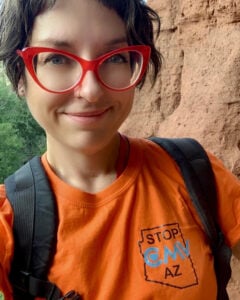
Her personal experiences with disability sparked a deep interest in communication science and public health. She has delivered more than 200 seminars and workshops globally and serves on academic and state committees advocating for patient- and professional-centered care. She is cofounder of Stop CMV AZ/Alto CMV AZ, fostering partnerships among health care providers, caregivers, and vulnerable communities.
Her expertise has been featured on NPR, USA Today, and multiple podcasts, and her academic work includes a featured publication in The Anatomical Record. She shares insights and resources on Linktree, Instagram, Substack, and LinkedIn.