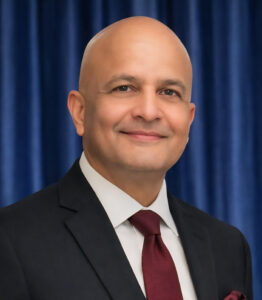
Matt Hasan is an economist, AI strategist, and founder of aiRESULTS. He advises health systems, payers, and life sciences organizations on the strategic implications of artificial intelligence, digital transformation, and emerging technologies. Over a career spanning more than four decades, he has held leadership and advisory roles with organizations including AT&T, IBM, Deloitte, Capgemini, and Citigroup, and previously served on the faculty of New York University's Stern School of Business.
Dr. Hasan's work focuses on the intersection of technology, institutions, and human decision making, with particular emphasis on how AI is reshaping medicine, governance, leadership, and professional practice. He is the founder of The AI Humanist Movement and an advocate for Human-AI Synergy, a framework that views AI not merely as a tool, but as a cognitive partner capable of extending human capabilities.
His writing includes "A Profession at the AI Frontier: Medicine Must Reinvent Itself or Cede Ground," published in Health Affairs Forefront. He shares updates on LinkedIn and Medium.
Health systems are buying software that assembles a prior authorization packet from the chart, files it, and chases status. Health plans are buying software that reads the same packet, scores medical necessity against internal rules, and routes a yes or a request for more information. Vendors on both sides advertise essentially the same promise: Artificial intelligence will fix prior authorization.
That is only half true. What is arriving is a dual-use …
Read more…
AI in prior authorization: 3 contract questions for 2027
A new national report on obstetric care should concern anyone worried about the future of American health care. Between 2010 and 2024, 718 U.S. hospitals lost obstetric services through unit or hospital closures. By 2024, 57.5 percent of rural hospitals had no obstetric services at all.
This is not simply a maternity-care problem. It is another warning that the economics of delivering health care in smaller communities are becoming increasingly difficult.
Now …
Read more…
AI adoption in rural hospitals could fuel consolidation
A patient sits across from her physician and asks that the AI-assisted reading of her scan not be the final word. She isn’t opposed to technology. She remembers reading about an AI system generating false clinical information at another hospital, and the story stayed with her. Her physician understands the hesitation. He has become more cautious himself after a documentation tool fabricated part of a medication history, an error he …
Read more…
Trust in health care AI is a design problem, not a patch
Lately, there has been considerable discussion about the changing boundaries between physicians and patients. How quickly should doctors respond to portal messages? When does reasonable access become unreasonable intrusion? Where does professional responsibility end and personal time begin?
These are legitimate questions. Physicians are entitled to privacy, reasonable working hours, and protection from inappropriate demands. No one should expect a physician to be available to every patient at every hour through …
Read more…
Protect physicians from bureaucracy, not from patients
Another state just added itself to the list of places with its own AI health care law. Another compliance memo just landed on somebody’s desk. It’s easy to file this under bureaucratic noise, something legal will sort out. It isn’t. A physician documents why she overrode an ambient scribe’s note. A nurse practitioner checks a disclosure banner before a generative AI-drafted message goes out to a patient. A physician assistant …
Read more…
Why AI governance in health care falls on clinicians in 2026
A randomized controlled trial can tell us that a treatment reduces mortality by a measurable percentage. It cannot tell us what it feels like to receive that treatment, to wait for its results, or to watch someone you love decide whether to accept it. That gap, between what medicine measures and what patients actually experience, is where fiction has always done work that research papers cannot.
Consider Tolstoy’s The Death …
Read more…
Why doctors should read fiction, not just research papers
Artificial intelligence is forcing medicine to make a choice that has received surprisingly little attention. Should AI be designed to replace increasing portions of clinical judgment? Or should it be designed to elevate it? Much of today’s discussion assumes these are the same objective. They are not. One seeks to substitute human reasoning. The other seeks to strengthen it.
Unfortunately, the momentum today is largely toward replacement. We read almost daily …
Read more…
AI should elevate clinical judgment, not replace it
Artificial intelligence is arriving in eldercare for a reason that receives far less attention than the technology itself. It is not entering because the technology has suddenly matured or because health care has embraced a new digital vision. It is entering because the workforce responsible for caring for older adults is approaching its practical limits.
The United States is entering a demographic transition unlike any it has experienced before. Millions of …
Read more…
AI in eldercare is a workforce story, not a tech one
Every day in medicine, we hear a familiar refrain: “I want to do the right thing for my patients, but my hands are tied by the system.”
It is a comforting narrative. It casts doctors, administrators, and clinical leaders as helpless victims of an invisible and rigid machine. It positions them as casualties of a vast medical-industrial complex driven by insurance mandates, regulatory compliance, and predatory billing cycles. We shrug our …
Read more…
Why health care leaders keep blaming the system
The most unsettling thing about artificial intelligence is not what it can do. It is what people feel when they talk to it.
I keep hearing the same things. “It listens.” “It doesn’t rush me.” “It helps me think.” “It seems to care.” Some people say this with embarrassment, as though confessing a weakness. Others say it with relief. A few say it with something close to gratitude.
These reactions have set …
Read more…
AI in health care is a mirror, not a therapist
Every physician knows the feeling. You trained for years to think independently, to assess, to judge. Now you spend more than half your workday staring at a screen, entering data into fields someone else designed, responding to alerts someone else configured. The patient is in front of you. The system is between you.
That experience is not just a workflow frustration. It is a signal of something far more consequential that …
Read more…
AI in health care is quietly displacing physicians