During my first week as a clinic operations volunteer at Lawndale Christian Health Center, I expected to learn about medicine. Instead, I learned about a scooter.
This scooter belonged to a certain Mr. Simmons (or so I will call him). Mr. Simmons was a man experiencing homelessness who was beloved by the Lawndale Mobile Care Team (the group which provides health care to Chicago’s homeless shelters) because of his unwavering optimism and his radiant personality. He could always be found riding his trademarked blue electric scooter through the shelter, greeting the care team with a smile and his signature phrase: “Keep it Gucci and stay pimpin’.”
On my third morning on the job, I arrived for my day at the Shelter Placement and Resource Center (SPARC) to find the care manager and doctor deep in conversation. The previous night, Mr. Simmons had been taken in an ambulance to a local hospital. His scooter had been left on the street where the ambulance had picked him up. Now hospitalized, he was more distressed about his stranded scooter than his multiple medical issues.
The team began calling colleagues and reaching out for more information. All we knew was the neighborhood where the scooter had been left behind. We did not have the exact location or even the street where it had been last seen. Even if we had that information, we had doubts as to whether the scooter would have survived the night unattended. As the SPARC clinic was luckily quiet that morning, the care manager and I consulted with the doctor and we decided to go search for the scooter ourselves, however ill-fated we felt the search might be.
I had fortunately driven my mom’s Ford to work that day, the only car large enough to fit the scooter. We strapped in and headed to the extraction zone.
As we drove through the neighborhood in which Mr. Simmons had been picked up by the ambulance, I was struck by the stark reality surrounding us. Abandoned buildings lined the streets, their decrepit facades revealing a glimpse of what had once been thriving communities. The neighborhood reflected the social and economic challenges faced daily by many of our patients.
A few blocks into our search, and to our great disbelief, we found the scooter. The old blue scooter sat alone on a street corner, exactly where it had been left behind.
Using nearly all of our combined strength, the care manager and I hauled the heavy scooter back to the car and into the Ford’s trunk. The scooter was covered in dirt and grime and I was praying the stench wouldn’t stick to the car (Sorry Mom!). The scooter was in rough shape. Yet, as we drove towards the hospital, I began to realize that what we were transporting was far more than just an old scooter. To Mr. Simmons, it was independence.
We gruelingly wheeled the scooter through the hospital’s parking lots, hallways, and elevators until we finally reached Mr. Simmons’ room. The room was small, sad, and stuffy. His clothes and belongings were scattered across the room, as his plastic carrier bag had torn. Yet, the moment he saw the scooter roll in, his face lit up and the entire room brightened. He smiled broadly and called us both angels.
For the next several minutes, we sat with him and talked about his health, housing plans, and his hopes for the future. And despite the uncertainty surrounding his life, he remained remarkably positive as always. As we prepared to leave, he smiled and bid us farewell, reminding us to “Keep it Gucci and stay pimpin’.”
I left that hospital room feeling grateful that we had been able to help. Mission accomplished.
A few days later, that feeling changed.
The mobile care team received a message from the hospital that Mr. Simmons was being discharged. Although his immediate medical condition was stable, there was still no plan for where he would go next. The hospital was planning on dropping him off at a day shelter near where he had been picked up. Furthermore, the hospital requested that we once again transport his scooter because they were unable to do so themselves.

ADVERTISEMENT
I was surprised. How could a health care facility capable of delivering advanced medical treatment be unable to coordinate transportation for a handicapped patient’s primary means of mobility?
Initially, our team pushed back. Surely there was a procedure in place for situations like this instead of relying on an outside volunteer’s car. Yet after considerable discussion, we found ourselves once again loading the scooter into the Ford’s trunk.
This trip felt very different. The first trip had been returning something important to a patient who was distressed and worried. This time, we were delivering it to a day shelter because no better solution had been found. While the hospital successfully treated Mr. Simmons’ immediate medical needs, the broader circumstances affecting his health had not been addressed.
For several days after our second delivery, we did not know what had happened to Mr. Simmons. We had lost contact and could no longer locate him.
Then we received good news. Mr. Simmons had been placed into more permanent housing. We were able to reach out to him via phone, and although he jokingly described his new apartment as “a small box,” he was grateful to have a more stable place to call home.
The story of Mr. Simmons’ scooter fundamentally changed my understanding of medicine. Before that experience, I had viewed health care primarily through a clinical lens. Physicians diagnose illnesses, prescribe treatments, and the patients leave happy (for the most part). While those responsibilities do remain central to medicine, I began to appreciate how profoundly a person’s health is shaped by other factors. Factors that exist long before they even enter the clinic and remain there long after they leave.
The more time I spent at Lawndale Christian Health Center, the more I learned that Mr. Simmons’ story was far from unique. Chicago is a city of remarkable medical institutions, but it is also a city of profound economic inequalities and health disparities. Some of the city’s wealthiest and poorest communities are separated by less than a few miles, yet the difference in life expectancy between them can approach two decades. As Dr. Omar Lateef, president and CEO of Rush University System for Health, observed, “If you’re born on Michigan Avenue, you’ll live 16 years longer than if you’re born five subway stops west.” Dr. David Ansell, author of The Death Gap and senior vice president for community health equity at Rush University Medical Center, has described the causes of this disparity bluntly: “Heart disease, cancer, homicide, overdoses, maternal infant health and accidents. Add them up, you get a 20-year gap.”
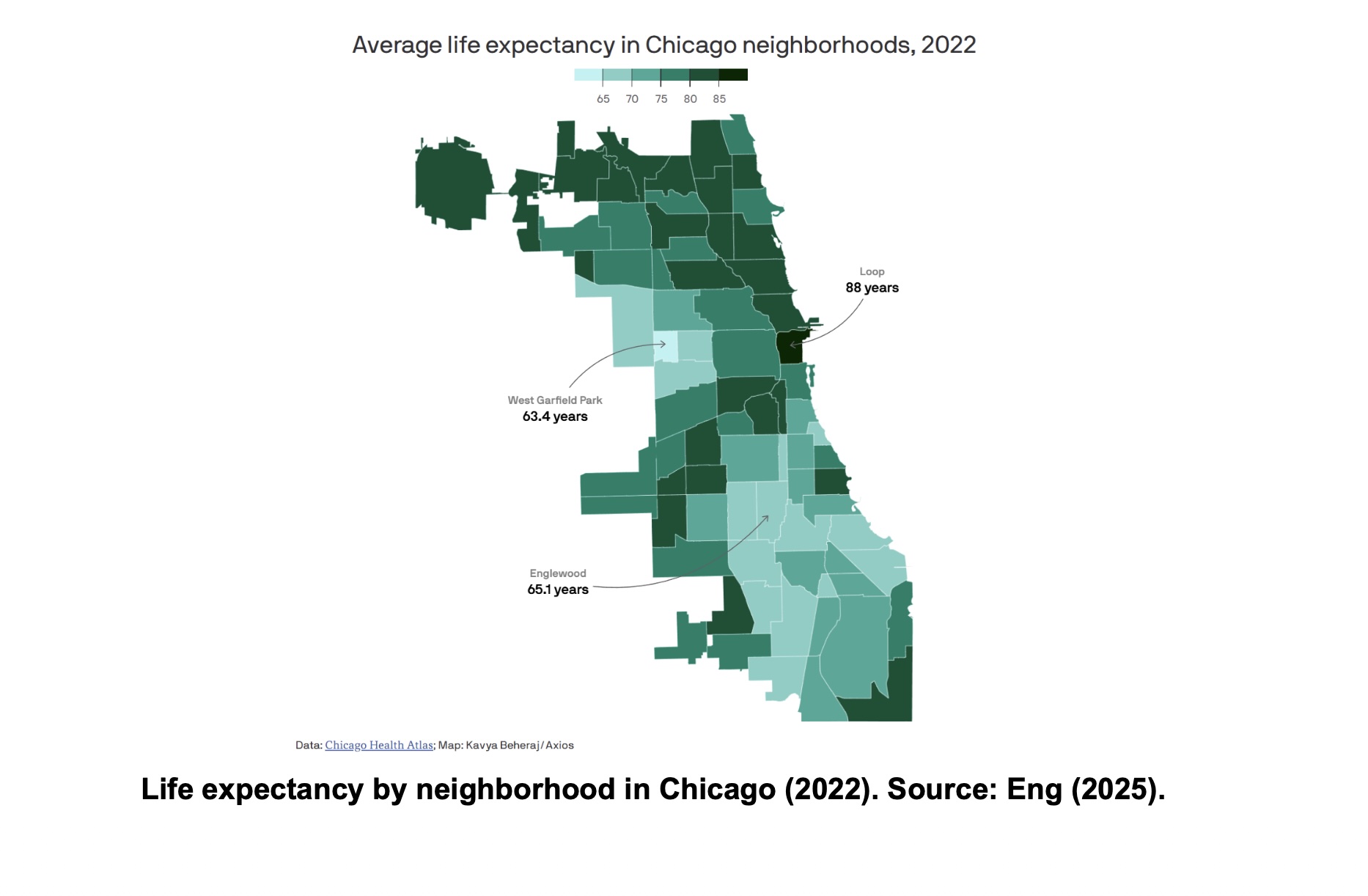
It’s a shocking statistic. Sixteen years is more than the time it takes for a child to grow from infancy to adulthood. Yet as I reflected on my experiences at Lawndale, I realized I had already seen many of the reasons behind those numbers.
Mr. Simmons’ greatest challenge was not the illness that brought him to the hospital but the system which often struggled to see him as a complete person. While the hospital addressed his immediate medical needs, there was little effort made to address the struggles which awaited him after discharge. His primary means of mobility was someone else’s problem. His uncertain housing situation was someone else’s problem. His next meal was someone else’s problem. His future seemed to end at the hospital doors.
Yet each of those problems was a health problem.
Without transportation, accessing medical care becomes difficult. Without stable housing, managing chronic disease becomes harder. Without support systems, recovery becomes more uncertain. All factors that actively contribute to the drastic life expectancy gap. These are not abstract public health concepts; they are the everyday realities faced by patients like Mr. Simmons.
Yet this is not what I witness everywhere. The physicians, care managers, and staff I met at Lawndale Christian Health Center refused to view Mr. Simmons as merely another patient encounter. They worried about him when he was hospitalized. They searched for his scooter because they understood what it meant to him. They followed up after discharge, advocated for his needs, and continued working to ensure that he remained in good health and found a more stable living situation. Their concern for his well-being did not end when his immediate medical needs were taken care of.
At Lawndale they understand that medicine is not only practiced in exam rooms and hospitals, but in neighborhoods, shelters, schools, homes, and communities. They recognize that improving health does not only mean prescribing medication, but also helping secure patients’ housing, transportation, and support systems.
The physicians I met during my time at Lawndale were not remarkable solely because of their medical knowledge (although extremely vast). They were remarkable because of the genuine compassion they showed their patients. They understood that health does not begin when a patient enters a clinic and does not end when they leave a hospital. They understood that a patient’s ZIP code can be as important as their genetic code. Their willingness to advocate for vulnerable individuals demonstrated the kind of physician I hope to become.
I want to pursue medicine because I want to have that same impact on my patients as the providers at Lawndale had on theirs. I want to be a physician who looks beyond the diagnosis and sees the person living with it. I want to advocate for patients when systems fail them, support them through challenges that extend beyond medicine, and help ensure that they are treated with dignity regardless of their circumstances. The example set by the physicians at Lawndale showed me what medicine can be at its best.
When I think back on that experience, I do not remember the weight of the scooter or the effort it took to move it through hallways and parking lots. I remember the smile on Mr. Simmons’ face when he realized that someone cared enough about him to return his scooter.
That moment taught me that healing is not always measured by curing illness. Sometimes it is measured by showing a patient that they matter.
That is the kind of physician I aspire to become.
Alexander Aschinberg is a premedical student at Northeastern University, studying mechanical engineering and history. Aschinberg plans to pursue an MD/MBA and build a career dedicated to helping others through medicine.
Published research includes “Expanding Prosthetic Applications: A Multidisciplinary Approach to Assistive Technology for Bedridden Patients.” Aschinberg shares updates on LinkedIn.