There very well may have been times throughout our country’s history where opioids have been overprescribed, such as the Civil War era and 2000 to 2010. Of course, determining whether opioid prescribing is actually excessive requires one to quantify an association of opioid prescription rates with some relevant population characteristic (e.g., opioid overdoses per capita). Failing to consider the relationship between opioid prescription rates and any other population characteristic whatsoever as is done in the JAMA Research Letter published in April 2026 not only is a disservice in assessing reasonable prescribing rates but can also harm those with debilitating pain who require opioid medications for a tolerable existence given that such publications may be used in litigations and in shaping opioid prescribing policy. Like similar opioid-related articles published in high-impact journals over the past decade, many aspects of opioid prescribing patterns and their relation to the “opioid epidemic” are negligently overlooked:
1. The current consensus fails to recognize that there is a small subset of people living with intractable chronic pain (whether cancer-related or not) for which prescription opioids are a vital component of their pain management and quality of life. Chemotherapy also has risks and bad side effects, but there isn’t a constant stream of articles being published in high-impact journals that simply point out an increase in chemotherapy prescriptions and associated harms without ever mentioning any potential benefits of chemotherapy.
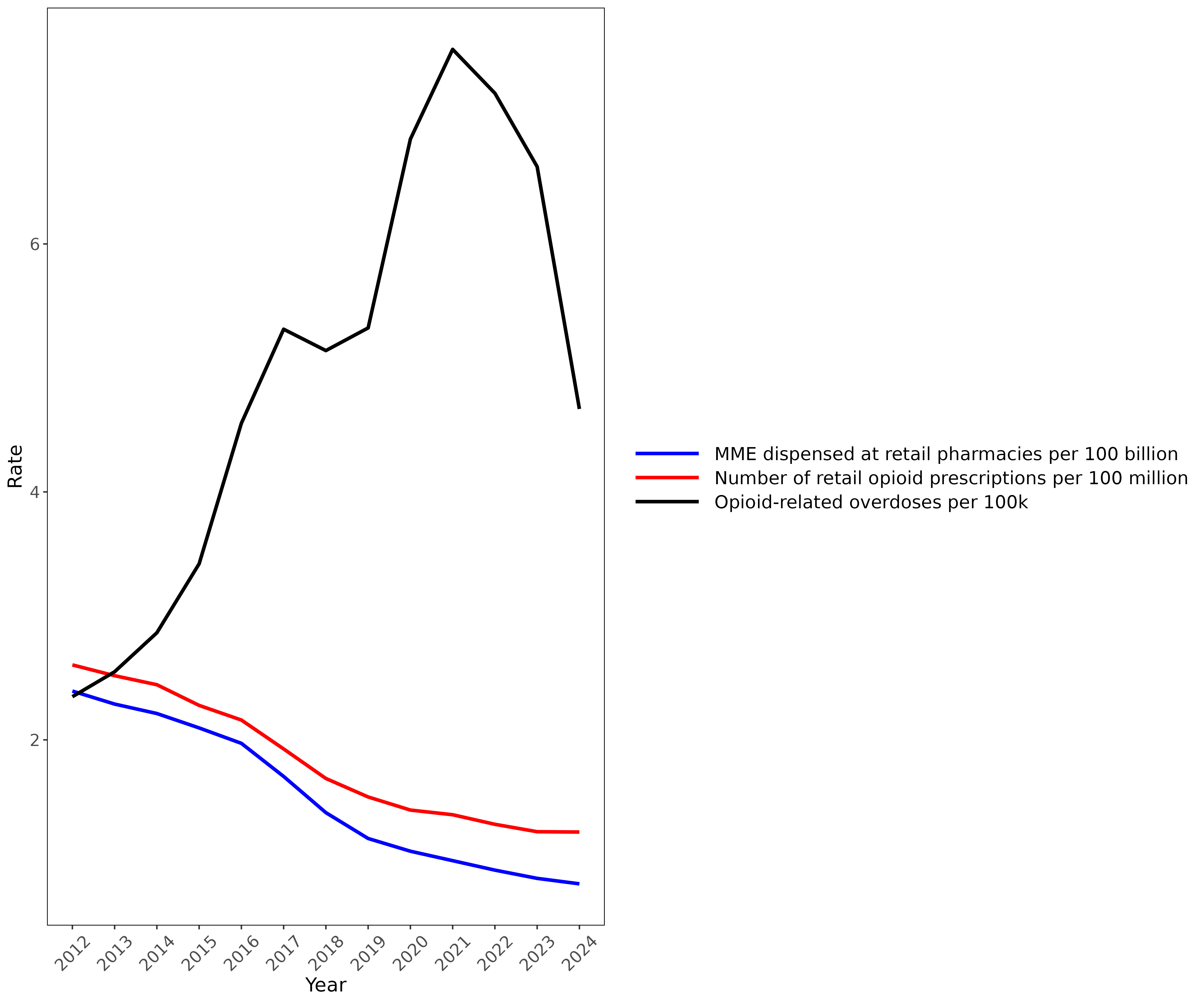
2. Such papers typically implicate prescription opioids as the primary driver of the opioid epidemic; however, due to the lack of data distinguishing opioid overdose deaths as stemming from either prescription opioids or illicit opioids, this underlying assumption is misleading. For example, personally, I suspect that most of the recent deaths due to fentanyl overdoses are due to illicit fentanyl and not fentanyl prescriptions written by American doctors and filled at American pharmacies (of course we don’t have data on this to know with certainty). Regardless of the extent to which prescription opioids contributed to the increase in opioid overdose deaths per capita rate in the 2000s and early 2010s, the data show that there is actually a negative correlation between opioid prescriptions per capita and opioid overdose deaths per capita from 2012 to 2024 as seen in the figure below. To emphasize this point: Papers are continuously being published that portray prescription opioids as the driving cause of the opioid epidemic when in reality, from 2012 to 2024, there is a negative correlation between opioid overdoses per capita and opioid prescriptions per capita. Of course, a thorough statistical analysis would account for various confounders and autocorrelation, but this inverse relationship is overlooked by much of the published literature over the past decade, perhaps in part due to the publishing bias favoring the prevailing attitude toward opioids. See more thorough documentation on how data for this figure was gathered and summarized.
3. Older people tend to have more diseases, including conditions that cause non-trivial pain, and the proportion of Americans 65 or older increased by nearly 4 percent from 2010 to 2020 per the U.S. Census Bureau. Similarly, per Table 10-2 in the March 2026 MedPAC Report to Congress, the percentage of Medicare decedents who used hospice increased from 43.8 percent in 2010 to 52.9 percent in 2024. Per the U.S. Government Accountability Office, the number of people enrolled in hospice increased by 32 percent from 2015 to 2024, and the average length of time spent in hospice increased by 15 percent over this time period. Regardless of the exact numbers, it seems that hospice care has been becoming more common over the past decade. I wonder if the authors of the April 2026 JAMA letter would encourage a decrease in the number of people seeking hospice care in order to cut what they claim to be an unreasonable number of opioid prescriptions?
4. Per Table 1 in the April 2026 JAMA letter, the mean age of a patient receiving an opioid prescription increased from 52.5 in 2025 to 60.5 in 2023. Meanwhile, only 35 percent of people who died from an opioid overdose in 2023 were older than 49.
Of course, effective pain management includes substantive social relationships, physical activity, treatment of underlying disease/inflammation, and a strong doctor-patient relationship. For a small subset of individuals, opioid medication (accompanied by risk education) may be necessary to control pain to a level where individuals can go about their activities of daily living. Given the cultural climate over the past decade, in part created and encouraged by JAMA papers, it may be too easy to stigmatize these individuals, the medications they need for a tolerable existence, and their physicians.
Hunter Dlugas is a graduate student.