

















Listen and followApple PodcastsSpotifyYouTubeMore apps · Browse all episodes
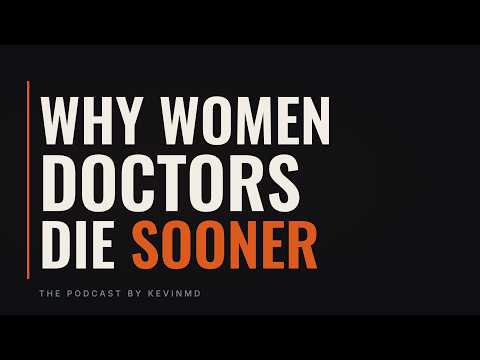
Women doctors lose the longevity edge other women have, and they are about 50 percent more likely to die by suicide. Ali Novitsky is a triple board-certified physician in obesity medicine, pediatrics, and neonatal-perinatal medicine and the CEO and founder of The FIT Collective. This episode is based on her KevinMD article “Women physicians die sooner. Hospitals still won’t act.” You will hear what the mortality data show, including for Black women physicians, and why work-life imbalance dominated about 1,200 anonymous coaching sessions with 650 women doctors. She explains a coaching approach that starts with exercise, draws on cognitive and dialectical behavior therapy, and sorts stress into six types, and why 67 percent of participants had never been coached because of cost and time. She also describes the pushback she gets from hospital systems, the 5 percent use she found for hospital wellness apps, and an OB/GYN client who went from weight-loss goals to bringing a strength program into her own practice. Press play to hear why women physicians cannot wait for answers before systems act.
If this episode helped, follow The Podcast by KevinMD on Apple Podcasts or Spotify, and leave a rating.
Partner with me on the KevinMD platform. With more than 100 million impressions a year and nearly 750,000 followers, subscribers and email recipients across my channels, I give you direct access to the doctors and patients who matter most. Whether you need a sponsored article, email campaign, video interview, or a spot right here on the podcast, I offer the trusted space your brand deserves to be heard. Let’s work together to tell your story.
PARTNER WITH KEVINMD → https://kevinmd.com/influencer
SUBSCRIBE TO THE PODCAST → https://www.kevinmd.com/podcast
Transcript
Kevin Pho: Hi, and welcome to the show. Subscribe at KevinMD.com/podcast. Today, we welcome Ali Novitsky. She is an obesity medicine, pediatrics, and neonatal-perinatal medicine physician, and she is the CEO and founder of The FIT Collective. Today’s KevinMD article is “Women physicians die sooner. Hospitals still won’t act.” Ali, welcome to the show.
Ali Novitsky: Thank you so much for having me. I’m a super fan.
Kevin Pho: All right. Well, thank you so much for writing and for joining me. We’ll start by having you briefly share your story, and then tell us why you decided to write this article on KevinMD.
Ali Novitsky: OK. I grew up in a really small town, and my dad is an internal medicine doctor. He’s now seventy-eight, and he’s still practicing. His office was in our house growing up, so I got introduced to medicine very early, but in a very different way. My two brothers are also physicians, and I really see medicine as something that’s part of our life. So I have a different relationship with it, a very loving relationship.
As the years have gone on, the way I have started to see myself in medicine is by helping those who are in medicine. A lot of times, people start businesses because they burned out or whatever, but that wasn’t really my story. It was that I saw a different, more impactful way that I wanted to serve, so I started working with women doctors. For the past ten years, I have worked directly with women doctors, taking care of their optimal health and building communities. And I’ve really taken the work that I’ve done and realized, you know what, everybody needs this. So it inspired me to ask what data is out there to show that women, and not only women, men too, but for the purpose of this article, women physicians, need more.
Real physician voices, twice a week
Free, and one click to unsubscribe.
Kevin Pho: So tell us about this article. You cite some pretty provocative data from JAMA Internal Medicine. Maybe we could start with some context, and then, for those of you who get a chance to read your article, tell us what it’s about.
Ali Novitsky: Absolutely. About a year ago, an article was published out of Harvard looking at mortality rates. Typically, we hear that in the general population, women live longer than men, and it’s about 45 to 50 percent. That’s our mortality advantage. Women doctors actually lose that advantage completely. They actually do not outlive their male peers, if you will. And what was interesting is that if you take it one step further, Black female physicians fared even worse.
So we as women doctors lose this advantage of living longer, and nobody knows why. We might not know the exact reason why. I think we can all guess that it’s multifactorial. But what can we do to look into that a little bit further? That’s number one. And number two, I don’t know that we can wait to find the answer before we, as a whole population, start doing a little bit more. So that’s what inspired it. And when you look at the causes, suicide is really high. In general, compared to women who are not doctors, women doctors are about 50 percent more likely to die by suicide.
Kevin Pho: So you said the answers haven’t really been clear in the data, but just from your work with female physicians, speculate and spell out some of the reasons you think that’s happening.
Ali Novitsky: Absolutely. I have to tell you that the big thing I have been studying, and this is what my main research is in, is actually stress. We all know stress, and we can all talk about its physiology, but I like to put really simple language to it. We’ve identified different stress tendencies, and the coaching we do is around those stress tendencies.
We actually created a tool. It’s my digital coaching brain, and we took 650 women doctors, anonymously, from this past July to September, and had them coach with me, completely anonymously. I didn’t know who was in there. The app was very well developed. It has a lot of guardrails, so if it identifies anybody being in danger, there’s help for that. We asked a lot of questions, because I wanted to get some ideas about where to go next with this. When they answered the question, “What is the biggest stressor?” and when we pulled from the coaching sessions what was most commonly coached on, it was really work-life imbalance. They always felt inadequate at work and at home. And I’ll tell you what, it was a huge number. I think within those two months, there were 1,200 coaching sessions that my brain completed, and something like 80 percent of the sessions dealt with work-life imbalance.
Kevin Pho: What are some of the paths forward? Because of course I hear this all the time about both men and women physicians, but for this conversation, we’ll focus on women physicians. They’re burned out. They’re suffering moral injury because of this work-life imbalance, as we’re speculating. What are some of the options for them? When they come to you for coaching, how do they typically present? Talk to us about some paths forward.
Ali Novitsky: Absolutely. I think this is such a great question, because I think the answer is completely in the gray zone, and there are a million different ways it could go. At the end of the day, and again, I hate to limit it to women, because it’s men, too, it’s about having women doctors feel seen, right? Just allowing them to be seen by somebody. One of the things I know to be true is that anything you do that promotes the mental, emotional, or physical health of women doctors in a community, where you don’t feel isolated, is going to be the first place to start.
I can tell you about the individual level, because for the past decade, my work has been at the individual level. It’s been going door to door: “Any women doctors here? Who can I help today?” Right? And the question now is, how do we bring this to systems? Well, it’s ready, and many of us actually do have scalable programs. Getting it in the door is the problem.
So the paths forward are, as women doctors, perking up our ears and saying, “OK, this is great. This hospital system has this employee assistance plan. Is there anything in there that can actually benefit me, benefit my mental health?” It’s about, first of all, destigmatizing the fact that we suffer with a lot of different things that can impact our mental health, normalizing that, and then having actual access. I mean, coaching is evidence-based, and we know it works, but how do we get more access for more people?
If you look at our data, 67 percent of our members in this study had never been coached, 67 percent. And the two reasons cited were cost and time. One of the reasons our company developed the tool we studied is that it’s very low-cost and it’s available 24/7, right? And if we can move the needle, and we did: We showed that each session people were coached on this digital tool decreased stress by two points, two points on a scale of one to ten. So if somebody came in with a stress level of six, we could get them down to four. So I think what it is, is taking some of the work of the people who have been in this space for a while, most of us at the individual level, and letting us have a voice with decision-makers. That’s where I’ve run into the most trouble, to be quite honest.
Kevin Pho: So tell us about your coaching approach. I’ve talked to a lot of physician coaches, and as you know, a lot of physicians are trying to address this problem through coaching. What exactly happens during a coaching session? And I guess the other question is, does coaching put the responsibility on the individual physician and absolve the systems themselves of a lot of the causes they’re placing on these physicians?
Ali Novitsky: Absolutely, and I love this question. My husband is a psychiatrist, a child psychiatrist. And I have to tell you, in full disclosure, I had postpartum depression. I’ve had a lot of my own things, and a lot of the struggles I’ve had have really prompted me to develop this work. Everything we do is based on CBT, cognitive behavioral therapy. But we go one step further, with dialectical behavior therapy. All you have to know about that, if you’re not familiar, is that dialectical behavior therapy, DBT, is a subset of CBT, but it involves more emotional processing, communication, distress tolerance, and mindfulness.
Being an obesity medicine doctor, I focus heavily on nutrition, and actually exercise. What I’ve found through the years of coaching is that exercise has always been part of my coaching program, which has made me a little bit different. We always work out first, and exercise in general really lowers your stress level. What I found is that when individuals came in with a lower stress level, they were actually able to use their, and it’s not my coined phrase, what DBT calls your wise brain. The idea is that if we can emotionally regulate our body, and nobody wants to talk about emotions, so we have to give it simple language, then we can actually get to the thoughts that are going to serve us well.
So our approach is that you come in, and we have a validated stress quiz, because we’ve determined that we think there are six different distress types. In other words, how you respond to stress is very unique, which is why we miss a lot of people, because not everybody responds the same way. So we do this evaluation on everybody who comes in, and we get their stress type. A stress type doesn’t identify you as a person. It’s just your most common way of responding to stress. Once we know that, we can give people individual pathways within a group setting for how we’re going to approach the next year. My programs are typically about a year long.
And doctors love to learn, so we educate. Education is very empowering, so we educate them while they do the internal work. What you’ll find is that education and simple language take the fear away. They say, “You know what? OK, exercise. I can exercise.” They come in, they exercise, and they say, “Yeah, OK, this isn’t so bad. This is OK.” Then they go to the next level: “Oh yeah, I do feel grief. I do feel shame, but I also feel joy.” So it’s not that they come in and we say, “OK, this is how you have to think, and this is your new thought. Go back to work.” It’s all about them owning the conversations they’re having in their heads. Instead of going back into work and blaming the system or blaming what’s not working, they come in with answers. They come in with solutions.
I always say I should disclose this up front: Your life might be very different after you work with me, or with any coach, really. People start to make big changes. They actually start to lose friend groups, because they start to set boundaries. Essentially, we create group settings, but we focus on you as an individual within that group, and then we have frameworks. We cover mental, emotional, physical, and also social health. It’s a full-pronged approach, and what you’ll find is that as more and more individuals come in, a culture develops around what we’re no longer willing to do anymore. My hope is that systems can see that it doesn’t have to be that expensive, it’s not going to take more time, and that we have people outside doing this right now. How can we help more people?
Kevin Pho: In your article, you talk about some of the difficulties you face trying to incorporate what you’re doing with systems, that they’re pushing back on this. Give us an example of some of that pushback. What exactly does it look like? And speculate: Why do you think they’re pushing back?
Ali Novitsky: Absolutely. I think it’s a fear of the unknown, to be honest with you. I’ve done a lot of research on what the actual interventions are in hospital systems, what’s actually happening. I’ll give you an example. I got on a phone call with a very well-known hospital system that covers a lot of doctors, and I presented my data. That’s what I do now. Being ACCME-accredited, plus the data, the credibility has definitely helped me, but it hasn’t really moved the needle yet.
Anyway, I went into the conversation and explained everything, and they basically said, “You seem really nice. You seem really great. Your energy’s great. I don’t think that’s going to work.” I said, “OK, so what’s your data on what you’re currently doing?” “Well, we don’t. What are we currently doing?” They didn’t really know what they were currently doing. And then they said, “You know what? Maybe you’re right. Maybe we need to pull the numbers to see what we’re actually spending our money on.” So I think it’s an understaffed area: What are you actually spending your money on, and is it moving the needle?
Because when I looked at app-based wellness programs, very few hospital systems are actually using them. Hospital systems in general don’t all have a wellness-based EAP or app that they give to doctors, but for the ones that do, the utilization rate is 5 percent. I looked at the utilization of our coaching app: 84 percent. Change is hard for humans in general, right? And then it’s, OK, we’re going to have this outside company come in and present something that’s outside the box. How are we going to move forward with that?
Then there was another local hospital I went to. I actually spoke for them. I did my stress workshop, and they loved it. So I followed up and said, “I’d love to pilot the program.” And the email back was, “Wow, you know what? We have something internally that we’re really trying to leverage right now. We’ll let you know if the need ever arises.” OK, well, here’s the deal: Half of the doctors at that hospital are my personal clients. They came to me because what they have isn’t adequate.
And I’ll be honest with you, I don’t often get on phone calls with decision-makers. That would be, like, ten more phone calls from now. So it’s not really being taken as an option, and I think it’s a worry about how much it’s going to cost and how it’s going to be delivered. What I’ve done on the back end is figure out how to make it as low-cost and yet as valuable as possible, and also how to deliver it so that the system doesn’t even have to do the work. That’s available, and yet it’s no, no, no. I don’t know if I can take another no.
Kevin Pho: I also think, and this may be a little bit provocative, that hospital systems don’t want empowered physicians, right? Because we’re talking about things like setting boundaries, speaking up, and pushing back, and I think a lot of hospital systems are under so much pressure that they don’t necessarily want any friction when it comes to working with their physicians. So all the stuff that’s going to truly help with burnout is eventually going to be in tension with the financial bottom line of a hospital. I think there’s a little bit of incongruence there, which is why I think hospitals are a little more hesitant when it comes to accepting a lot of the programs that really work.
Ali Novitsky: Yeah, I love that perspective. I agree.
Kevin Pho: So tell us a success story. I know you probably have a lot, but let’s say there is someone who is burned out listening to you on this show. Of course you’re going to talk about your app, but in general, give us a before-and-after picture of what successful coaching can look like and the impact it can make on a physician’s professional life.
Ali Novitsky: I love this question. I’m thinking of a particular client, because she started with me about seven years ago. Back then, I used to have retreats at my house, and there was one spot left. She said, “You know, I’m going to try it out. I’m going to come.” She’s an OB/GYN. She came to the house and was just quiet. She did not talk much and was by herself a lot, so I found myself always going over and being near her. She came to me for weight loss, and that was fine.
But every year, it was almost as if she had more and more negative emotions, and I started to worry: “Am I even helping her?” I didn’t know that she was feeling any better, because it seemed like things were not going any better. And then there was this low point, and at that low point, the most amazing thing happened. She showed up to the next call and said, “You know what? I realized I was just living with my eyes closed, and I’m ready to do this.”
She was one of the first people who actually brought it into her practice. I do strength training for patients, too, and she brought the program into her practice when everybody else told her, “Don’t do it. Don’t do it. Not a good idea.” She put in her own investment, paid for it herself, brought it in, and now she’s serving her whole population of patients as an entrepreneur. She came in not able to do it for herself, and now she’s brought a program in. It’s just mind-blowing. That’s just one story of how she came in for weight loss and left serving her patients so much better.
And that’s the general theme. I’ll tell you, typically, people come to me for one thing, because it’s easier to say, “Oh, can you help me get more consistent with my health habits?” Well, sure, but that’s not why you’re really coming to me, right? But I like that, because it’s the carrot, and then we find out what it is you actually want.
Kevin Pho: We’re talking to Ali Novitsky. She’s an obesity medicine, pediatrics, and neonatal-perinatal medicine physician, and founder and CEO of The FIT Collective. Today’s KevinMD article is “Women physicians die sooner. Hospitals still won’t act.” Ali, as always, let’s end with your take-home messages to the KevinMD audience.
Ali Novitsky: I love it. I’d say you are the most important person in the room, and don’t be shy about that. Think about not only what you need but also what you want, and go after that.
Kevin Pho: Ali, thank you so much for sharing your perspective and insight, and thanks again for coming on the show.
Ali Novitsky: Thank you so much.
Listen and followApple PodcastsSpotifyYouTubeMore apps · Browse all episodes
Your KevinMD author page is one of the top results for your name. Turn it into a premium profile, publish in 1 to 3 days, and get a guaranteed podcast slot.