Pediatricians and the clinicians who care for children writing on KevinMD about child health: childhood illness, development, vaccines and the parents who refuse them, breastfeeding and the pressure around it, childhood obesity, prevention, and the realities of caring for young patients and their families. Most contributors are pediatricians. For a maintained record of what pediatricians have said about children's health since 2004, from fever and sleep through obesity, abuse, teenagers, and Medicaid, see Children's health: what pediatricians say, in their own words. For what physicians have said about vaccines and vaccine hesitancy, from the autism claim through measles, exemptions, and federal policy, see Vaccines: what physicians say, in their own words. For what child psychiatrists and pediatricians have said about children's and teens' mental health, see Mental health: what psychiatrists and physicians say, in their own words. For what pediatricians have said about breastfeeding and postpartum care, see Women's health: what physicians say, in their own words.
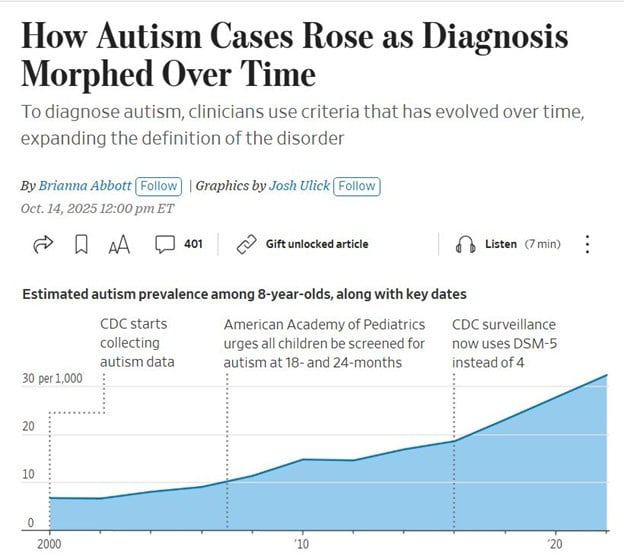
A recent Wall Street Journal graphic traces the rise in autism prevalence among eight-year-olds from 2000 to 2020. The slope is unmistakable, upward, steady, and steep. But it’s not a crisis. It’s a reckoning.
Each inflection point on that chart marks a milestone in institutional clarity:
- 2000: The CDC begins formal autism surveillance.
- 2007: The American Academy of Pediatrics urges universal screening at …
Read more…
Autism prevalence surveillance: a reckoning, not a crisis
“The FDA has issued a nationwide recall of lisdexamfetamine capsules.”
That sentence in Newsweek magazine should have triggered alerts, guidance, and coordinated response. Instead, the silence from pediatric leadership has been deafening. Newsweek turned to the FDA and the American Academy of Family Physicians. Where are the leadership of the American Academy of Pediatrics (AAP) and the Society for Developmental and Behavioral Pediatrics? Silent. Why?
The recall that should have sparked action
In …
Read more…
Pediatric leadership silence on FDA ADHD recall
Introduction
Tay-Sachs disease is a devastating genetic disorder that primarily affects individuals of Ashkenazi Jewish descent, though it is also found among Cajuns in Louisiana and French-Canadians. This fatal condition typically manifests within the first six months of life and leads to progressive neurological deterioration, often resulting in death by age five. As medical science advances, the question arises: Should genetic testing for Tay-Sachs be mandatory for all individuals of reproductive …
Read more…
The ethics of mandatory Tay-Sachs testing
One of the first questions you’re asked when applying to medical school is: Why do you want to be a doctor? For most, the answer is some version of “I want to help people.” But for me, that was never the real question. It was always “Why do you want to be a pediatrician?”
I’ve known since I was very young that I wanted to work with children. I’ve always loved …
Read more…
Why I became a pediatrician: a doctor’s story
Children often surprise us with the seriousness they bring to a clinic visit. Every so often, when the room feels tense, I turn to a simple question and ask what their favorite toy is. Caregivers smile, and children lean forward with the kind of excitement that only play can spark. In a moment, the atmosphere changes. The room feels lighter, the conversation easier, and the visit begins to unfold with …
Read more…
Why toys matter in the exam room
When the American Academy of Child and Adolescent Psychiatry released its October 2025 policy statement expanding what counts as valid, evidence-supported autism treatment, it marked a turning point that has been needed for years. For more than a decade, insurance companies pushed a narrow, outdated narrative that applied behavior analysis was the only evidence-based intervention for autism. That narrative was not accurate. It shaped policy, and it left families with …
Read more…
New autism treatment guidelines expand options for families
In aviation, the right seat is typically reserved for the instructor. In medicine, it’s the role of the diagnostician, the mentor, the gatekeeper. I once piloted a T-37B “Tweet” trainer from the right seat, not as a student, but as someone trusted to guide. That experience shaped how I approach clinical decision-making, interdisciplinary fluency, and the choreography of care.
During a military training program, our squad faced a simulated obstacle: an …
Read more…
Interdisciplinary medicine: lessons from the cockpit
Idaho has become the first state to end Medicaid funding for Applied Behavior Analysis (ABA) therapy. This marks a shift away from concerns about inflated billing and variable outcome metrics toward a model focused on measurable and inclusive care. As a pediatrician who participated in NIMH-RUPP trials and has observed the clinical evolution of ABA, I recognize the significance of Idaho’s decision. The state acted proactively rather than awaiting federal …
Read more…
A new autism care model in Idaho
You arrive on time: 8:20 a.m. for your 8:30 appointment. You’ve done your part; you showed up early, brought your insurance card, and maybe even filled out the forms online. You expect to see your doctor at 8:30. After all, that’s what the schedule says. But the clock, like the system, runs on its own rules. At 8:35, you’re still at the front desk. They’re scanning your card, verifying your …
Read more…
The problem with the 15-minute doctor appointment
The Trump administration recently released a long-promised report decrying the sorry state of the health of American children and saying how it planned to change this.
They correctly begin by noting that “Despite outspending peer nations by more than double per capita on health care, the United States ranks last in life expectancy among high-income countries and suffers higher rates of obesity, heart disease, and diabetes.” Unfortunately, they then largely focus …
Read more…
The flaws in the new child health report
My son Gideon is almost 12 years old. He is funny in that sharp, unexpected way that catches you off-guard. He is deeply expressive and full of life. He gives love and joy more freely than most kids his age. He is curious and social. He is healthy, and I am grateful for it. We are endlessly proud of who he is.
And, our family constantly walks the edge of breaking …
Read more…
The need for pediatric respite care
When parents bring their children to the clinic, they often expect quick advice: “Eat healthy. Exercise more.” But after years in practice, I’ve learned those generic prescriptions rarely work. Families leave feeling uncertain, children feel pressured, and real changes at home are hard to sustain.
That’s why I focus on a family-centered, personalized approach. Nutrition is not just about a child; it’s about routines, traditions, and stresses that affect the whole …
Read more…
A better way to talk about kids’ nutrition
For decades, I practiced developmental-behavioral pediatrics with a focus on coordinated care, measurable goals, and clinical accountability. I believed that if we could define a child’s needs clearly and track progress with integrity, we could build systems that honored both science and dignity.
But I now realize I missed something critical.
After reviewing the #BanABA initiative and speaking with Dr. Henny Kupferstein, I’ve come to understand the full scope of harm linked …
Read more…
A pediatrician’s reckoning with behavior therapy
The terrain I refused to leave
At Madigan Army Medical Center, I built a diagnostic model that delivered autism answers in under 30 minutes. No shortcuts, just smarter care. A Ph.D. pediatric nurse practitioner performed triage. I conducted the Screening Tool for Autism in Toddlers (STAT-MD), a targeted autism screening protocol developed at Vanderbilt, confirmed criteria from the Diagnostic and Statistical Manual of Mental Disorders, Fifth Edition (DSM-5), and families left …
Read more…
The collapse of developmental pediatrics
I learned that in a rural exam room where four agencies circled a child with autism; and no one moved. Not the nurse. Not the case manager. Not the system. The child failed the Autism Screening Test. He was nonverbal, avoided eye contact, even with his parents, and flapped his hands while playing with toys in unusual ways. The signs were classic. The diagnosis was clear. I spoke the “A” …
Read more…
What is professional inertia in medicine?
Autism was never meant to be diagnosed in 15 minutes.
The original vision, born in war-torn Vienna and postwar Baltimore, called for deep observation, multidisciplinary insight, and time. But somewhere between the ideal and the insurance code, we lost the standard.
Today, families navigate a system built for speed, not truth. And children pay the price.
The ideal vs. reality
In theory, pediatricians perform routine developmental surveillance. Screenings like the M-CHAT happen at 18 …
Read more…
The crisis in modern autism diagnosis
Parents are inundated with advice and guidance on all manner of topics from an array of sources, but as a pediatric emergency medicine physician, I have been astonished to realize that parents hear almost nothing about the risk that actually poses the greatest threat of causing serious harm to their children. Approximately 10 percent of children in the United States experience sexual abuse, with one in four girls and somewhere …
Read more…
The childhood risk we never talk about




















