Listen and followApple PodcastsSpotifyYouTubeMore apps · Browse all episodes
“I had also used arts and crafts previously in my own experience to help with healing. Including the previous year when I had a breast cancer recurrence did many crochet projects and took classes in mosaics making as I navigated from victim to survivor. However, following my catastrophic accident, I didn’t know how to do these activities until I could again use my left arm. Which now I am a little thankful for, as I might not otherwise have been as open to trying drawing.
As I go forward, I will be taking myself more seriously as an artist and looking to learn how my patients can access actively learning art as a tool to manage pain.”
Martha Sommers is a family physician.
She shares her story and discusses her KevinMD article, “Art as a tool to manage pain.”
Did you enjoy today’s episode?
Rate and review the show so more audiences can find The Podcast by KevinMD.
Subscribe on your favorite podcast app to get notified when a new episode comes out.
Click here to earn 1.0 AMA PRA Category 1 CME for this episode.
Also available in Category 1 CME bundles.
Powered by CMEfy – a seamless way for busy clinician learners to discover Internet Point-of-Care Learning opportunities that reward AMA PRA Category 1 Credit(s)™. Learn more at about.cmefy.com/cme-info
Do you know someone who might enjoy this episode? Share this episode with anyone who wants to hear health care stories filled with information, insight, and inspiration.

Hosted by Kevin Pho, MD, The Podcast by KevinMD shares the stories of the many who intersect with our health care system but are rarely heard from.


Transcript
Kevin Pho: Hi, and welcome to the show, where we share the stories of the many who intersect with our health care system but are rarely heard from. My name is Kevin Pho, founder and editor of KevinMD. Rate and review the show at KevinMD.com/rate. Subscribe at KevinMD.com/follow. On today’s show, we welcome Martha Sommers. She’s a family physician, and her KevinMD article is titled “Art as a tool to manage pain.” Martha, welcome to the show.
Martha Sommers: Thank you. It’s an honor to be here. Thank you very much.
Kevin Pho: We’ll get into your article in a little bit, but first off, can you share your story and journey to where you are today?
Martha Sommers: I’m a family physician. I trained in family medicine, and I did a residency that also included global health. That was the first global health track, and it was at Marshall University. Following my finishing that, I worked in Wisconsin, and I paid off my loans in Wisconsin. Then I went basically full-time to Malawi, where I was sponsored by the Presbyterian Church (U.S.A.) to work at mission hospitals, collaborate with the Ministry of Health there, and work with the national medical schools that were coming up: Malawi’s national medical school, and then later in the Democratic Republic of the Congo, as well as Madagascar.
Then I had breast cancer twice. The second time I had breast cancer, it was pretty bad and complicated. That was 2018. It took about a year to get better, and it really aged me. About the same time, I had talked to a financial advisor and was told that I should really take a job where I could start saving significantly for retirement. So after 25 years, I returned to Marshall University and joined their faculty. That was September of 2019. Then just a couple of months after that, I was able to get off for Christmas. I went dog sledding and visited my sister in Colorado, and that’s where I had the accident that is part of the article.
Real physician voices, twice a week
Free, and one click to unsubscribe.
Kevin Pho: All right, so let’s talk more about that article, and talk about the accident that you mentioned and what happened.
Martha Sommers: So two years after the accident, I’m, what should I say, I’m living very grateful for all the health care workers, very grateful for family and friends, and for my workplace that let me get back to work. At the same time, I had a lot of processing to do: for the trauma, for the adjustments that I’ve had to make in life with that, and for the grief. So I started writing. When I was writing, at the same time, I came across an article that a friend had done for KevinMD, and I thought, “Ah, maybe part of my experience would be helpful as an article.” So that’s how I wrote the article.
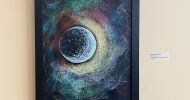
The article starts: I’m with my niece Erin, and we’re at the sixth exhibit, called “Creativity During Confinement.” We actually spot my moon paintings and drawings, which are behind me now. So anyway, when we spot them, we start crying, because it just kind of took us back to the two years of healing.
You know, I was riding a dog sled, flew off the dog sled, was dragged out of the forest, and needed a couple of surgeries, blood, and oxygen for a couple of weeks. I was in a nursing home doing rehab for many weeks. Even when I got home, I actually couldn’t go to where I was living, because I was still in a wheelchair. So my landlords, whose house I share part of, actually moved me into their son’s room and made it wheelchair accessible.
During that time, my niece came to stay with me. She was my full-time caregiver. Besides working 24 hours with me, she was also an artist, so she got me into art. She got me set up with a wheelchair on the patio, she got my supplies, and she kept encouraging me. The more I got into art, the more art became my go-to anytime I was having intrusive pain, and it was really effective. So to this day, it’s drawing that makes me the most pain-free.
Kevin Pho: So tell me more about that. As you were recovering from this injury, tell me how often you would draw. What specific art would you do? And how would that affect your pain?
Martha Sommers: Yeah, I would use pencils and colored pencils. And then every time, I’m adding. You have artist friends who get excited that you’re drawing, so you go from regular pencils to charcoal, to pastels, to fixing it, and to adding gel pens.
In the beginning, it was just kind of our daily routine. She wheels me out to the patio, and I’m drawing what I see. The patio looked out over the beautiful Ohio River. So I would draw the river, and you would draw the trees, and it was, you know, still before spring, but you draw that. Then I started drawing animals from Africa that I think I was missing, or drawing just about whatever was in front of me. And then I kind of settled on moons. I don’t know if it was that whole confinement, looking out through the moons, or also that you could see the moon come up each day. And since then, just a variety of things.
Right now, I draw probably, hmm, every week I do draw a few hours, usually in a sitting, and usually it is inspired by a time when I can’t sleep because of the pain. Then I get up and draw, or sometimes during the day. At that time, yes, it was a daily routine to draw. Then it went to more sporadic. And now that I work on things, sometimes I draw when I don’t have pain, just kind of touching them up. So I probably draw right now about 6 to 8 hours a week.
Kevin Pho: And when you were drawing, did that completely take your mind away from the pain?
Martha Sommers: For parts of it. Certainly not like you start drawing and then the pain is gone. No, it’s not like that. It’s more that you start drawing and get more into it, and then you kind of forget you have pain, and then it comes back a bit, and then you kind of keep going into it. So it certainly does not take it away all the way. Sometimes it’s a fight, and you’re not really able to draw so effectively; you’re kind of fighting it. But many times you do go into a zone, and you kind of get an hour or two free of pain.
Kevin Pho: Now, how did this experience affect your practice when you see patients in pain? Is this something that influences your treatment?
Martha Sommers: Yeah, it’s quite interesting, because this last month I’m now doing Thursdays at the nursing homes that are doing rehab. So, like this morning, I was seeing patients who had had painful accidents, who were doing rehab at a nursing home, and one of them I even had to examine had to remove from the same rehab situation I was in.
So how does it influence it? Well, sometimes it makes you so empathetic that you have to make sure that you’re being objective, too. Sometimes you kind of have to take a break and come back in, because you’re actually living your own experience, which is not the patient’s experience. But most of the time, it’s quite helpful. Most of the time you can share, “Yeah, I understand a little bit. I don’t understand your experience, but I have some experience with this.” And there’s that kind of idea of just using every tool possible. So it helps, but it’s still a learning process. It’s a learning process not to be triggered into your own emotions, which are not helpful to the patient.
And so I think that’s why I feel like we almost have this feeling that we have to be able to do this better. I try to figure out, is this something that, you know, we can do studies on? So what I’m doing right now is, Dr. Adam Frank is the head of research in our department, and I’m working with him on how to turn this idea of drawing as a tool for pain into a research study. I’m discussing with other colleagues whether we’ll be doing it at a nursing home or, you know, other places where people are in residence, whether we’ll be doing it as part of our addictions medicine, or whether we’ll be doing it with other patients who are chronic care patients. So we’re just kind of figuring that out now, so I can give you an answer in the future that says, “Yes, it’s really helping them,” versus kind of how to do that.
Kevin Pho: As far as you know, is there any data or studies that suggest a connection between art, and art can of course be more than drawing, it could be music as well, and relieving illness and pain? As far as you know, is there any data or studies supporting that?
Martha Sommers: Yeah, there is. There’s certainly data as far as art therapy, when someone works with an art therapist. There is also data for specific diagnoses, where they’ve termed it either programmatic visual art-making or therapeutic art-making. For that, there is some with cancer patients, children with cancer and adult patients. There’s some with dementia patients, though it wasn’t the main thing they were looking for. So those are the ones that did. Oh, and there was also one study on patients with dialysis where, again, it wasn’t what they were mainly looking for, but it showed decreased pain. So it’s diagnosis specific: some with cancer, some with patients on dialysis, and some with patients with dementia. And that’s all that we have so far.
What’s kind of interesting is I saw this last month that the article I did for KevinMD was cited in Discover Magazine, and they also cited the article that showed improvement with cancer pain.
Kevin Pho: We’re talking to Martha Sommers. She’s a family physician. Her KevinMD article is titled “Art as a tool to manage pain.” Martha, assuming that a lot of your studies come to conclusions that have fruition, what do you anticipate the role of art to be when it comes to managing chronic pain?
Martha Sommers: Well, I think it’s something that we don’t know. And I kind of liked that the article is even cited in Discover Magazine, so many other people’s ideas will come and will go forward. I think in the shorter term, something like drawing with supplies is something that could be rolled out if it shows to help in specific settings. It’s, let’s say, cheap enough. We could use artists or art teachers to give, let’s just say, we don’t have it worked out, but let’s say it was two-hour sessions over six weeks. Get people started, see how that works, and then go forward from what we learn.
And if that does work well, then, you know, again, it’s not the end-all, for sure. Friends and Facebook hits, you know, they had asked about it, but it’s another tool for a very hard-to-manage issue. And so my hope is it will play an increased role. We already know looking at art can be helpful, and listening to art can be helpful. So the hope is it will play an increased role.
Kevin Pho: And my final question: What are some of your take-home messages that you want to leave with the KevinMD audience?
Martha Sommers: Yeah, I think when you’re frustrated, look to the arts. We talked about drawing and how that can help with pain. I also did a lot of occupational therapy, but I didn’t get the nuanced movement in my left hand. So I’m taking piano lessons.
Yeah, in Pittsburgh. You can hear that I don’t have the best speaking voice. I really took speech therapy as a child, and then again in France, too, when I was learning French, but it was singing. It was actually taking singing lessons for two years that helped me to be more understandable in speech. So I think when you’re frustrated, look to the arts to give you more tools.
Kevin Pho: Martha, thank you so much for sharing your story, time, and insight, and thanks again for being on the show.
Martha Sommers: OK, thank you very much.
Listen and followApple PodcastsSpotifyYouTubeMore apps · Browse all episodes