

Subscribe to The Podcast by KevinMD. Catch up on old episodes!
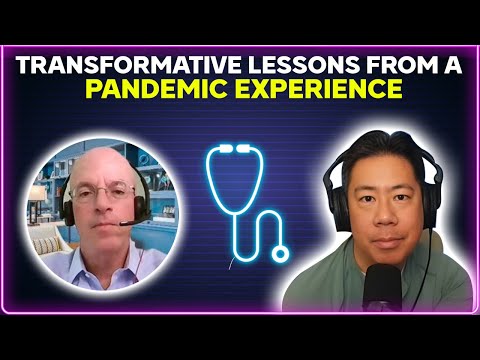
Join Lee Scheinbart, a medical oncologist, as he shares his transformative experience during the height of the COVID pandemic. Discover the power of intrinsic motivation, advocacy, and empathy in health care. In this episode, we delve into the lessons learned from a pivotal moment and how it reshaped his perspective on medicine.
Lee Scheinbart is a medical oncologist.
He discusses the KevinMD article, “A memorable day during COVID: Staying true to my calling.”

The Podcast by KevinMD is brought to you by the Nuance Dragon Ambient eXperience.
Ambient intelligence augments human capabilities to make our lives easier. The applications are many, especially in health care. Ambient clinical intelligence is offsetting the most pressing challenges in health care today, such as burnout, physician shortages, physician and patient dissatisfaction, and underperforming financial outcomes, by applying the technology to clinical documentation.
The Nuance Dragon Ambient eXperience, or DAX for short, utilizes artificial intelligence and natural language processing to automatically document care. It securely listens to and captures the natural, clinician-patient encounter conversation unobtrusively, and turns that conversation into a clinical note for the clinician’s review and signature directly in the electronic health record. You just talk naturally, and DAX does the rest.
DAX is being used by thousands of physicians across 30 different specialties nationwide. It has already won the Silver Stevie award in the health care technology category and was ranked #1 for improving clinician experience in KLAS’s top 20 emerging solutions.
VISIT SPONSOR → https://nuance.com/daxinaction
SUBSCRIBE TO THE PODCAST → https://kevinmd.com/podcast
RECOMMENDED BY KEVINMD → https://kevinmd.com/recommended
GET CME FOR THIS EPISODE → https://earnc.me/F15SRO

ADVERTISEMENT
Powered by CMEfy.
Transcript
Kevin Pho: Hi, and welcome to the show. Subscribe at KevinMD.com/podcast and get CME for this episode by clicking on the CME link in the show notes. Today we welcome Lee Scheinbart. He’s a medical oncologist. Today’s KevinMD article is titled “A memorable day during COVID: Staying true to my calling.” Lee, welcome to the show.
Lee Scheinbart: Thanks, Kevin. Thanks for having me.
Kevin Pho: So let’s start by briefly sharing your story and journey to where you are.
Lee Scheinbart: It’s a very traditional path. I came out of a small town in Ohio, went off to college, went off to medical school and entered the field of hematology. Then, around 2013, I drifted into administrative work and became the director of our local cancer center, then a vice president of medical affairs in our hospital system and ultimately the chief medical officer. I was in that position through COVID, until last summer, when I elected to take a career leap of faith and go in a different direction, and I ended up in medical education, which is what I’m doing now.
Kevin Pho: All right, tell me about that transition from medical oncology to medical leadership, and now to medical education. Talk about your latest transition.
Lee Scheinbart: Part of it is reflected in the article I wrote: the attempt to really stay true to what motivates me, my calling. At the end of my time as chief medical officer, I was losing touch with that calling, and it was time to take some space and find out what that looked like. That’s how I ended up drifting into medical education, which was serendipity. Our area has no local medical education, no undergraduate medical education or GME, and a group had been looking to put something together. I had gotten to know them over the years in the CMO role, and I took the opportunity when they approached me and said, “Hey, we understand you’re stepping away. Perhaps you’re retiring. Perhaps you want to come out of retirement and do this work with us.” And I said yes.
Kevin Pho: All right, so let’s talk more about what led you to that, which is the story in your KevinMD article, “A memorable day during COVID: Staying true to my calling.” Tell us how your article came together.
Lee Scheinbart: When I told my colleagues and friends that I was going to leave my career as a chief medical officer, it was very confusing for people. They didn’t understand, and I had a hard time articulating that deep sense that I wanted something else. Through the act of writing that piece, which I then shared at my going-away party, people came to understand what I was doing and what I was looking for. The day I refer to in the article was a sort of awakening. It came into my feelings first, and into my brain later, and as I wrote it out for the going-away party and then put it into article form, it made a lot of sense. I can go into a little more detail about what happened that day, if you’d like.
Kevin Pho: Yeah, absolutely. For those who didn’t have the benefit of reading your story, tell us what happened.
Lee Scheinbart: Florida is where I live, and it was a difficult place to manage COVID. As the chief medical officer, I was in our hospital incident command as our medical-technical specialist, really running the clinical response for all four hospitals in our system. As for everybody else, it was day in and day out, wash, rinse, repeat, and it was very challenging. I reached a point during the Delta wave, in August, when we were really assaulted by the number of patients seeking care. I was sitting at my desk, like I am now, looking at a computer with all this data in front of me and all these requests and needs, and we got an email request to start publishing certain statistics in our daily report that we weren’t sure were a great idea. My boss, the CEO, really jumped out of his chair and made some wild statements about that, which triggered me to jump out of my chair and run and shut the door, so nobody outside our command center could hear what we were talking about. He and I had some choice words later, and I wasn’t sure I was going to keep my employment.
But what was happening to me at that time: If you looked at me, I was wearing scrubs, I wasn’t shaving, I was down to my fighting weight, and I was staring at this computer and doing all this work all the time. I’m sure people around me thought, “He’s going to lose it. This is classic burnout. He’s depersonalized, he’s fatigued and he’s not taking care of himself.” And I will tell you, I didn’t know day, night, hour or weekend. I was zoned in. I was in a place like when I was practicing medicine, when I didn’t know I’d be running late with patients because I enjoyed the interaction, or I’d sit in tumor board and forget what time it was. I really figured out that I was meant to be there. It was good for me, and it was part of who I was, even though to the rest of the world it didn’t look like that. But once it was over, I couldn’t get that feeling again, and that’s what led me to start thinking, “How do I get that feeling in my life again?” I began to calculate a transition away, to get some space and see what would happen to me. That’s it in a nutshell.
Kevin Pho: Sure. Tell me about the interaction you had with the CEO that day. What kinds of statistics did he want to publish that triggered that?
Lee Scheinbart: The specific question, not verbatim, was generally whether we in the command center could publish not only our daily census of COVID and non-COVID patients, and we reached a point where 50 percent of our inpatient census was COVID. Compared to New York and other cities early on, it wasn’t as high; they were at 90, 99 percent. But for us it was a substantial amount. In the Delta wave, the vaccine had already come out about eight months prior, and people began to ask, “Well, can you tell us how many COVID patients have had vaccination, and how many people are dying with or without having had, or declared, a vaccination?” That was a sensitive topic. Everybody remembers how political it was, and perhaps still is, and how people were approaching their sense of well-being, and that just really got everybody going. The CEO felt there was no reason to discriminate in a published report based on what people had or had not done, and he literally said, “People die in a pandemic. That’s what they do.” That was explosive. It came from his heart, Kevin; I hope I don’t mislead anybody. It just came out.
Kevin Pho: So after COVID abated from its peak, you started to re-evaluate what your next steps were. Like you said before, you were trying to get that feeling back. As you were reflecting on that, what options were available to you at that time?
Lee Scheinbart: That’s a great question. I think the first thing was to really just do nothing for a while. If I was going to be retired, I really needed to understand what that felt like and what it looked like, and to let things happen to me. Because in medicine, so many things happen to us that feel out of our control, or we’re asked, “Hey, would you like to be a medical director?” Next thing you know, they ask you to be a vice president, and next thing you know, they ask you to do something else, and most of us just tend to fall into that. So I wanted to let things come at me and then take time to process them. A mentor suggested I read a couple of books, From Strength to Strength and The Second Mountain, both by Brooks. One is Arthur, and one is David; they’re not related. They really made me think about whether it was time for me to give back, what that would look like, how I would do it and whether it would generate the feeling I was looking for. So I just took this space and time to listen to all that.
Kevin Pho: How much time did it take before you decided to go down the path you did?
Lee Scheinbart: A couple of months. It happened quickly. By August, when I’d been not fully employed for a couple of months, the leadership of the medical education program came to me and said, “We’re going to keep doing this, and we’d really like some local help.” I said, “Well, let me do this at a part-time level, so that I continue to have space to think.” And over time, it was like a magnet. I enjoyed it. I got to go to the premedical student club at the local university, and I got to work with some of the medical students from the parent campus. I found that teaching and talking, and later writing, which is something I had forgotten I enjoyed, really brought me to a place where, if I could teach and provide guidance to all manner of folks in the medical field, that would give me back some of that sense. So that’s what I did.
Kevin Pho: So, hypothetically, let’s say the pandemic hadn’t happened, and you weren’t exposed to the intensity you were describing. Do you think you would have continued being CMO if the pandemic hadn’t happened?
Lee Scheinbart: No one has ever asked me that, and I’ve never given it any thought, but if I were to just speak from the gut, I would submit two things to you. I would have continued to stay in the role, and possibly even continued in that physician leadership. But I probably would have left anyway, because my wife and I had decided anyway to make a transition at this point in my life, and that would have started to take priority, in terms of what we wanted to do for each other and for the family. So that’s my quick answer.
Kevin Pho: Now, I talk to a lot of physicians and hear a lot of their stories, and a lot of them are at crossroads similar to the one you’re describing. Perhaps they’re losing their passion, or perhaps they’ve forgotten why they went into medicine in the first place, and they’re at that career crossroads. Tell us what kinds of questions they should be asking themselves to help guide their next step.
Lee Scheinbart: That’s really important, because even as I tell this story to you, I can sense how it can be confusing. I was busy and working hard, but I didn’t feel what people describe as burnout. I was exhausted, but it was that good exhaustion. But then you have to come down after the crisis. You do that in the military, and you do that in first-responder life: You have to come down and regroup. I knew the passion I was feeling was also going to fade, and I wanted to make sure it stayed part of my life.
So the number one lesson is to really listen to yourself and take the requisite time. It’s not a day off, and it’s not a week off. You really have to take a chunk of time, and only you, the clinician, know what that means. But you have to take a chunk of time and ask yourself a lot of questions: What did I like? What didn’t I like? Why didn’t I like it? Why did I like what I liked? Do that reflection and figure out what your internal motivations are. That’s part of leadership, and that’s part of getting older: What are you capable of? And I would submit to you that, given the work all of us have done in that mid-career zone, we’re working harder than ever. Everybody knows that, though nobody has actually calculated it. But if you did a time study, I guarantee we’re doing more tasks per patient than ever in the history of human medicine.
Kevin Pho: One of the things you mentioned earlier was that when you talked to your colleagues, friends and maybe family about your transition out of that leadership role into medical education, they were a little perplexed. They weren’t quite sure why you were doing what you were doing. Tell us more about that reaction.
Lee Scheinbart: I think the folks around me must have sensed that I enjoyed the role, took the responsibility seriously and seemed to thrive, and I’m trying to articulate that. So they thought it was a disconnect: How can somebody at the top of their game want to make a transition? I think that’s part of the difficulty in medicine. We do find ourselves doing a little of what they call surface acting, but deep down you’re feeling something else, and there’s a misalignment. You walk into a terrible trauma bay situation, and you’ve got to put on your game face. You’re telling somebody they have a terminal illness, and you have to put on the right face, but sometimes you’re not feeling that. So there’s a gap between what you’re doing on the outside and what you’re feeling on the inside. When they’re together, you feel really darn good. When they separate, it doesn’t feel that good. There are a lot of terms for this, and a lot of people study it; I’m not a researcher in this area. So I think that was probably the disconnect. I didn’t express to people what was really happening inside me. They only saw the external, so I had to find a way to close that gap, for them, in fairness, and for myself.
Kevin Pho: And as you reflect on this experience, if you were to replay this scenario, is there anything you would have done differently?
Lee Scheinbart: Probably not.
Kevin Pho: We’re talking to Lee Scheinbart. He’s a medical oncologist. Today’s KevinMD article is titled “A memorable day during COVID: Staying true to my calling.” Lee, tell us some of the take-home messages that you want to leave with the KevinMD audience.
Lee Scheinbart: Sure. I think what I’ve discovered is that, unlike a few generations ago, certainly even just one generation ago, medicine is no longer linear. It is no longer a pathway where you get your education and then spend 40 years doing the same thing day in and day out, and people still have that mental model. I think we need to be more open to the fact that it is a nonlinear career, and we need to learn how to be adaptable. We weren’t necessarily taught that in our training; it’s a very rigid sense of how to be a skilled, competent physician, and it doesn’t allow for the kind of weird trajectory a lot of other people go through in their careers. Really just try to listen carefully to where you want to go on that variable path in life, and don’t be so locked in that you’re stuck, or that you have to do it this way, or that it has to be this way. Wiggle around a little bit, see what that feels like and get out of your comfort zone.
Kevin Pho: Lee, thank you so much for sharing your story, time, and perspective, and thanks again for coming on the show.
Lee Scheinbart: Thank you, Kevin.


























