Listen and followApple PodcastsSpotifyYouTubeMore apps · Browse all episodes
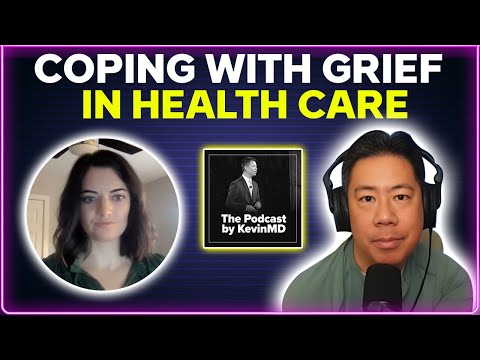
Join Natalya Beneschott, a pediatric infectious disease fellow, as she shares her personal experience and insights on coping with the lasting impact of a patient’s death, the challenges medical professionals face in processing grief, and the importance of creating a supportive environment for health care providers.
Natalya Beneschott is a pediatric infectious disease fellow.
She discusses the KevinMD article, “Coping with haunting memories of a patient’s loss.”

Our presenting sponsor is Nuance, a Microsoft company.
Together, Microsoft and Nuance are leveraging their rich digital technology and advanced AI capabilities to tackle some of health care’s biggest challenges. AI-driven technology promises to revolutionize patient and provider experiences with clinical documentation that writes itself.
The Nuance Dragon Ambient eXperience, or DAX for short, is a voice-enabled solution that automatically captures patient encounters securely and accurately at the point of care. DAX Copilot combines proven conversational and ambient AI with the most advanced generative AI in a mobile application that integrates directly with your existing workflows.
Physicians who use DAX have reported a 50 percent decrease in documentation time and a 70 percent reduction in feelings of burnout, and 85 percent of patients say their physician is more personable and conversational.
Discover AI-powered clinical documentation that writes itself. Visit https://nuance.com/daxinaction to see a 12-minute DAX Copilot demo.
VISIT SPONSOR → https://nuance.com/daxinaction
SUBSCRIBE TO THE PODCAST → https://kevinmd.com/podcast
RECOMMENDED BY KEVINMD → https://kevinmd.com/recommended
GET CME FOR THIS EPISODE → https://earnc.me/9GIZCt
Powered by CMEfy.
Transcript
Kevin Pho: Hi, and welcome to the show. Subscribe at kevinmd.com/podcast and get CME for this episode by clicking on the CME link in the show notes. Today we welcome Natalya Beneschott. She’s a pediatric infectious disease fellow. Today’s KevinMD article is titled “Coping with haunting memories of a patient’s loss.” Natalya, welcome to the show.
Natalya Beneschott: Thanks for having me.
Kevin Pho: So let’s start by sharing your story and journey to where you are today.
Natalya Beneschott: I am a pediatric infectious disease fellow in the middle of my fellowship training right now. I got into pediatrics really after going through medical school clerkships and realizing how invigorating peds felt, especially when I was maybe physically or emotionally drained from another clerkship. And then I got into infectious disease really after recognizing how much I love to deep dive and care for a variety of patients across the spectrum of disease.
Real physician voices, twice a week
Free, and one click to unsubscribe.
Kevin Pho: So tell us about a typical day. What are some typical cases you will see as a pediatric infectious disease fellow?
Natalya Beneschott: A lot of it is inpatient; however, we do follow a lot of patients in the clinic as well. So you might be, say, in the NICU managing patients who maybe have maternal infections, TORCH infections, maternal HIV, things like that, or premature infants who are struggling with meningitis or things like that. But a lot of it can involve some of the more complex patients, like in the cardiac ICU and transplants, and managing invasive fungal disease. So there really can be a spectrum, while also getting calls from the community docs who might need help with, say, an osteomyelitis. So there’s no day that’s the same, but it’s definitely engaging and keeps me on my toes.
Kevin Pho: All right. So you shared one of these stories in your KevinMD article. It’s titled “Coping with haunting memories of a patient’s loss.” So tell us, how did this article come together? And share that story.
Natalya Beneschott: I was finishing up my first year of fellowship, which for us is the most intensive clinical service year, and there was one neonatal death that really stuck with me. I remember thinking, “Why this patient? Why now? Why is this scenario really sticking with me?” Thinking back on it, I was able to recognize that I was really grieving this patient over a matter of months. I also was able to reflect a little bit on the difference in how people on the medical team were processing this patient death. There was a new medical student who was truly devastated and had a very appropriate, raw response. There was the kind of compartmentalization of other members of the team, where they were able to respectfully honor that patient but then keep moving on, as we all have to do in our day-to-day. And then there were also some of the more senior people on the team, who were able to be very emotionally poised and actually help others cope.
So I wrote this article as a way to share my own experience of how I process my grief, but also how I think in the medical community we maybe need to be a little bit more aware of our own needs and the needs of our staff, and especially our learners, who might not have had the same training, especially in medical school, where a lot of it may have been virtual. So they might need a little bit more help in developing those skills and in how to be able to sustain their career in medicine.
Kevin Pho: So tell us that story. Tell us a little bit about that specific case.
Natalya Beneschott: We had a neonate come in with a TORCH infection who was instantly just so ill, with multi-organ failure, one of the sickest.
Kevin Pho: So for those who aren’t familiar with a TORCH infection, what is that?
Natalya Beneschott: Sorry. There are a handful of infections that can be transferred from mom to baby, and they can be very, very serious and either have a poor prognosis or be lethal to the baby. With this particular infant, there was nothing that could have been done to prevent this particular infection, and so it was especially devastating, as the parents were so appreciative and so deserving and would just thank everyone on the medical team every day who really was able to care for them. But ultimately, the patient ended up passing after a few weeks. I think it was especially hard watching the slow process of that with multi-organ failure, and I think that’s one of the reasons it was especially hard for everyone involved.
Kevin Pho: So you mentioned that when the infant unfortunately passed, there was a spectrum of responses, from the medical student all the way up to the attending. In that immediate aftermath, describe that scenario. What exactly was it like?
Natalya Beneschott: I think there’s the immediate response, where everyone that day was a little more solemn and processing it and trying to be sensitive to other people’s needs. But there wasn’t really a time-out, which I think may have been helpful, not only in being there for the family but in recognizing that everyone’s needs might be a little bit different. Some people might need a little more time to themselves to think; others might need some form of distraction. So for us, in the moment, it was unfortunately more of that compartmentalization, as it’s the middle of the day, unfortunately, and there are a lot of other very sick patients who need to be seen.
As time went on, I was able to talk to a handful of people on the team, and we ended up having a morbidity and mortality conference that included this patient. I think that was actually really helpful, not in that there was anything wrong, the management didn’t include a significant error or anything, but in really recognizing that everybody had a little bit different experience with this family, and sometimes, no matter what you do for a patient, they may succumb to their disease.
Kevin Pho: So tell us about your personal reaction. You mentioned that along that spectrum, the attendings would share some of their wisdom and help comfort the team. What was your reaction, and what was your role on the team in that aftermath?
Natalya Beneschott: I think my first response was to try to help the medical student, as I had heard from someone else in the hospital that she was very, very upset. I tried to hear her and give her that space to talk, while also recognizing that it was helpful for me to talk about how I was feeling about that scenario. Then, with time, I was able to talk with the learners and say, “These are some of the ways that people find it helpful to cope with these scenarios,” and recognize that it’s not something that is instantaneous. No matter how far along you are in your career, patient deaths are never going to be easy. And while some people may seem very poised and like it doesn’t affect them, moving families through a dying infant is never normal. It’s OK for us to feel abnormal, even though what we do day to day is very abnormal.
Kevin Pho: And how about yourself? How do you cope with what you say is always an abnormal situation, where an infant or a neonate passes away? How do you cope with these emotions?
Natalya Beneschott: I have a really good support network. I think there’s a portion of me that needs to talk some of it out and also recognize why this is bothering me now, what part of it is triggering me. And even though I may have shared my experience with someone, over time I might need to talk through it again as I am able to process my own emotions. So I think it’s not necessarily going through the stages of grief, but the ebbs and flows that come with coming to terms with reality: being able to process it by talking and by just really sitting with those uncomfortable feelings in a safe space. I was able to do that. And, I mean, initially I intellectualized it, especially with some of the teaching and looking more into presenting for the M&M and going through the literature, but it’s definitely a process and takes a lot of time.
Kevin Pho: One of the things that you mentioned while you were telling your story was that the attending tended to compartmentalize some of their reaction to it. You are in the midst of your fellowship training, and eventually you will become a pediatric infectious disease attending yourself. So if you were to encounter a situation similar to this in the future, would you do anything differently with the team if this happens again?
Natalya Beneschott: I think I would. I think a lot of it is setting the situation up beforehand, especially if it’s impending, where there might be an imminent death, and being selective about who is involved, but also talking with the team about the process and giving them the freedom to elect: Do they want to be there? Do they want to be involved? Here is when it’s appropriate to talk to the family. And while we have to respect what other people’s needs are in this moment, especially the family’s, we need to also respect what you’re feeling. Offering that support ahead of time, preemptively, I think can actually be really beneficial. And then also following up with the team and saying, “Hey, are you doing OK?” I think oftentimes, especially with the first patient death, learners shouldn’t go right back into clinical duties. Giving them the time, the rest of the day at least, to just be and reflect upon that I think is really important.
Kevin Pho: To be clear, a lot of institutions, I hear, don’t have any formal training in terms of dealing with a situation like this. It’s almost on a case-by-case basis, depending on who the senior resident, fellow, and attending are. Some people may compartmentalize those reactions, and some people may be like yourself and really be more reflective on this situation. In your experience, is there any type of formal training, any type of institutionalized reflection after patient deaths?
Natalya Beneschott: I don’t really see much formal training. Anything that we do learn, I think, is more patient-centered, appropriately, but not really with the tables turned, in terms of how do we help ourselves, how do we help people on the medical team. There are resources available that are fairly nonspecific, in terms of having counseling and things like that, but I felt like I needed to educate myself on how to help others, especially with the variety of things that we’re seeing now in patient care. And like I mentioned, a lot of the training that our trainees are going through has been virtual, especially with the pandemic. I think we need to address this, especially if we want to help with burnout, physician burnout, physician suicide, things that are very imminent. I think we need to really help the people so that we can help ourselves.
Kevin Pho: So you mentioned that you took the initiative to educate yourself about dealing with situations like this. What did you do?
Natalya Beneschott: I think for me, I am fortunate that I have some people in my support system who are psychologists themselves. So it was talking with them, learning what I can do, reading online, reading different books, even going onto your platform and seeing what other ways people in the field are recommending that we process, so we do have that ability to continue working. I think it’s something that I’m always interested in and always learning about. There’s no perfect way to do it, but for me it was really having to read elsewhere and utilize other people’s expertise.
Kevin Pho: So you mentioned that this case was discussed in morbidity and mortality rounds. Take us into that room. How much of that time was spent dealing with the emotions of the team during that difficult case?
Natalya Beneschott: Very, very minimal time, unfortunately, was about the actual processing of this situation. I mean, the time that I heard the PICU fellow, who obviously is very versed in important outcomes and patient death, it was only as he was walking out that I heard him say, “This patient still haunts me.” I tried to set the stage for talking about that a little bit more, but I think oftentimes it’s hard to overcome that barrier and make yourself vulnerable and say, “This was really hard, and I’m struggling.” I don’t think we’re good at that as physicians. It’s almost trained out of us to address and recognize our own weaknesses. But I think we have to. I wish I had made myself, even in that moment, be more vulnerable and say, “Hey, this was something really hard. Did anybody else really struggle with this particular scenario?”
Kevin Pho: What would you like to see happen? It sounds like eventually, when you’re an attending, you would give your team that space to reflect whenever a similar situation comes up. On a more systemic level, what exactly would you like to see happen to help with this situation?
Natalya Beneschott: I think existing physicians need the training to help other people on the team. I’m not saying it needs to be another online module, but at least having the resources available and saying, “These are ways that are more evidence-based that can be helpful in processing and overcoming some of this grief.” And then making sure that the next generation coming in is really armored with those tools, and that it is a continuous process that we can work to improve upon, and not just throwing the number of the student health center at learners, or saying, “Hey, here’s the hotline to call if you’re suicidal.” I don’t think that’s sufficient. I think we need to be much more proactive and improve upon the physicians that are already there, but, like I said, really start ingraining it into the teaching now.
Kevin Pho: When you talk to other pediatric infectious disease fellows across the country, or even your colleagues across the country, is it common not to have that space after a difficult patient experience? Is your situation unique, or do you feel like this is happening elsewhere as well?
Natalya Beneschott: I don’t think it’s unique. I think, particularly in areas where you’re going to be managing critically ill patients, there’s always the option, and I feel like I have the support to ask. It may take some time, it may take a moment, but it’s definitely not available, and so it’s really having to advocate for your own space. And when I say space, it’s not like there’s a given space, even within the hospital, where I could sit to really be alone if I needed that moment, or tell a trainee, “Hey, here’s a spot where you can go and be.” So I think that would be helpful going forward.
Kevin Pho: We’re talking to Natalya Beneschott. She is a pediatric infectious disease fellow. Today’s KevinMD article is titled “Coping with haunting memories of a patient’s loss.” Natalya, why do we end with some take-home messages that you want to share with the KevinMD audience?
Natalya Beneschott: I think one of the biggest things is recognizing that while we try to honor the families when a family member is dying, or a son or daughter, we also need to honor ourselves and give ourselves the time and space to really process what we do on a day-to-day basis. And then just being cognizant of those emotions that a lot of us are going to compartmentalize. Over time, those compartments are going to be full, and being able to be in the moment and experience those emotions is ultimately uncomfortable, but it’s going to help in the long run and make it so you can really sustain yourself. So I just encourage people to advocate for themselves just as much as they advocate for their patients.
Kevin Pho: Natalya, thank you so much for sharing your story, time, and insight, and thanks again for coming on the show.
Natalya Beneschott: Thank you, Kevin.
Listen and followApple PodcastsSpotifyYouTubeMore apps · Browse all episodes