Subscribe to The Podcast by KevinMD. Catch up on old episodes!
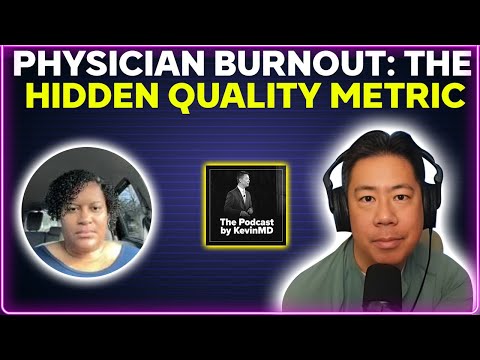
Join Trina E. Dorrah, an internal medicine physician. We explore the concept of integrating physician burnout as a quality metric in health care. Discover why Trina believes this change could revolutionize the American health care system, potentially saving lives and improving patient care.
Trina E. Dorrah is an internal medicine physician.
She discusses the KevinMD article, “It’s time for burnout to become a quality metric.”

Our presenting sponsor is Nuance, a Microsoft company.
Together, Microsoft and Nuance are leveraging their rich digital technology and advanced AI capabilities to tackle some of health care’s biggest challenges. AI-driven technology promises to revolutionize patient and provider experiences with clinical documentation that writes itself.
The Nuance Dragon Ambient eXperience, or DAX for short, is a voice-enabled solution that automatically captures patient encounters securely and accurately at the point of care. DAX Copilot combines proven conversational and ambient AI with the most advanced generative AI in a mobile application that integrates directly with your existing workflows.
Physicians who use DAX have reported a 50 percent decrease in documentation time and a 70 percent reduction in feelings of burnout, and 85 percent of patients say their physician is more personable and conversational.
Discover AI-powered clinical documentation that writes itself. Visit https://nuance.com/daxinaction to see a 12-minute DAX Copilot demo.
VISIT SPONSOR → https://nuance.com/daxinaction
SUBSCRIBE TO THE PODCAST → https://kevinmd.com/podcast
RECOMMENDED BY KEVINMD → https://kevinmd.com/recommended

ADVERTISEMENT
GET CME FOR THIS EPISODE → https://earnc.me/b5MF6u
Powered by CMEfy.
Transcript
Kevin Pho: Hi, and welcome to the show. Subscribe at KevinMD.com/podcast, get CME for this episode by clicking on the CME link in the show notes. Today we welcome back Trina E. Dorrah. She’s an internal medicine physician. Today’s KevinMD article is “It’s time for burnout to become a quality metric.” Trina, welcome back to the show.
Trina E. Dorrah: Thank you.
Kevin Pho: So Trina’s been on several times. Go to KevinMD.com/podcast, search for her name and her prior episodes, hear her story. Let’s jump right into this article about burnout. You think it should become a quality metric. Tell us about your article.
Trina E. Dorrah: Well, I did a fellowship in quality improvement after I finished my residency, and so I worked in quality improvement for several years. And as you probably know as a physician, since quality metrics have become so important, I mean, there are entire departments dedicated to making sure hospitals meet the quality metrics. So many different people have been hired specifically for these metrics, and whenever Medicare comes out with a new metric then all of these resources get devoted to meeting it, because the hospitals don’t want to lose money.
And so I was thinking, well, what if burnout, or some way we could measure the burnout, what if that also were a quality metric? Then what kind of resources would be devoted to helping with burnout if this really were a quality metric? And then how would the quality of those resources increase or improve from the resources that are available now?
Kevin Pho: Why should administrators care about physician burnout?
Trina E. Dorrah: Right, so I think that ultimately it affects the patients. And so we are all in medicine because we felt a calling to help patients in this way, but whenever you’re burned out it’s just so hard to focus, it’s hard to care, you can lose some of your compassion and your empathy. And then it also can affect quality metrics. Whenever people just feel burned out and they don’t feel cared for, they don’t go the extra mile a lot of times. Or maybe they still are really trying very hard, but they just are not in the mental place to be able to do a good job, they don’t have the resources that they need to do a good job. And so I think that all of the things that hospital administrators care about would actually improve if they started first by focusing on their physicians and medical staff.
Kevin Pho: There’s a cost when it comes to replacing clinicians who leave because of burnout, isn’t that right?
Trina E. Dorrah: I know there was a study that we had spoken to our administration about, and I believe it said it was about a million dollars to replace a physician. And I’m sure it depends on the type of physician and how much lost revenue there is while they are searching for another physician.
And I think a lot of times what health systems do is they just add that person’s work to everyone else, and then they say, well, we’re still seeing patients, and so it’s fine. But I don’t think that they realize how adding that person’s work to everyone else, while they are finding someone else, is just increasing the burnout of those people who are left behind.
Kevin Pho: So when you brought this argument up to administration, saying it costs a million dollars to replace a physician, did that argument resonate with them?
Trina E. Dorrah: Yes, I would say that it did. And I would say this for all health care administration, that money does talk, right? And so they are interested in the financial side of things. So I do think that it helps your argument, for anyone listening who is wanting to really put some financial resources into helping reduce burnout at your organization. I do think that that is an important thing to point out, because it’s one thing to talk about maybe the less tangible outcomes, but I think whenever you show how much it costs to replace someone, then I think that administrators really do listen, because that is what they’re trained in. They’re trained to pay attention to the financials.
Kevin Pho: So let’s say you were running a medical institution, and I want to ask you, how exactly would you measure burnout? What are some of the things that you would look for? What are some of the things that you can objectively measure to track burnout?
Trina E. Dorrah: Right, the one that I’ve seen used most often is the Maslach Burnout Inventory. It’s been around a long time, and so that is what I have seen most often. There’s also another one that I think would be great to measure, because I think a lot of physicians are lacking in self-compassion, and so there is actually a survey by Dr. Kristin Neff on self-compassion. You could measure that. And so I think I would use the Maslach, I’d probably use the self-compassion survey, just because physicians are so hard on themselves, and so I think it would be nice to see if the self-compassion improved.
Kevin Pho: Now, for those who aren’t familiar with those surveys, what kind of questions do they typically ask?
Trina E. Dorrah: In general, the Maslach Burnout Inventory, there’s three kind of main categories, and it’s basically trying to figure out, do people have a sense of accomplishment at work, do they already feel like they have depersonalization at work, are they already feeling like it’s too much to handle? And so there are several questions that kind of help figure that out.
And then the self-compassion survey is just asking a lot of questions basically trying to assess how kind you are to yourself. Because again, physicians are so hard on ourselves, and I do think that that is one of the things that leads to burnout, like we think that we must do everything perfectly. And I’m not just talking about work, but in the rest of our life as well, and we don’t give ourselves a lot of grace.
Kevin Pho: Now, once an institution has this data, how can they be held accountable for poor results of this data?
Trina E. Dorrah: Right, well that’s what I’m arguing for, is that that would be a Medicare metric. And so just like all the other Medicare metrics, you have to submit your data to Medicare, and depending on the metric they compare you to your peers all across the country, and they have a cutoff, and certain institutions maybe can keep all of their money or certain institutions then lose money. And so that is what I would argue Medicare could do, is they could have institutions held financially accountable to decreasing burnout, increasing work satisfaction.
Kevin Pho: So you are a coach, and of course you are very familiar with physician burnout. Again, speaking from the institutional level, what kind of interventions have you seen to be effective in terms of improving the metrics of physician burnout across an institution?
Trina E. Dorrah: Right, so I would say that one intervention is coaching. And there’s actually been data from randomized control trials that have been published in recent years, the first one I remember was 2019, showing that coaching and coaching programs can reduce burnout. And I think that coaching is a great solution. Every year more and more physicians are becoming coaches, so there’s no lack of coaches that health systems across the country could contract with to work with their physicians and their medical staff.
Kevin Pho: So how can you scale up coaching? Because coaching I always envision as a one-to-one thing, and when you have a system of hundreds of physicians, how can coaching work at that scale?
Trina E. Dorrah: Right, and so yes, there is an option for one-to-one coaching, but there’s also group coaching as well. And so I myself have been part of group coaching programs, and there’s hundreds of people in the program. What you will find actually is that it’s a lot of the same things that people bring up over and over again. So even if I’m not getting coached, there is someone that’s talking about very similar things to what I experience in my life, and so you can actually learn a lot from hearing other people get coached.
And then you can teach people a concept called self coaching, where they can learn to examine some of their own thoughts and figure out whether those thoughts are helpful or not. There are virtual libraries of information where people can learn topics that are helpful. So I do think that there are ways it can be scaled beyond just the traditional one-to-one model where you spend an hour with every person.
Kevin Pho: So share a story or a case study where maybe one of these group coaching sessions has improved the metrics of a particular institution, improved the scores on these surveys, improved patient care. Can you just share a story of how this might look, that would move the needle?
Trina E. Dorrah: I’ll give you a hypothetical example. But think about just in these last few years how burned out everyone has been because of COVID and everything that went along with that. And so people can only work to a certain point until they develop that compassion fatigue, until they start to not want to go the extra mile, until they just kind of stop caring. And I think that by implementing these programs it helps to prevent physicians from getting to that point.
And so therefore all these other metrics that we talk about, reducing UTIs, reducing central line infections, reducing C. diff, or those types of things, I think you have a workforce who is more bought in, more engaged, they are in a mental space to actually think about these things and not just be trying to survive every day. I think that that’s how burnout can help with those metrics.
But then I think that that shouldn’t be the only reason we should do it. We know that there are a lot of physicians who die by suicide every year, and so this could potentially be a way of reaching our colleagues before they get to that point, or before they get worse, if we had comprehensive coaching programs and comprehensive support. And like I said, the reason I like the idea of Medicare kind of holding people accountable is, that way health systems wouldn’t just say, OK, let’s do the pizza party and that counts. They would have to come up with actual interventions that really do work.
Kevin Pho: Now, in your experience, do you feel that medical institutions and administrators, are they taking burnout seriously?
Trina E. Dorrah: I think that they do care sometimes. I think that they don’t really know what to do about it, but I do think that they do need more education on it and more of a motivation to care.
Kevin Pho: We’re talking to Trina E. Dorrah. She’s an internal medicine physician. Today’s KevinMD article is “It’s time for burnout to become a quality metric.” Trina, let’s end off with some of your take-home messages that you want to leave with the KevinMD audience.
Trina E. Dorrah: If you know how to get Medicare to pay attention to this, I would love to take this message to them. But the one thing I do want to leave people with is, we do have an evidence-based intervention to help reduce burnout, and that is coaching. And there are every year increasing numbers of physician coaches out there, and a lot of us like myself are still practicing medicine, and so we are in the trenches just like everyone else, and we’re able to use our coaching skills to help our colleagues. And I would encourage everyone to reach out and find a coach. You can find coaches in all different areas, all different price points. So yes, coaching works, that has been shown by evidence.
Kevin Pho: Trina, thank you so much for sharing your time and insight, and thanks again for coming back on the show.
Trina E. Dorrah: Thank you.