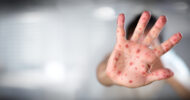
On Saturday, August 29, 2026, a headline in my local paper caught my eye. There were 460 confirmed measles cases in Pennsylvania as of Friday, August 28, according to the Pittsburgh Tribune-Review. As of Wednesday, September 16, there are 731 cases in 38 of Pennsylvania’s 67 counties, and over 120 hospitalizations.
A brief search of the CDC website shows that since 1991, the number of measles cases nationwide has been in the low one hundreds, and in some years fewer than 100 cases. It saddens and angers me that we are moving backwards. Due to the current outbreak, the United States is on track to lose its measles elimination status when the Pan American Health Organization meets in November 2026 to review the data.
The shift to more cases is directly related to three factors. First, the virus that causes measles is one of the most contagious viruses on Earth. Since it is a virus, treatment is supportive, not curative. Vitamin A does not cure measles. Second, the number of people vaccinated in order to support herd immunity in the general population has decreased, leaving infants younger than one year old and the immunocompromised at risk. Vaccine hesitancy and suspicion of science have increased since the pandemic, and while there have always been groups of people who have been vaccine hesitant, there were cohesive public policies and education campaigns which encouraged the public to get vaccinated. The message was clear and concise. Vaccines save lives and prevent suffering. This message is being undermined directly by the secretary of the U.S. Department of Health and Human Services, Robert F. Kennedy Jr. I have decided that I will not take advice from a man as unqualified for his position as he is, no matter what his title.
Prior to the vaccine, the only way to stop the spread of the virus was quarantine. My grandmother lived in New York City in the 1920s before the measles vaccine was available. Quarantines for measles were expected and predictable every spring and fall due to the high population density and contagiousness of the virus. The year that my grandmother and her siblings caught measles, my great-grandfather moved out of their apartment for nine months as the virus went from child to child at an agonizingly slow rate. My great-grandfather had to support the family who was living under a quarantine order initiated by the Department of Health. My great-grandmother was alone in caring for a household of sick children. It was a hardship on everyone in the family. Thankfully, everyone recovered, but do we want to go back to quarantining the population for long periods of time? It didn’t work out very well during the COVID-19 pandemic. It is no wonder the measles vaccine was embraced as a miracle when it was introduced.
Real physician voices, twice a week
Free, and one click to unsubscribe.
My husband contracted measles when he was fifteen. He was vaccinated before 1968, and the earlier versions of the vaccine were not as effective and only one dose was required. It is the sickest that he’s ever been, and that includes his bout with COVID-19. He remembers lying on his bed in his underwear because he felt so hot. His fever hit 105 and was climbing. His father served in the Army in the Korean War as a hospital corpsman. My in-laws had three boys who sustained many illnesses and injuries over the years, but my husband said this was the only time that he ever saw his father scared. His father turned to his mother and said, “Get me a mixing bowl with ice water, a bottle of rubbing alcohol, and a washcloth.” My husband remembers him mixing the alcohol in with the water, and soaking the washcloth. He remembers the cold washcloth touching his feverish skin, and he passed out with the shock. That was the last thing he remembers until he woke up three days later.
In 2021, while speaking in Lancaster, Pennsylvania, the heart of the current outbreak in Pennsylvania, RFK Jr. made a speech making light of having the measles, stating in part that he was “very, very lucky to have lived through that nightmare because we had to stay at home and watch TV the whole week with all of my brothers and sisters.” This drew laughter from his audience. While I am happy that the secretary had a mild case of the measles, not everyone is so lucky. So far, there are now four deaths associated with the current outbreak, one of which was the death of an infant too young to receive the vaccine. His complete dismissiveness of the seriousness of this particular disease, the mixed messages he is sending, and disregard he has shown for the experiences of others are astounding for someone whose job it is to safeguard the health of a nation.
Humanity has made so much progress eliminating or at least ameliorating the effects of illnesses that used to kill or leave people, especially children and their families, dealing with long-term complications. Because of the strides made due to scientific research and vaccines, worrying about diseases like measles, mumps, rubella, and polio is mostly history. The downside of this is we have several generations who have not seen these vaccine-preventable diseases and the negative, sometimes chronic, or even lethal effects that they cause. My sincere hope is that we don’t have to go backwards to a pre-vaccination era of illness or even death to discover how lucky we are.
This essay is cited in the KevinMD record on vaccines.
Christine King is a certified registered nurse anesthetist (CRNA) with 20 years of experience in a field that demands precision, empathy, and a deep understanding of health care. Her clinical background informs a holistic perspective she brings to life’s challenges, whether in the operating room or in everyday life.
Now focused on writing, she draws on two decades of practice to explore the human side of medicine. Her work has appeared on KevinMD, and she writes at The Best Third and on Medium. She shares updates on LinkedIn.h