Subscribe to The Podcast by KevinMD. Watch on YouTube. Catch up on old episodes!
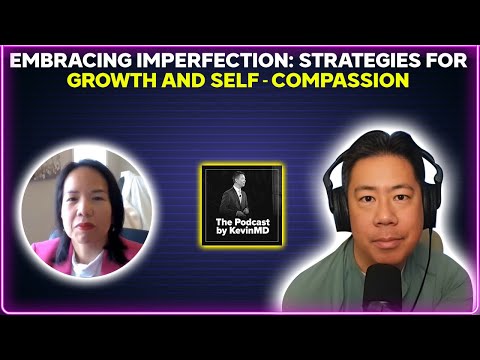
Join Caissa Troutman, an obesity medicine physician, as we delve into the intricate relationship between self-perception, mistakes, and personal growth. Caissa shares insights on how our beliefs about perfectionism shape our reactions to failure and explores the transformative power of self-compassion and mindfulness in navigating setbacks. Discover practical strategies for breaking free from self-judgment, embracing imperfection, and cultivating intentional living.
Caissa Troutman is an obesity medicine physician.
She discusses the KevinMD article, “Navigating self-judgment with compassion.”

Our presenting sponsor is Nuance, a Microsoft company.
Together, Microsoft and Nuance are leveraging their rich digital technology and advanced AI capabilities to tackle some of health care’s biggest challenges. AI-driven technology promises to revolutionize patient and provider experiences with clinical documentation that writes itself.
The Nuance Dragon Ambient eXperience, or DAX for short, is a voice-enabled solution that automatically captures patient encounters securely and accurately at the point of care. DAX Copilot combines proven conversational and ambient AI with the most advanced generative AI in a mobile application that integrates directly with your existing workflows.
Physicians who use DAX have reported a 50 percent decrease in documentation time and a 70 percent reduction in feelings of burnout, and 85 percent of patients say their physician is more personable and conversational.
Discover AI-powered clinical documentation that writes itself. Visit https://nuance.com/daxinaction to see a 12-minute DAX Copilot demo.
VISIT SPONSOR → https://nuance.com/daxinaction
SUBSCRIBE TO THE PODCAST → https://kevinmd.com/podcast
RECOMMENDED BY KEVINMD → https://kevinmd.com/recommended

ADVERTISEMENT
GET CME FOR THIS EPISODE → https://earnc.me/REkRUe
Powered by CMEfy.
Transcript
Kevin Pho: Hi, and welcome to the show. Subscribe at KevinMD.com/podcast, and get CME for this episode by clicking on the CME link in the show notes. Today we welcome Caissa Troutman. She’s an obesity medicine physician and a family physician, and her KevinMD article today is “Navigating self-judgment with compassion.” Caissa, welcome to the show.
Caissa Troutman: Thanks for having me, Kevin.
Kevin Pho: So we’ll talk about your article in a little bit, but first off, briefly share your story and journey.
Caissa Troutman: Yeah. So, I’m Caissa Troutman. I’m triple board certified in obesity medicine, culinary medicine, and family medicine. I opened my direct care weight and wellness practice here in central Pennsylvania late last year, and I help patients lose weight for the last time.
Modern science has shown us that it’s not as simple as calories in, calories out, so I help my patients understand their unique brain and biology to achieve that long-term weight loss. That’s something I speak about not just from a professional standpoint but also from personal experience, as a person with obesity who has lost and kept off almost a third of my body weight.
Kevin Pho: All right, so you mentioned that this is a direct pay obesity medicine practice. So talk about your typical day and some of the cases and patients that you would see routinely.
Caissa Troutman: Yes. So again, my own practice is fairly new, it’s about five or six months in. Prior to that I was the medical director of an integrated system, a big system over in central Pennsylvania.
A typical day now in my own practice, which is my dream practice, is that I see my patients in the office, but I also support them outside of the office. When I see them in my office or by telemedicine, we really look at the four pillars. How are they doing with their nutrition? Can we make some tweaks in their nutrition that will generate the goal that they want? We talk about physical activity and the common barriers they experience, because everybody’s life is different. My life is different from my patients’ lives.
We talk about stress and sleep a lot, because a lot of my patients struggle with stress, for sure, and there is that connection where we eat when we’re stressed, we eat when we’re overwhelmed, which is part of what my article is about. And I also prescribe FDA-approved anti-obesity medications as a tool to help with their lifestyle modifications and with instituting the practices that we want.
Kevin Pho: All right, so let’s talk about your KevinMD article. It’s titled “Navigating self-judgment with compassion.” For those who didn’t get a chance to read your article, tell us what it’s about.
Caissa Troutman: Yeah. So this came about because one of the things I do in my practice is send a weekly thought, I call it Monday Musings from Your MD, to my patients. It can range across topics from nutrition to physical activity, and this particular time I actually just shared an excerpt from my life.
So it talks about how I made a mistake, a mistake that certainly, looking at it from different points of view, could have been prevented. But in the end the mistake happened. And as a physician, as I think most physicians are, we’re all very hard on ourselves. We have such a harsh inner critic.
I would say I am a recovering perfectionist, and that perfectionist attitude created a behavior for me, which was emotional eating. That’s how I got tuned into it. I first looked at the behavior and thought, why am I eating when I’m not hungry? This is exactly what I tell my patients about, don’t eat when you’re not hungry. So I used that time, when I was eating and I wasn’t hungry, to pause and say, why am I eating when I’m not hungry?
And then from there I dove into, OK, the reason why is this, the reason why is this, which brought me to the thought that I’m a perfectionist. And it was so mind-blowing for me to realize at that moment that I was living under the weight of, I cannot make mistakes.
Obviously I know that everybody makes mistakes. The rational part of me knows that everybody makes mistakes. But the reason I was so hard on myself for this mistake was that I was under the belief that I couldn’t make mistakes. And it made me realize, too, retrospectively, why I’m always so hard on myself for things that happen either outside of my control or, certainly sometimes, because of what I did.
Kevin Pho: So tell us, how did you come to that realization? What was the thought process behind that, that made you think, hey, I need to make a change, or I realize that I have to change?
Caissa Troutman: I always tell my patients, when you find the behavior, find the underlying reason or thought, because when you realize what that is, that will help you change.
Meaning, we know when we’re doing something that we know we’re not supposed to be doing, but we do it anyway. Exercise more, drink more water, eat my veggies. We all intellectually or rationally know that that’s what we should do, but we end up not doing it. Anybody want to raise their hand and say that’s kind of who we are? So when that happens, it’s always because there’s a reason why we’re not doing it.
In this case, I’m an obesity medicine doctor, I shouldn’t be eating when I’m not hungry, and I try my best to willpower my way out of it by putting the cake away, by not surrounding myself with trigger foods. But I still found myself doing that, that habit. So it was, OK, why am I doing this again, what’s happening? And then, is it in line with who I want to be? Is it aligning with my goals? And obviously eating when I’m not hungry does not align with my goal to keep the weight off.
So that’s how I would say we begin to change, when we realize the action isn’t generating the result we want, and ask whether it’s in line with the person you want to be, the future you, or the future me.
And then from there, OK, if I keep thinking this, then I’m going to keep eating the cake. If I keep thinking that I can’t make mistakes, then I’m going to keep buffering the emotion. So that’s how I started. OK, if I want to change this behavior of eating the cake, I have to change my thought. And what is a good thought to have, so I could feel better?
And that’s where I came upon Kristin Neff, that idea of self-compassion and not self-judgment. I’d heard about her before, I’d read her work before. I guess at that time it didn’t connect with me, for whatever reason, but this time it really spoke to me. It’s really about acceptance. And it’s interesting, if you read her work, or go on her website, or read her book, the best motivator is not self-judgment, it’s self-compassion.
Kevin Pho: So that journey from self-criticism to self-compassion, you outline all the steps that you took. How difficult was that for you to do?
Caissa Troutman: Super difficult, and it’s not over. It’s not overnight, that realization. I think the awareness is the first step.
And I would say that through the power of practicing mindfulness, that literally maybe took me three to four years. Number one, oh, I’ve heard of mindfulness, what is that? And number two, oh, listen to some podcasts about mindfulness, sounds kind of out there, but yeah, people say it’s cool, whatever. Until, I’m in life coaching, I have a physician life coach, so I got to see it more applied in real life. And that’s how I was able to connect it from just the theoretical that I heard to something I could apply in something as simple as eating my cake.
Kevin Pho: Yeah, one of the things that you wrote was reframing mistakes as opportunities for growth, and I think that shifted mindset really contributes to a healthier mindset. Give us an example of how you would do that in your life. In the past, how would you reframe a mistake as an opportunity for growth?
Caissa Troutman: I think intellectually we know that not everything is meant to happen for us, that it’s not going to all be happiness and roses and rainbows and butterflies. But we just don’t want it to be that way. We want to be the always positive, always happy. But it’s not. That’s the first one.
So when I encounter anything negative, sometimes I just look at it as, what is God showing me? Let me rephrase that. One of the things that changed for me as well is a renewal of my personal faith. For other people it could be a belief in the universe, a belief in that oneness. But for me it was a personal relationship, a renewal of faith, and within that is the understanding that there is a plan for me. If I start my day with the understanding that there is a plan for me, then positive or negative things that happen actually have a lesson for me. So part of how I ask it is, OK, what’s the lesson for me? In a way it’s like trying to find the positive, the gratitude.
I can tell you one example. My husband had a stroke. He had a stroke in 2020, and he was at that time 46, 47. He has no residual deficit, thank God, maybe just some mild fatigue, but he recovered from that stroke. Now, by definition you would say having a stroke is horrible, right? It’s a negative life experience. And obviously it was horrible, what we went through and what he went through.
But on the other side of that painful experience, my husband and I started communicating more. Our marriage is not perfect, obviously, but I think we’re in a better place, we’re better friends, better best friends. And I think from there, too, that was part of what galvanized me to actually follow my dream instead of being an employee, to finally take that jump, to listen to that quiet inner voice that kept saying, maybe there’s more in life. Whereas before I’d think, I’d rather stay here where it’s safe and just keep doing my job.
So yeah, and so many more things, I think we became closer as a family and all of that. So it doesn’t always have to be effects of that magnitude. But I think with anything, again, sometimes it may be negative, but sometimes you don’t change the circumstances, you just change how you look at it.
Kevin Pho: A lot of physicians are today where you were back then. They’re perfectionists by nature, a lot of physicians are very self-critical. What kind of advice do you have for them? You mentioned that you had a life coach to help guide you. Should physicians have life coaches to guide them? What kind of tips can they use to really start that journey from self-criticism to self-compassion?
Caissa Troutman: Yeah, that’s a great question, and I think, as with anything, everybody’s path is different. I do think life coaching is amazing, and I think having someone external to you show you how you think, and how maybe you can make adjustments in how you think, or how the effects of what you’re thinking are creating your current situation, is helpful.
One thing I’d probably say to start, as an actionable tip, would be to read Kristin Neff’s work, Self-Compassion. I like the example she gave, about a child coming home with a failing grade in math. For those who have children, they probably would connect to that, and if they don’t, they can certainly use a dear friend instead.
The example she gave was, if you have a high school kid who came home with a failing grade, how would you as a parent respond? And there are two ways. One would be shame and blame, which would be, oh my God, you’re horrible, you are a loser, you are a failure. And that would create, maybe, a small percentage of them working harder and maybe getting a better grade next semester, but in the end it creates that defeated, depressed feeling.
That sounds so familiar, how we talk to ourselves, right? Oh my God, I made a mistake, I’m horrible, I’m bad, I don’t deserve XYZ. So that’s the self-critical inner critic that is self-judgmental.
And then the other way would be to be more supportive. We would say to the kid, oh, that must feel horrible, that you failed in math. I know you really wanted to go to college, or to have a good grade so you can go. How can I support you? Because failing will not get you to college. So what can we do, how can we support you so you can do better next time and get to college?
So the way she broke it down was, just recognize the feeling. In this switch from, oh, I’m so horrible, it’s first, this feels bad. Failing, making my mistake, felt bad. And then switching to, how can I support you? So, talking to ourselves, if I’ll just use myself as the example, OK, Caissa, how can I support you? How can I support the fact that you feel crappy?
So we’re not diminishing the need to still do better at math, but it creates that positive self-efficacy, coming from a place of compassion, and it’s OK.
Kevin Pho: So we’re talking to Caissa Troutman. She’s an obesity medicine physician and family physician. Today’s KevinMD article is “Navigating self-judgment with compassion.” Caissa, we’ll end with some of your take-home messages to the KevinMD audience.
Caissa Troutman: Yeah, so I think, physicians, we are our own number one critic. And we can continue living in that space of criticizing ourselves, but I think the end result there would be an unhappy doctor, an unhappy physician, and you may not be living the best life you have.
If we come and change it to this place of self-compassion, we’ll get healing, and then we get to live, I think, an intentional life, coming from a place of peace and clarity.
Kevin Pho: Caissa, thank you so much for sharing your story, time, and journey, and thanks again for coming on the show.
Caissa Troutman: Thanks a lot, thanks for letting me on.