

Subscribe to The Podcast by KevinMD. Watch on YouTube. Catch up on old episodes!
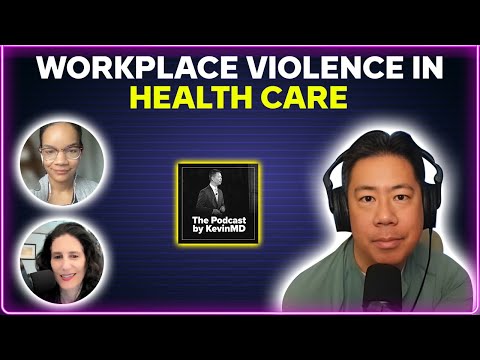
Join emergency physicians Resa E. Lewiss and Adaira Landry as they discuss workplace violence in health care settings. With their expertise and insights, they discuss strategies for cultivating psychological safety, intervening effectively in violent situations, and supporting health care teams after such incidents.
Resa E. Lewiss and Adaira Landry are emergency physicians.
They discuss the KevinMD article, “Microskills to be a team player: workplace violence.”

Our presenting sponsor is Nuance, a Microsoft company.
Together, Microsoft and Nuance are leveraging their rich digital technology and advanced AI capabilities to tackle some of health care’s biggest challenges. AI-driven technology promises to revolutionize patient and provider experiences with clinical documentation that writes itself.
The Nuance Dragon Ambient eXperience, or DAX for short, is a voice-enabled solution that automatically captures patient encounters securely and accurately at the point of care. DAX Copilot combines proven conversational and ambient AI with the most advanced generative AI in a mobile application that integrates directly with your existing workflows.
Physicians who use DAX have reported a 50 percent decrease in documentation time and a 70 percent reduction in feelings of burnout, and 85 percent of patients say their physician is more personable and conversational.
Discover AI-powered clinical documentation that writes itself. Visit https://nuance.com/daxinaction to see a 12-minute DAX Copilot demo.
VISIT SPONSOR → https://nuance.com/daxinaction
SUBSCRIBE TO THE PODCAST → https://kevinmd.com/podcast
RECOMMENDED BY KEVINMD → https://kevinmd.com/recommended

ADVERTISEMENT
GET CME FOR THIS EPISODE → https://earnc.me/mhpFYW
Powered by CMEfy.
Transcript
Kevin Pho: Hi, and welcome to the show. Subscribe at KevinMD.com/podcast, get CME for this episode by clicking on the CME link in the show notes. Today we welcome back Resa E. Lewiss and Adaira Landry. They’re emergency physicians. Their book is called MicroSkills: Small Actions, Big Impact. Today’s KevinMD article is “Microskills to be a team player: workplace violence.” Resa, Adaira, welcome back to the show.
Resa E. Lewiss: So glad to be here.
Adaira Landry: Yeah, thanks for having us.
Kevin Pho: So you’ve been on in the past. Go to KevinMD.com/podcast to hear their story and prior episodes. But today we’ll jump right into the KevinMD article about workplace violence. Resa, tell us what this article is about for those who didn’t get a chance to read it.
Resa E. Lewiss: Thanks. So Kevin, this is a composite of real accounts that have happened in the emergency department, certainly to me as an emergency physician, and I think to many listeners who work in the clinical environment.
We start by discussing, a patient comes into the emergency department complaining of chest pain. They are intoxicated with alcohol, and the health care team tries to escort him to the bedside, hook him up to a monitor, blood pressure cuff, pulse oximetry, perform an EKG. And he is resisting, he’s stumbling, he’s slurring his speech, and he keeps trying to get out of bed.
And yeah, this is just such a common scenario. Now, it becomes tricky when you really, really, really are trying to take care of someone and they’re resisting, for whatever reason. And in this case the patient was resisting for some of the reasons I shared, and in addition he actually starts becoming a little verbal and a little physical, meaning the nurse introduces herself by her professional name, he calls her Hun, he tries to pull her towards him to give her a hug. Again, not outside what I have witnessed in the emergency department on many, many, many occasions.
So the team works together, steps in, gets things done, redirects him verbally, redirects him physically, and then ultimately they step out of the room and have a discussion.
Kevin Pho: So give us the context, Resa, in terms of how often do episodes like this happen in the emergency department?
Resa E. Lewiss: You know, this story comes from, number one, it is a scenario we see commonly. Also, workplace violence is something that is rightfully getting attention. And to be clear, nurses experience workplace violence in health care more commonly than physicians, although physicians commonly experience it. The emergency department is a hotbed area for workplace violence. Thankfully a lot of institutions are working hard to address this and to really look at this systemically.
So it comes from, number one, common patient scenario, credible situation, also bringing up a current topic that needs to be addressed for workplace safety, clinician safety, patient safety. And really, we do keep things patient centered.
You were generous in sharing with the listeners the title of our book that is launching, launched maybe by this point, April 16th, 2024, called MicroSkills: Small Actions, Big Impact. And Adaira and I put forth a framework for breaking down any big goal, any problem, any situation into small pieces. And this vignette that I just discussed served as the nidus for us talking about ways to break things down, behaviors and ways to act as a team member in the moment.
Kevin Pho: Adaira, as you’re an emergency physician, before you see patients, does that threat of violence, is it always in the back of your mind?
Adaira Landry: I would say not always in the back of my mind, but I think I have learned through real life experience how to recognize patterns or concerns. I don’t think I would go into every single room with some guard up, but I do have very conscious decisions that I think I have just baked into how I interact with patients, such as, I always try to be in between the patient and the door. Hardly ever, especially with someone who is upset, angry, agitated, confused, intoxicated, especially in those scenarios, I’m always closest to the door. That is something that probably I did not learn in a classroom setting, but just natural human instinct has taught me that.
So we have had some systems changes that have really helped, so that if I’m walking into a room, I do have my safety not really on the back burner but on the front burner, like these alerts that come up in our Epic system that, patient has been violent in the past, patient has a history of being agitated with women physicians, pregnant physicians. I remember when I was pregnant I had a patient who had a history of being violent towards pregnant physicians, and thankfully there was an alert that came up right away. Unfortunately I was the only physician, so I still had to see that patient, but at least I knew to bring someone with me.
So I think there are some movements from a systems level that are helping providers just be more aware. The other thing would just be having alarms near patients’ beds. So I think because of these systems in place I feel a little bit more aware, but there’s still a lot of unpredictable behavior that we face. I mean, I would say on every shift there’s someone who’s on edge, who could go in one particular direction, but we’re able to de-escalate and redirect. But there’s always, I would say on almost any shift, there’s someone who’s just a little bit on edge.
Kevin Pho: And Adaira, to follow up on that, are there any common triggers or factors that may contribute to the potential threat of violence?
Adaira Landry: It’s honestly probably similar to just outside of the hospital, right? Like lack of communication, someone being overtired, someone being hungry, someone not trusting another person, someone feeling themselves that they are threatened. I would say it’s all of those things that would make someone triggered outside of the hospital.
Of course there are metabolic, organic things that can cause someone to be agitated, and I have certainly seen delirious patients agitated in a way that they probably would not be outside of that scenario. But I honestly think I have seen patients who are agitated because they are just confused, like, what’s going on, I don’t trust this doctor in front of me, no one’s explaining anything to me. And I’ve seen it from someone who’s just really hungry, and they’ve been in the emergency department for two days waiting for a bed, and that’s why they’re agitated.
Kevin Pho: Resa, I’m going to ask you about that microskills framework that you mentioned earlier when it comes to addressing workplace violence. But before you do so, I just want to ask, for those who aren’t familiar about what it’s like behind the scenes at an emergency department, talk about some of the stressors, what’s it like that may precipitate violence? Because whenever I read about workplace violence in mainstream media, more often than not it happens in an emergency department setting.
Resa E. Lewiss: It’s a great question. I relate a lot with what Adaira shared about pattern recognition, and it’s this spidey sense, Malcolm Gladwell may consider it a blink. But there are certain scenarios that are set up to have patients, I think it’s really accurately characterized, not feel safe. And when people don’t feel safe, they react accordingly.
We would be remiss with not mentioning the role that mental illness can play. And in this scenario in the article, and what’s very common, is patients that are using, addicted to alcohol and other drugs. And so we take care of everybody and we are committed to taking care of everybody. So learning how to navigate and to take the best care of patients, but never neglecting that you have to take care of yourself as well.
Kevin Pho: All right, Resa, tell us a little bit more about that framework that you mentioned when it comes to when we want to mitigate workplace violence in the emergency department setting. What are microskills, and how can that approach help?
Resa E. Lewiss: Microskills are fundamental building blocks, small steps that people can take, act upon, utilize, integrate into the way they respond in a situation. Now, we’re emergency physicians, and so this vignette is related to the emergency department. However, I would want people to take from the article that these ways to support a team member can be no matter who you are, no matter the industry.
So in the scenario, what we break down and talk about is ways to respond in the moment. And what we talk about is something called upstanding. And if you’re using a term all the time you think everybody knows the term, but I’m very familiar that probably not everybody knows what upstanding is. But I do think people know what we mean when we say bystanding, standing by, witnessing, kind of passively observing an interaction, a conversation. Upstanding kind of flips it to, rather than being a passive observer, to being an active participant.
And there are many situations that can happen in the workplace where you’re caught off guard. Maybe an inappropriate joke is made, maybe you see some sort of conflict happening in the workplace between two people, one person steps into the other person’s physical space. So there are always ways to respond, and many of us are caught off guard, we don’t know how to do it.
So in MicroSkills, our book, we talk about ways to upstand, and part of it is maybe having a verbal response at the ready. Also there are physical behaviors that you can have at the ready. And it’s hard to predict what to do in the moment, but what we really encourage people to do is to have something front of mind, at the ready to say, so that they can respond and be a team member.
We also discussed this concept of psychological safety, and that people do their best work when they feel safe, when they feel like they can focus on, in our case, patient care, but also, again, any industry, you just want to get the project done, you just want to meet the timeline, you want to sit quietly at a computer and get your work done, that kind of thing.
So circling back to the story, we talked about redirecting him verbally in terms of what he called the nurse, and correcting him and telling him to call her by the name she requested. We talked about the power of, if someone is grabbing or flailing, of just sort of putting up a hand, almost like stop, and have seen that be effective not just in the emergency department but frankly at a meeting where the conversation is getting heated. There are physical actions that you can do to actually break the tension of the moment.
Another microskill we discuss with this story is, once you get out of the room, sort of a check-in, checking in with each other, checking in with your teammates, and allowing people to say nothing or to say something. And then finally we talk about this concept of the follow-up check-in, that I’ll call, where, in the moment sometimes you’re not even sure how you feel, or you may not even feel ready or safe to say something, but checking in with that person the next day or the next time you see them randomly on shift.
Kevin Pho: Resa, I want to follow up on that in terms of having that phrase at the ready. What would be an example of such a phrase that you would have at the ready when you sense that something may be escalating?
Resa E. Lewiss: I really like that question, because what comes out of Resa’s mouth is different than what comes out of Kevin’s mouth, which is different than what comes out of Adaira’s mouth. It’s got to fit maybe the words that you would normally put together, your personality.
And I want to hat tip Karen Catlin, who has really taught me some of these phrases. And so one is, hey, we don’t do that here. Another would be, if in the case of a joke, and again this scenario is not one of a joke, but often in the workplace there’s the joke or the snide remark or the inappropriate compliment, and you can just say, I’m sorry, could you repeat that? Or, I’m sorry, I don’t understand the joke, can you explain it to me?
Kevin Pho: Adaira, in general, what kind of training is involved for the medical staff in the emergency department in order to de-escalate or address workplace violence issues? I think both you and Resa have given a lot of tips when it comes to microskills, but in general, is there any de-escalation training that’s normally given in the emergency department setting?
Adaira Landry: I’ve been fortunate enough to work at two institutions that have very robust de-escalation training and policies in ways that were multidisciplinary. So the training, I will speak at my current institution, involves not just the physicians and not just the nurses but also the PAs and security. And so we train together in a simulated environment. It’s actually led by physicians, but there’s a lot of input from other folks on how to best verbally de-escalate.
And this was actually, I would say, spurred by data showing that we were over sedating patients too quickly without attempting to just verbally redirect and de-escalate them, and also offer oral options for people who are very anxious and stressed and see if they would be willing to take that over the IM.
And when it comes to workplace violence, sometimes it’s when you’re trying to restrain someone. The patient is really terrified, as you can imagine, that there’s people around them holding them down, they’re kicking, they’re flailing. And certainly I’ve seen people hit and kicked and grabbed and scratched and spat upon in those scenarios.
So by really trying to be as proactive as possible, now, I’m not the expert on leading these sessions but I have attended these sessions, you can really try to avoid that risk that comes from physically handling someone. And so a lot of this is through simulated scenarios where people are rehearsing what role they would have in real time if they were actually in the clinical scenario.
So as a physician I’d be the one perhaps leading the conversation, de-escalating the patient, offering oral medications and/or ordering IM versus IV meds. But in the scenario you’re really trying to work through, like Resa was saying, the phrases, the training of the language. There’s also other things like turning down some of the lights, or removing people from the room, turning off the television, trying to remove them from a high stimulation environment. In the emergency room we do a lot of hallway care, and the worst place for an agitated person who’s just over stimulated by all the hustle and bustle is in the hallway. And so really trying to remove someone and put them in a more calming environment, all of these things mitigate the risk of later being physically attacked, whether it’s purposeful or accidental, by patients just naturally reacting to fear.
Kevin Pho: Adaira, on one of my prior shows where I also talked about workplace violence in health care settings, the guest mentioned that a lot of these institutions are not too excited about publicizing this because it reflects poorly on their institution. What’s your experience in terms of how seriously health care leadership is taking the issue of workplace violence?
Adaira Landry: Oh, that’s interesting. It’s probably also institution dependent. I would say our leadership is really serious about it. I mean, we get constant training, we get constant email reminders or policy updates during our faculty meetings on how best to calm our patients down. Even our psychiatry colleagues are involved in this process as well, and they are on board with really trying to calm patients down.
I’m sort of moving into the patients who have mental illness. I mean, those are definitely patients who are at higher risk of being violent because of all sorts of reasons. But for patients who have no background, they still are very capable of being violent to us.
And so I think we get a lot of training, and to me, because there’s so much investment within those resources, of hiring coaches, reserving simulation center time, all of that to me speaks to an investment from our leadership to making sure people are safe. I can’t say that that’s everywhere, but I will say that there’s been a lot of training.
Kevin Pho: Let me ask you that same question, Resa. From your experience, do you feel that in general health care leadership is taking the threat against health care workers seriously?
Resa E. Lewiss: Great question. I think it depends on the institution. And I think a workplace culture is reflective of its leadership and its history. So if you have an innovative, cutting-edge health care institution, system, that wants to be the best, that’s motivated to get whatever ranking, but wants to train the best physicians, the best nurses, the best medical students, there is a motivation I think to have a growth mindset. And as hard as it can be, and as tempting as it may be to put things under the rug, embracing what’s truly going on in the workplace is the way to go, because the only way to get to the other side is to go through it.
I think institutions that maybe are motivated otherwise, and they feel very defensive, or cover up, I think ultimately that’s, as I just said, reflective of the culture of that institution and of its leadership. And I’ve been at both kinds of institutions. And this goes back actually to the article and to our book about the importance of psychological safety.
I’m going to name drop another person, Jennifer Freyd, who talks about this concept of institutional courage and institutional betrayal. And what Adaira described in terms of her current institution, that’s one of courage. People do their best work at those kinds of places and they feel psychologically safe. Those that are known to betray their employees and not really want to address the true problems going on, they’re more likely to have people working in their systems that don’t feel safe and maybe arguably are not doing their best work.
Adaira Landry: I think that part is really, really important. An institution can do as much as they want to try to prevent workplace violence, and also what really matters is how they respond once it occurs. I can think of colleagues at multiple different institutions, including my own, who were victims of violence and felt like not enough change happened afterwards to prevent an assault.
And it’s really tough, because some of these assaults are so unpredictable. Like you think a patient’s OK and all of a sudden they’re not. How does any leader create a system that keeps everyone safe when some of the violence is just unpredictable? Even the person who was assaulted was like, this came out of nowhere. That’s the scariest part.
And I think there is this hope that there would be a solution, and I hear that, and I think I would want the same thing. But I also, just from being a practical person, I say, how could any single leader predict all of the small ways something like this can creep in?
Kevin Pho: We’re talking to Resa E. Lewiss and Adaira Landry. They’re emergency physicians and authors of the book MicroSkills: Small Actions, Big Impact. We’re talking about “Microskills to be a team player: workplace violence.” Now I’m going to ask both of you just to briefly share your take-home messages to the KevinMD audience. Adaira, why don’t you go first?
Adaira Landry: I think it’s really important to recognize that, actually, as someone who is part of a team, if you see someone else feeling threatened, feeling uncomfortable, it is really important to recognize your own voice and that you have power to intervene and to upstand, to say something, whatever you want in your tone, as simple as, please stop, I’m calling for help, we don’t do that here. Titrate it to your comfort. But just by doing that, that creates a page break, that creates an exclamation point, something that makes pause.
Kevin Pho: And Resa, why don’t we end with your take-home messages?
Resa E. Lewiss: I would say Adaira and I write from a place of understanding and being exquisitely human. We’ve made the mistakes, we’ve not always done the upstanding. And also we truly believe that all of these skills are learnable, and we really want to motivate people to contribute to having better, safer, more equitable workplaces. And that means, for example, learning how to upstand, learning your phrases, actually checking in with teammates. And just, overall, part of being better at work is being a really good team player.
Kevin Pho: Resa and Adaira, thank you so much for sharing your perspective and insight, and thanks again for coming back on the show.
Resa E. Lewiss: Thanks, Kevin.
Adaira Landry: Yes, thank you so much for having us.


























