

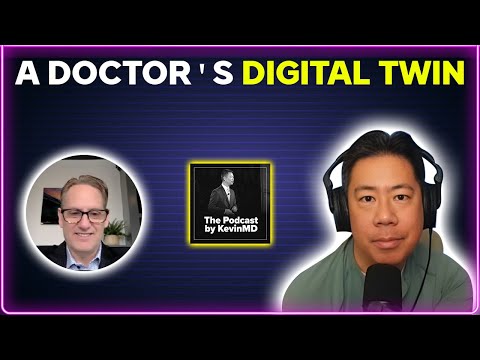
Subscribe to The Podcast by KevinMD. Watch on YouTube. Catch up on old episodes!
We delve into the future of health care with Scott Ellner, a general surgeon. Join us as we explore how AI and machine learning are transforming preventive medicine, addressing the looming physician shortage, and tackling issues of data privacy and bias in health care algorithms. We’ll discuss the role of regulatory frameworks, the importance of diversity in AI development teams, and practical strategies for integrating AI into clinical practice.
Scott Ellner has been a general surgeon for over 20 years, and can be reached at PEAK Health.
He discusses the KevinMD article, “The doctor’s digital twin will see you now.”

Our presenting sponsor is Nuance, a Microsoft company.
Together, Microsoft and Nuance are leveraging their rich digital technology and advanced AI capabilities to tackle some of health care’s biggest challenges. AI-driven technology promises to revolutionize patient and provider experiences with clinical documentation that writes itself.
The Nuance Dragon Ambient eXperience, or DAX for short, is a voice-enabled solution that automatically captures patient encounters securely and accurately at the point of care. DAX Copilot combines proven conversational and ambient AI with the most advanced generative AI in a mobile application that integrates directly with your existing workflows.
Physicians who use DAX have reported a 50 percent decrease in documentation time and a 70 percent reduction in feelings of burnout, and 85 percent of patients say their physician is more personable and conversational.
Discover AI-powered clinical documentation that writes itself. Visit https://nuance.com/daxinaction to see a 12-minute DAX Copilot demo.
VISIT SPONSOR → https://nuance.com/daxinaction
SUBSCRIBE TO THE PODCAST → https://kevinmd.com/podcast
RECOMMENDED BY KEVINMD → https://kevinmd.com/recommended

ADVERTISEMENT
GET CME FOR THIS EPISODE → https://earnc.me/UbAIMD
Powered by CMEfy.
Transcript
Kevin Pho: Hi, and welcome to the show. Subscribe at KevinMD.com/podcast, and get CME for this episode by clicking on the CME link in the show notes. Today we welcome back Scott Ellner. He’s a general surgeon, founder of Peak Health Technologies. Today’s KevinMD article is “The doctor’s digital twin will see you now.” Scott, welcome back to the show.
Scott Ellner: Great to be here, Kevin, as always.
Kevin Pho: Scott’s been on multiple times. Go to KevinMD.com/podcast to hear his story and prior episodes. But today let’s talk about your most recent one, “The doctor’s digital twin will see you now.” What’s this one about?
Scott Ellner: OK. Imagine that in real time or near real time you want to access your health care provider for a non-emergent concern or question. And what I mean by that is essentially, you have to refill a prescription, you have to see someone for an ailment. And many times we have to wait, we have to go through a process of scheduling, getting an appointment, or even having to drive to an urgent care, or logging into a telemedicine appointment.
In fact, when I was a CEO of a health care enterprise for a group, we tried to make sure that patients could be seen within 24 hours, and that was mostly with a nurse practitioner. But what this article is about is actually having access right away to a health care provider, and that health care provider is, believe it or not, an avatar or a digital twin of the actual physician, who has all of your personal private health information that is HIPAA protected, and is able to talk to you as if they are the actual physician.
Kevin Pho: So tell us an ideal scenario where that can happen. And given the advances in large language models, if they have access to your medical records, that’s certainly in the not too far future.
Scott Ellner: Well, you’re right. And you mentioned large language models. These are all terms under the subfields of artificial intelligence. And I want to also make note that the American Medical Association most recently likes to refer to AI as augmented intelligence, because we’re not supplanting the role of the physician. What we’re doing is we’re augmenting the role of the physician through this augmented intelligence.
You talked about large language models. There’s machine learning, deep learning, and other fields such as natural language processing, which are able to decipher a significant amount of data about you as the patient and then come up with a treatment plan which is personalized for you in real time.
And so there are companies that are working on this. There is one that just received a significant investment, and I believe a round of Series A funding. And I’m also working with a company as well where we’re developing these digital twins that are accessible through a virtual health care marketplace, where the information is right there and you can access what you need, as long as it’s non-emergent.
And so what we’re essentially doing is we’re addressing the pain points that are happening within health care today. And I’d love to share with the audience how we’re doing that, because I know that many physicians are absolutely frustrated and tired with the administrative burden that is being placed on them.
Kevin Pho: All right, give us some ideal scenarios where you see the digital twin in action.
Scott Ellner: OK. So let’s say you wake up after a really great six hours of sleep, and you look at your wearable, your watch, and it’s telling you that unfortunately you’ve got some changes going on in your ECG. You’re not sure what it means, but you can actually log into a HIPAA protected portal and ask your physician, based on an alert that went to your watch or wearable, and ask them, is this something I need to be concerned about? And if the physician is not there because it’s 4:00 in the morning, their digital twin or their augmented avatar will be available to provide you information on how to respond to that alert.
Another area is if you’re away on vacation and you ran out of your medication that you need. This is an opportunity to, in near real time, get that medication delivered through different mechanisms by having that avatar available anytime for the patient.
Now of course, for the physician, what this does, as we get through the regulatory hoops, is that it also allows the physician to see more patients, and it gives the live physician, the person, more time to interact one on one, to have that physician patient relationship that we all went into medicine for, while some of the other administrative tasks, the burdens of scribing the notes and putting together a comprehensive note for billing purposes, can be done by the augmented intelligence through this digital twin.
And the AMA did a survey asking physicians, what about augmented intelligence is something that you’re looking to, to improve health care? And 71 percent of the respondents said it’s to relieve the burden of all the administrative paperwork, or computer work, EHR work, that is now part of their role, as well as other things like insurance pre-authorization, which is another barrier to enjoying the physician’s day or finding meaning in their work.
Kevin Pho: Are we there yet with large language models, where we can trust the medical information that they may be dispensing?
Scott Ellner: So it’s a really good question, and it’s an important question based on ethical guidelines and legal ramifications. Are we there yet, to trust the information to dispense physician advice? Probably not yet.
But I would say that in a few years, as we start to get our hands around and really understand the capabilities of large language models, machine learning, machine understanding, and how to apply this information in a meaningful way, which will actually enable patients to feel more empowered about their health care, enable physicians to practice the joy of medicine, we’re going to get there. And I don’t think it’s too far off. I believe it’s about five years in the making, maybe even sooner.
But the access issues for patients are so challenging that we need to find another way, because there’s going to be a shortage of available primary care physicians, even with the rise in nurse practitioners and other allied professionals. So today we’re not there, and there are other reasons as well that I’ll go into.
Kevin Pho: So in terms of things like privacy, data breaches, these are concerns that we have with the current iteration of large language models, right? So what kind of precautions can the health care community take when this technology is being used as a doctor’s digital twin, to guard against these privacy breaches or security breaches?
Scott Ellner: Well, we’re all familiar with what happened recently with the cyberattack at Change Healthcare, which has been incredibly disruptive to physicians and getting payments. The concern that you’re raising around that protected health information under the HIPAA Privacy Rule is a real one.
And I would say that while this sounds incredibly promising, we have to remember that it is utmost part of the duty of care to ensure that we are able to attain privacy in patient records, protect that information from cyber threats, from physical threats or others, and to maintain confidentiality.
Right now there are things being worked on in order to create a mechanism to protect against these threats, but again, the technology is so new with this augmented intelligence that we’re not quite there. So there is going to have to be a regulatory framework around the HIPAA Privacy Rule, and probably the FTC if these are third party vendors, because remember, HIPAA privacy only applies to entities, and so the FTC will probably have to get involved for breaches in order to protect that information.
Kevin Pho: You mentioned five years until this can come to fruition. What needs to be done between now and five years from now in order for this to become reality?
Scott Ellner: Yeah, so five years isn’t that long. And so between now and the next few years, we really need to scrutinize the databases, the data that’s out there. ChatGPT 3.5 is now pretty archaic, it’s becoming obsolete, they’ve moved to a new version of 4.0. And one in 20 physicians are using ChatGPT, mostly for personal reasons, but it’s not robust enough to really provide the right type of medicine that we practice on a day to day.
What’s going to happen is, a large language model which focuses on biological variables, environmental variables, social determinants, will have to be developed in order for this to truly be the right kind of model in the future.
And I would say one of the reasons why we’re not there also is the algorithmic bias in the data. And I’ll share an example of what I mean by that. The algorithms today are really focusing on the typical white male, like me. And there’s bias inherent in the development of these algorithms, which don’t take into account the disparities in health care. And there are actually studies that show that different races, different ethnicities aren’t as developed in the large language models to actually provide the right type of care through these mechanisms, through this augmented intelligence.
An example is, if you’re looking at skin cancer screening on patients, the AI technology and software has a difficult time looking at darker skin to really determine if a mole or some growth is cancerous on a patient who is from a different ethnic origin.
So there’s a lot of work to be done on that end. Again, the legal regulatory framework, the cultural bias, the social bias. But over time I do believe that there are some really smart people who are working on these algorithms to make it so that at some point, because of the access issues that we’re facing today with physician shortages, this will become a framework.
Kevin Pho: So it’s very conceivable in the next five years we can have that avatar of us, a clinician with access to data, virtually see patients, ask questions, prescribe medications seamlessly, automatically, through this augmented intelligence. Is that what you’re saying?
Scott Ellner: It’s conceivable, yeah. And again, I’m not advocating to supplant the role of the physician. What I believe here is the opportunity to remove the biggest burden that physicians face today, which is that administrative burden of truly not spending time with that face-to-face interaction that we enjoy and really why we pursued our calling, to interact with patients.
Ideally the augmented intelligence that will develop within the health care industrial complex will be to eliminate the pain points that we’re feeling and recreate the joy and meaning that we’re all searching for as physicians.
Kevin Pho: Now, if these avatars are advanced enough that the information that they’re dispensing is trustworthy, and they could prescribe medications, what’s preventing hospitals or health care institutions simply from replacing live clinicians? I know that certainly wasn’t the intent, but not everyone may share those same values and ideals. What’s to stop them from simply replacing clinicians with this cheaper alternative that may be almost as trustworthy?
Scott Ellner: Yeah, and that’s an important question, because again you’re raising some ethical and moral issues. At this point I don’t think hospitals or health systems are looking to replace a live person who is doing their job well.
I would reframe the question to respond that we’re looking to augment and remove all the administrative burden that is going into the work that’s important for pharmacists, for pharmacy techs, for CNAs, nurses, physician assistants, as well as physicians. We don’t want to take away the human interaction, the humanistic approach to medicine. But certainly I think if a hospital or health system is struggling with finding the appropriate workforce to meet the needs of patients in the community for access to care, this is an option.
Kevin Pho: We’re talking to Scott Ellner. He’s a general surgeon, founder of Peak Health Technologies. Today’s KevinMD article is “The doctor’s digital twin will see you now.” Scott, as always, we’ll end with some of your take-home messages to the KevinMD audience.
Scott Ellner: So a couple of things for take-home messages. Number one, the American Medical Association is promoting augmented intelligence. We’re not calling this artificial intelligence, because we’re not replacing the role of the physician or other important health care professionals.
The augmented intelligence is an important step toward reducing the administrative burden that many of us as physicians are feeling every single day, without taking away the important patient interaction, one-on-one time, that we enjoy so much. And augmented intelligence should create an evolution of working with payers for better reimbursement models, and hopefully streamline the payment mechanisms.
And finally, we’re going to have to work on developing a mechanism through augmented intelligence that takes into consideration conscious and unconscious biases which are occurring right now in the data in which these large language models and machine understanding, machine learning techniques are being developed.
There’s more work to be done. As I mentioned, it’s about five years away from actually seeing this in production, maybe sooner. But the legal and regulatory framework is also going to step in to ensure that it’s safe and effective.
And so it’s exciting, yet on the other hand we must assume caution and take on this new technology with a skepticism but an optimistic approach.
Kevin Pho: Scott, as always, thank you so much for sharing your perspective and insight, and thanks again for coming back on the show.
Scott Ellner: Thank you for having me.


























