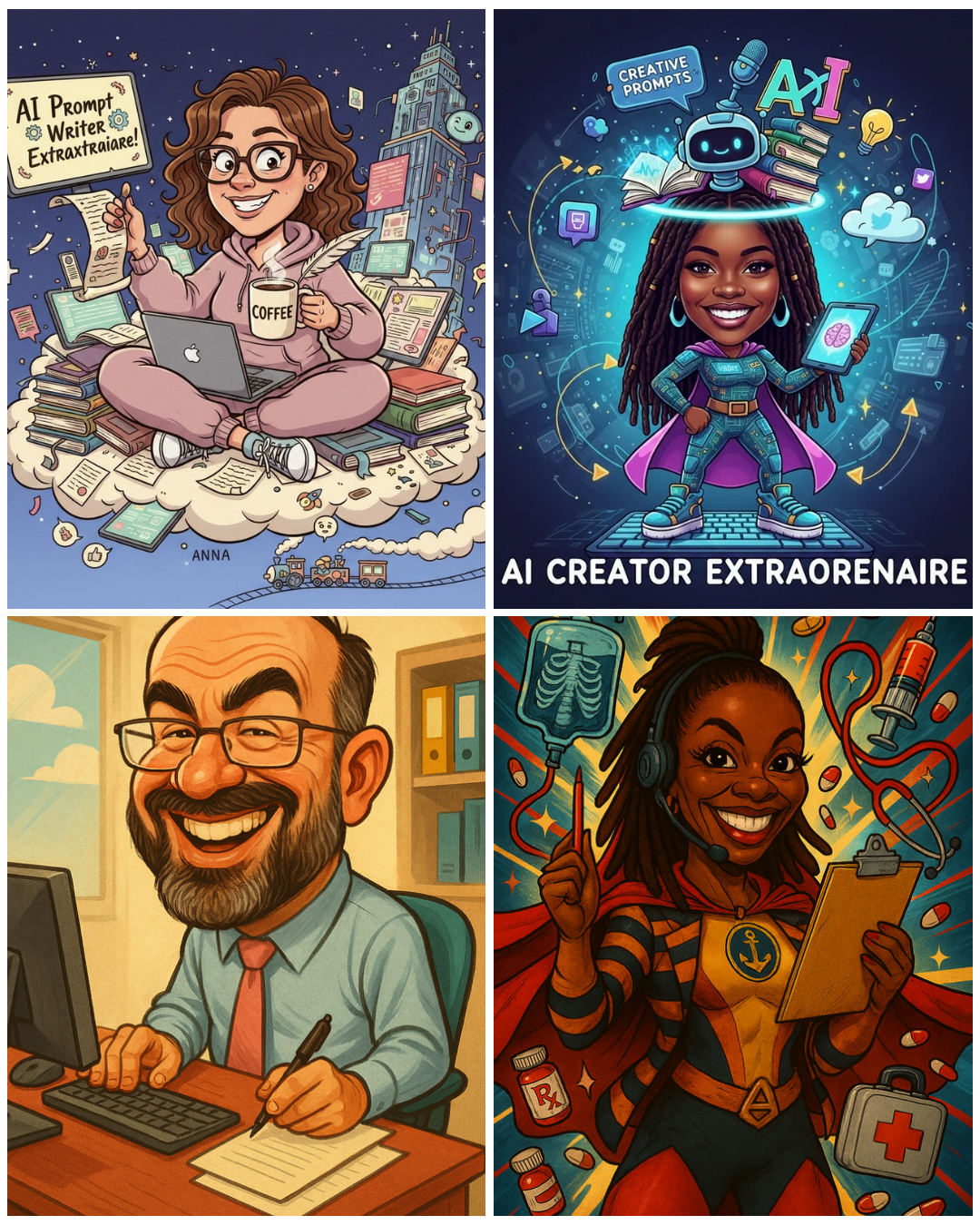
I was trying to be cool, so I recently joined a social media challenge with a simple prompt: “Create a caricature of me and my job based on everything you know about me.”
As a hospitalist, physician executive, and burnout architect, my digital footprint is deep. I talk about systemic health care reform, the psychology of exhaustion, and the structural “blueprints” needed to save our healers. I expected my AI algorithm to render a sharp professional landscape, perhaps someone surrounded by blueprints, sterile walls, and stethoscopes.
The result? The AI depicted me correctly, in my aspired kingdom, a dreamer and creator with so many books to boot and my favorite substance of choice, also known as coffee. The only but very overt omission, however, was that I was depicted as a white woman named Anna. This made me smile hard, shaking my head at the same time. I did the same with my work computer, and this time I was a middle-aged unnamed white male.
When I corrected the prompt to include my race and gendered, well-kept long locs, the pendulum swung to the other extreme: I was not just a professional anymore; I was rendered as a “superhero.” Who no longer was Zen and at peace in my kingdom but had to be in a capacity of expected servitude.
While being called a hero is flattering, this experience highlighted a jagged truth about the tools we are increasingly relying on to build our future.
For many, AI feels like a neutral arbiter of truth. But AI does not think; it predicts based on the data it has been fed. When an AI assumes a specialist or a “physician burnout architect” who loves travel, yoga, classical music, and jazz, has an eclectic taste in art and food, is white by default, it is not just making a creative choice. It is reflecting a data-driven erasure.
The erasure of identity
If the “standard” professional in a database is white, anyone else becomes an “exception” or a “specialty” category. In my case, once my race was identified, the AI moved me from “Professional” to “Icon.” By making me a superhero, it inadvertently stripped away my human identity as a working architect of change and career growth/development and replaced it with a caricature of “Black Girl Magic” that, while well-intentioned, still misses the mark of everyday professional representation.
This is not just about an avatar on a screen. The “freedom keys” to a more equitable society depend on recognizing how these biases manifest in daily outcomes:
- Health care disparities: If diagnostic AI tools are trained primarily on one demographic, they miss the nuances of skin conditions or symptom presentations in others, leading to delayed diagnoses in a system already rife with racial and socioeconomic disparities.
- Professional gatekeeping: If hiring algorithms equate “leadership” with the traits of a specific demographic, qualified Black and Brown professionals are filtered out before a human ever sees their resume, further deepening the schism of professional connectedness and lack of meritocracy that already exists.
- The burden of correction: Just as I had to manually “fix” my prompt, marginalized people are constantly forced to perform the extra labor of correcting the systems that should be serving them.
As someone who designs systems to prevent burnout and optimize utilization and quality, I know that you cannot fix a structure if the foundation is cracked.
We cannot “engineer” our way out of bias by simply adding a few more diverse images. We need to interrogate the datasets, diversify the engineering rooms, and, most importantly, be willing to challenge the “defaults” the digital world hands us.
AI is a mirror. Right now, that mirror is warped. It is time we demand a reflection that captures the full, complex, and diverse reality of the people doing the work.
Have you ever seen yourself “filtered” or misrepresented by an automated system? How do we ensure the tools of the future do not repeat the prejudices of the past?
Seleipiri Akobo is a physician executive.

ADVERTISEMENT