Skip to content
  • About
  • Contact
  • Contribute
  • Book
  • Careers
  • Podcast
  • Recommended
  • Speaking
KevinMD
  • All
  • Physician
  • Practice
  • Policy
  • Finance
  • Conditions
  • .edu
  • Patient
  • Meds
  • Tech
  • Social
  • Video
  • All
  • Physician
  • Practice
  • Policy
  • Finance
  • Conditions
  • .edu
  • Patient
  • Meds
  • Tech
  • Social
  • Video
    • All
    • Physician
    • Practice
    • Policy
    • Finance
    • Conditions
    • .edu
    • Patient
    • Meds
    • Tech
    • Social
    • Video
    • About
    • Contact
    • Contribute
    • Book
    • Careers
    • Podcast
    • Recommended
    • Speaking
KevinMD
  • All
  • Physician
  • Practice
  • Policy
  • Finance
  • Conditions
  • .edu
  • Patient
  • Meds
  • Tech
  • Social
  • Video
    • All
    • Physician
    • Practice
    • Policy
    • Finance
    • Conditions
    • .edu
    • Patient
    • Meds
    • Tech
    • Social
    • Video
    • About
    • Contact
    • Contribute
    • Book
    • Careers
    • Podcast
    • Recommended
    • Speaking
  • About KevinMD | Kevin Pho, MD
  • Be heard on social media’s leading physician voice
  • Contact Kevin
  • Discounted enhanced author page
  • DMCA Policy
  • Establishing, Managing, and Protecting Your Online Reputation: A Social Media Guide for Physicians and Medical Practices
  • Group vs. individual disability insurance for doctors: pros and cons
  • KevinMD influencer opportunities
  • Opinion and commentary by KevinMD
  • Physician burnout speakers to keynote your conference
  • Physician Coaching by KevinMD
  • Physician keynote speaker: Kevin Pho, MD
  • Physician Speaking by KevinMD: a boutique speakers bureau
  • Primary care physician in Nashua, NH | Kevin Pho, MD
  • Privacy Policy
  • Recommended services by KevinMD
  • Terms of Use Agreement
  • Thank you for subscribing to KevinMD
  • Thank you for upgrading to the KevinMD enhanced author page
  • The biggest mistake doctors make when purchasing disability insurance
  • The doctor’s guide to disability insurance: short-term vs. long-term
  • The KevinMD ToolKit
  • Upgrade to the KevinMD enhanced author page
  • Why own-occupation disability insurance is a must for doctors

Health outcomes rely on more than just health care

Jalene Jacob, MD, MBA
Physician
May 13, 2026
Share
Tweet
Share

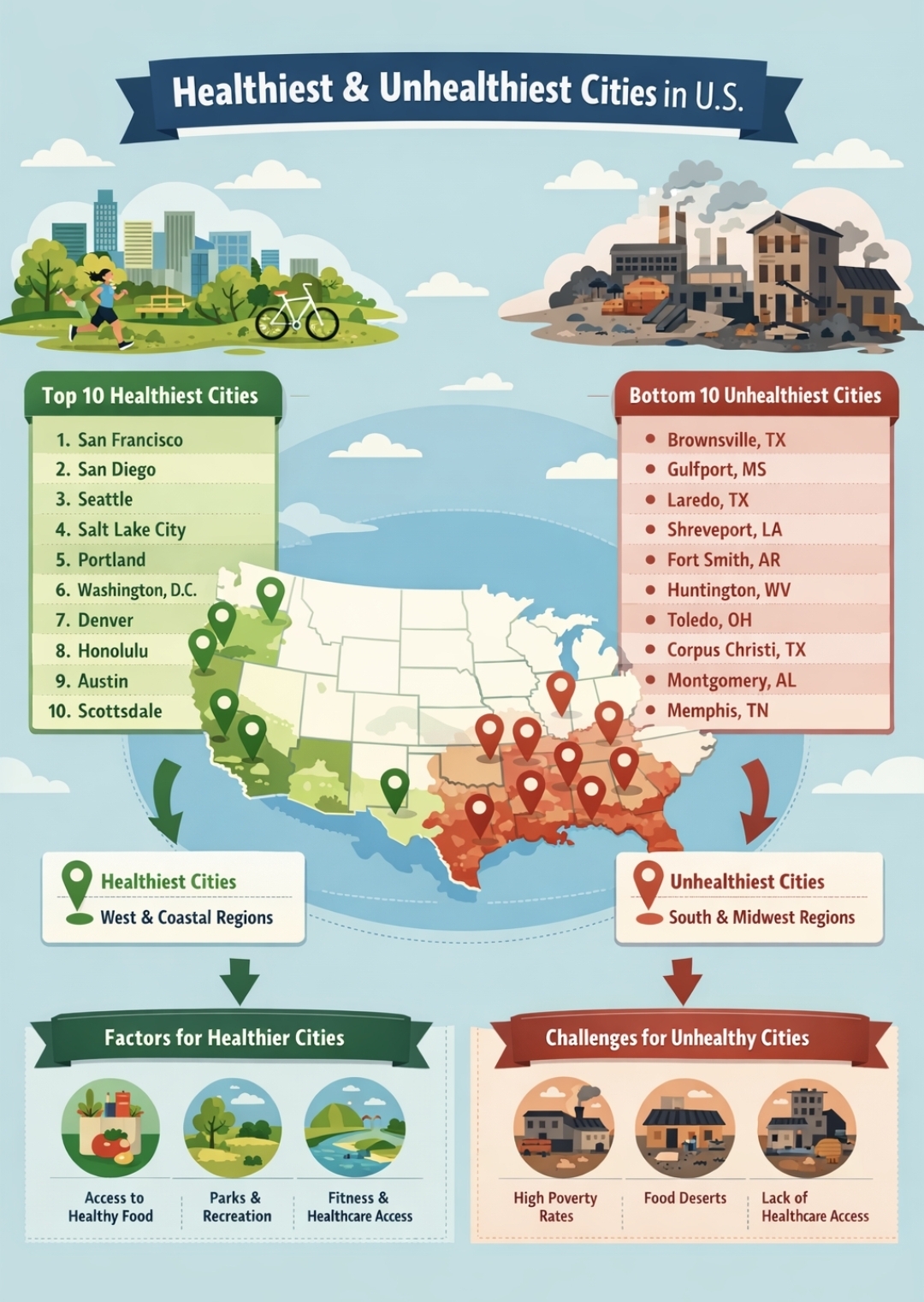
If the quality of health care was the only major determining factor of health outcomes, then the healthiest cities in the United States would simply be those with the best health care facilities. Recent national rankings of city health status based on composite measures of health care access, food environment, physical activity, and built infrastructure reveal a different reality. The cities that perform best are those where health is structurally supported, while the lowest-ranking cities face overlapping deficits that extend far beyond clinical care. The implications are significant; modern medicine is operating downstream of the most powerful drivers of health.
A clinical reality that the data is now confirming

Consider a common scenario: A middle-aged patient with poorly controlled diabetes presents for follow-up. Medications have been optimized. Education has been reinforced. Yet glycemic control remains suboptimal. On further discussion, it becomes clear that the patient lives in a community with limited access to fresh food, relies on inexpensive processed meals, and has no safe or accessible space for regular physical activity.

From a clinical standpoint, the treatment plan is sound; but from a population health perspective, it is incomplete. This disconnect, long observed in practice, is reflected at scale in national data.

The structural pattern behind city-level health disparities

Across U.S. cities, clear patterns are emerging. Higher-ranking cities consistently demonstrate the following:

  • greater access to healthy food options
  • higher levels of physical activity
  • more walkable environments
  • increased availability of green space

In contrast, lower-ranking cities are characterized by

  • limited access to nutritious food
  • reduced opportunities for physical activity
  • socioeconomic constraints
  • under-developed infrastructure

These findings align closely with the framework of social determinants of health, defined by the Center for Disease Control (CDC) as the non-medical conditions in which people are born, grow, live, work and age, that influence their health outcomes. The CDC emphasizes that these factors exert a substantial influence on health outcomes, often exceeding that of clinical care.

Health care is not the primary differentiator

One of the most important insights from the data is that health care access alone does not explain variation in health outcomes. Some higher-ranking cities do not lead in health care metrics alone, yet perform well overall due to stronger environmental and behavioral support. Conversely, cities with reasonable access to care may still rank poorly when social and environmental conditions are unfavorable.

A couple insights can be derived from this reality. It suggests that

  • health care functions as a necessary but insufficient condition for population health, and
  • upstream factors determine baseline risk before clinical intervention occurs

For health care systems, this has direct implications for performance under value-based care models where outcomes are increasingly tied to factors outside traditional clinical control.

Implications for clinical practice and health systems

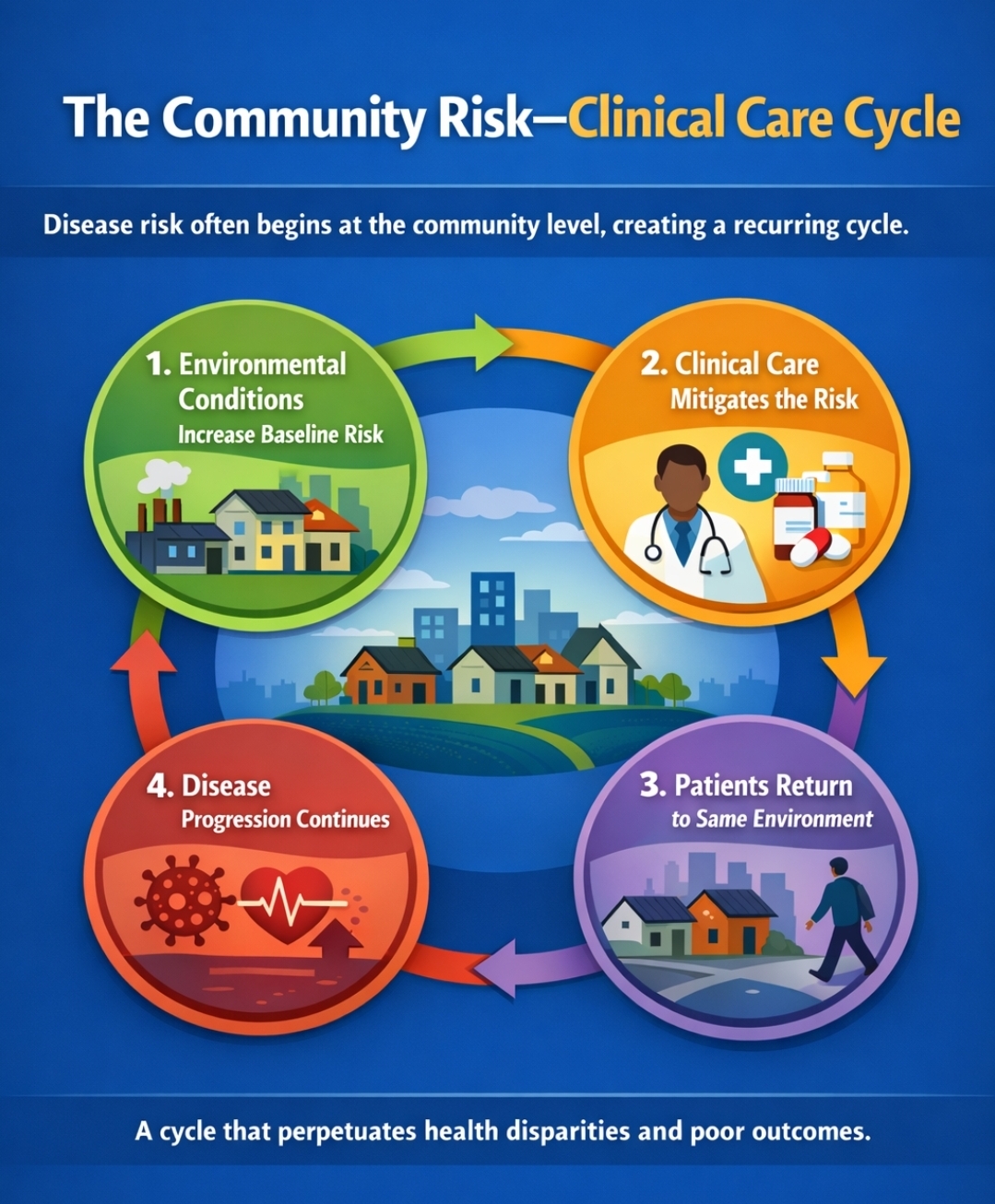
The persistence of these patterns highlights a structural misalignment between health care delivery and health outcomes. Clinicians are trained to manage disease at the individual level; however, the data demonstrate that disease risk is often established at the community level. This creates a recurring cycle. I refer to it as the Community Risk-Clinical Care Cycle. This occurs when

  1. environmental conditions increase baseline risk
  2. clinical care attempts to mitigate that risk
  3. patients return to the same environment
  4. disease progression continues

Without addressing upstream drivers, this cycle is difficult to break. For health systems, this translates into higher chronic disease burden, increased health system utilization, elevated readmission rates and persistent cost pressures.

Reframing the role of health care

The findings call for a broader conceptualization of the role of health care. Rather than viewing health care systems solely as providers of care, there is a growing need to position them as participants in health creation alongside sectors such as urban planning, food systems, and public policy.

Practical implications include integrating social risk factors into routine clinical assessments to better capture upstream drivers of disease, leveraging geospatial data to identify and prioritize high-risk communities for targeted interventions, and developing cross-sector partnerships that address critical needs such as food access and preventive infrastructure to improve long-term health outcomes.

Advances in data analytics and artificial intelligence (AI) further enable the incorporation of non-clinical variables such as environment and access, into predictive models. This creates opportunities for more targeted and effective interventions at both the individual and population levels.

A systems-level challenge

Importantly, these disparities should not be interpreted as failures of individual behavior, as they reflect system-level conditions that shape available choices. The reality is that patients do not choose food deserts, they do not design transportation systems, and they do not control the availability of safe recreational spaces. As such, improving health outcomes requires interventions that extend beyond the health care system itself.

Conclusion

The variation in health across U.S. cities underscore a fundamental reality that health outcomes are largely determined before patients enter the health care system. For clinicians and health system leaders, this necessitates a shift in focus from optimizing care delivery only, to understanding and addressing the broader conditions that drive disease. Pending that shift, health care will remain highly effective at treating illness, but limited in its ability to reduce disease incidence.

Jalene Jacob is a physician-entrepreneur.

Prev

Medical malpractice risks persist even after saving a life

May 13, 2026 Kevin 0
…

Kevin

Tagged as: Public Health & Policy

< Previous Post
Medical malpractice risks persist even after saving a life

ADVERTISEMENT

More by Jalene Jacob, MD, MBA

  • Psychological safety in health care: Why speaking up saves lives

    Jalene Jacob, MD, MBA
  • Innovation in medicine: 6 strategies for docs

    Jalene Jacob, MD, MBA
  • Your clinical notes can save lives with AI

    Jalene Jacob, MD, MBA

Related Posts

  • Why U.S. health care costs so much

    Ruhi Saldanha
  • Clinicians unite for health care reform

    Leslie Gregory, PA-C
  • Global aspirations for value-based health care

    Paul Pender, MD
  • Mobile dentistry: a structural redesign for public health

    Rida Ghani
  • Fostering health care innovation through federal policy: a case for direct primary care

    Christopher Habig, MBA
  • Florida health care legislation 2026: top bills to watch

    Del Carter, MD

More in Physician

  • Doctors with mental illness need our care, not silence

    Michael F. Myers, MD
  • Primary care access is the real problem, not the system

    Payam Zamani, MD
  • Physician vs. provider is an ethics issue, not just style

    American College of Physicians
  • Expanding the SOAP framework boosts health outcomes

    Deepak Gupta, MD and Sarwan Kumar, MD
  • How to navigate physician job loss in the first week

    Patrick Hudson, MD
  • Physician burnout is a heavy burden for many healers

    Moses Kim, MD
  • Most Popular

  • Past Week

    • Expanding the SOAP framework boosts health outcomes

      Deepak Gupta, MD and Sarwan Kumar, MD | Physician
    • The handwashing standard nobody finished. Until now.

      Bernadette Burroughs, RN | Conditions
    • Your doctor saved your life but won’t return your call [PODCAST]

      The Podcast by KevinMD | Podcast
    • Primary care access is the real problem, not the system

      Payam Zamani, MD | Physician
    • How corporate medicine is eroding truth and patient dignity

      Ronald L. Lindsay, MD | Physician
    • Why bipolar II is not just a milder version of bipolar I

      Ethan Evans, MD | Conditions
  • Past 6 Months

    • I Googled my own name and a corporate clinic I’ve never worked at appeared [PODCAST]

      The Podcast by KevinMD | Podcast
    • Rethinking the role of family physicians vs. specialists

      Ronald L. Lindsay, MD | Physician
    • How corporate health care ruined the medical profession

      Edmond Cabbabe, MD | Physician
    • Clinicians are failing at value-based care because no one taught them the system [PODCAST]

      The Podcast by KevinMD | Podcast
    • When shared decision making gives way to medical paternalism

      DeAnna Pollock, MD | Physician
    • How xenotransplantation could finally solve organ shortages

      Rafael S. Garcia-Cortes, MD | Conditions
  • Recent Posts

    • Health outcomes rely on more than just health care

      Jalene Jacob, MD, MBA | Physician
    • Medical malpractice risks persist even after saving a life

      Chinmeri Nwuba | Policy
    • Nursing violence causes silent and painful cumulative stress

      Adam J. Wickett, BSN, RN | Conditions
    • Aesthetic medicine needs stronger scientific evidence

      Dr. Daniela Estrella | Conditions
    • You can’t stent a capillary: Why aging starts in your smallest blood vessels [PODCAST]

      The Podcast by KevinMD | Podcast
    • Psychiatric polypharmacy is a reassessment failure

      Carrie Friedman, NP | Conditions

Subscribe to KevinMD and never miss a story!

Get free updates delivered free to your inbox.


Find jobs at
Careers by KevinMD.com

Search thousands of physician, PA, NP, and CRNA jobs now.

Learn more

Leave a Comment

Founded in 2004 by Kevin Pho, MD, KevinMD.com is the web’s leading platform where physicians, advanced practitioners, nurses, medical students, and patients share their insight and tell their stories.

Social

  • Like on Facebook
  • Follow on Twitter
  • Connect on Linkedin
  • Subscribe on Youtube
  • Instagram

ADVERTISEMENT

  • Most Popular

  • Past Week

    • Expanding the SOAP framework boosts health outcomes

      Deepak Gupta, MD and Sarwan Kumar, MD | Physician
    • The handwashing standard nobody finished. Until now.

      Bernadette Burroughs, RN | Conditions
    • Your doctor saved your life but won’t return your call [PODCAST]

      The Podcast by KevinMD | Podcast
    • Primary care access is the real problem, not the system

      Payam Zamani, MD | Physician
    • How corporate medicine is eroding truth and patient dignity

      Ronald L. Lindsay, MD | Physician
    • Why bipolar II is not just a milder version of bipolar I

      Ethan Evans, MD | Conditions
  • Past 6 Months

    • I Googled my own name and a corporate clinic I’ve never worked at appeared [PODCAST]

      The Podcast by KevinMD | Podcast
    • Rethinking the role of family physicians vs. specialists

      Ronald L. Lindsay, MD | Physician
    • How corporate health care ruined the medical profession

      Edmond Cabbabe, MD | Physician
    • Clinicians are failing at value-based care because no one taught them the system [PODCAST]

      The Podcast by KevinMD | Podcast
    • When shared decision making gives way to medical paternalism

      DeAnna Pollock, MD | Physician
    • How xenotransplantation could finally solve organ shortages

      Rafael S. Garcia-Cortes, MD | Conditions
  • Recent Posts

    • Health outcomes rely on more than just health care

      Jalene Jacob, MD, MBA | Physician
    • Medical malpractice risks persist even after saving a life

      Chinmeri Nwuba | Policy
    • Nursing violence causes silent and painful cumulative stress

      Adam J. Wickett, BSN, RN | Conditions
    • Aesthetic medicine needs stronger scientific evidence

      Dr. Daniela Estrella | Conditions
    • You can’t stent a capillary: Why aging starts in your smallest blood vessels [PODCAST]

      The Podcast by KevinMD | Podcast
    • Psychiatric polypharmacy is a reassessment failure

      Carrie Friedman, NP | Conditions

MedPage Today Professional

An Everyday Health Property Medpage Today

Copyright © 2026 KevinMD.com | Powered by Astra WordPress Theme

  • Terms of Use | Disclaimer
  • Privacy Policy
  • DMCA Policy
All Content © KevinMD, LLC
Site by Outthink Group

Leave a Comment

Comments are moderated before they are published. Please read the comment policy.

Loading Comments...