Like many doctors, I was initially skeptical about artificial intelligence (AI). As a retired Australian anesthetist, I had spent decades relying on clinical experience, scientific evidence, and professional judgment. I never imagined that one of the most useful health education tools I would encounter would be a mobile phone.
In 2024, I was living with obesity, type 2 diabetes, hypertension, sleep apnea, and gastric reflux. Like many people, I accepted these conditions as part of aging and expected that more medications might be needed over time.
Alongside my health care team, I began using ChatGPT to better understand nutrition, lifestyle medicine, and metabolic health. Artificial intelligence did not treat my medical conditions. It educated me.
It helped me understand scientific papers, evaluate nutrition claims, interpret health information, and ask better questions. Most importantly, it helped me become a more informed participant in my own health care.
Real physician voices, twice a week
Free, and one click to unsubscribe.
Over the following two years, I experienced significant improvements in my health. I lost substantial weight, achieved remission of type 2 diabetes, normalized my blood pressure without medication, and experienced major improvements in reflux and sleep-related symptoms.
My experience may not be typical, and I am not suggesting that artificial intelligence can replace health care professionals. However, it made me realize that AI has the potential to become one of the most powerful health education tools ever available to ordinary people.
Through our YouEatSafely health education project, we have explored practical ways members of the public can use AI to improve their health knowledge and lifestyle:
- Reading food labels: Many consumers struggle to understand ingredient lists and nutrition panels. A person can simply photograph a food label and ask ChatGPT to explain ingredients, protein content, fiber content, added sugars, and food additives in plain language. Instead of relying solely on marketing claims, consumers can make more informed decisions about what they buy.
- Analyzing meals: A photograph of a meal can start a conversation about nutrition. ChatGPT can identify major food groups, comment on protein sources, recognize vegetables, and suggest areas for improvement. The purpose is not to achieve perfection but to increase awareness.
- Suggesting healthier food choices: After analyzing a meal, users can ask how it might be improved. AI can suggest practical changes such as increasing protein intake, adding vegetables, reducing sugary drinks, increasing fiber, or including fermented foods. Small improvements sustained over time often have greater impact than dramatic dietary changes that are difficult to maintain.
- Navigating restaurant menus: Many individuals find it difficult to make healthy choices when dining out. By analyzing a menu, ChatGPT can help identify options that align with personal goals, whether that involves increasing protein intake, reducing processed foods, or improving overall dietary quality.
- Improving health literacy: Medical information can be difficult to understand. Patients frequently leave consultations with unanswered questions or struggle to interpret health information they encounter online. ChatGPT can explain common medical conditions, blood test results, nutrition concepts, and health news using language that is easier to understand. Better understanding often leads to better conversations with health care professionals.
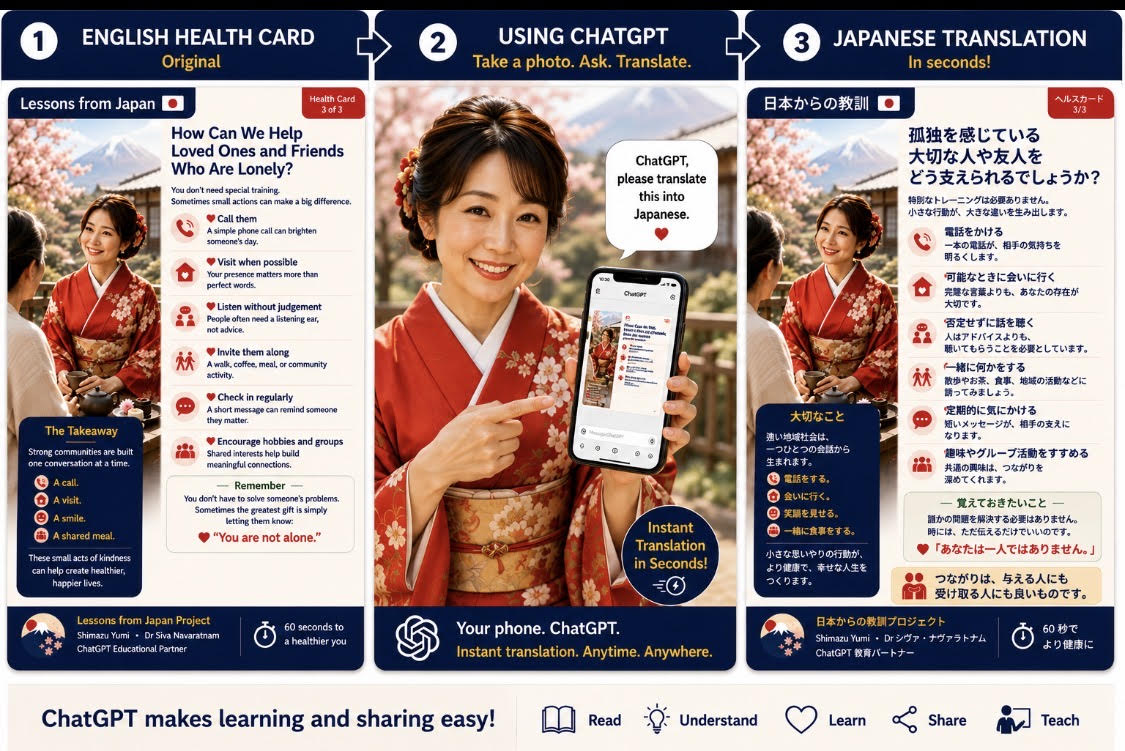
- Interactive HealthCards: This application is one that particularly excites us. Traditional health education is largely passive. People read a leaflet, watch a video, or attend a lecture, but there is often little interaction. To address this problem, we have developed simple Interactive HealthCards. Each card contains a health message and a short self-assessment checklist. Users read the card, tick the boxes that apply to them, and then upload the card to ChatGPT. For example, they might write, “I uploaded this HealthCard and ticked boxes 1, 3 and 5. What can I do to improve?” ChatGPT can then provide personalized educational feedback, practical suggestions, and motivational guidance. The interaction remains private, immediate, and available at any time. In our experience, this transforms health education from passive reading into active learning.
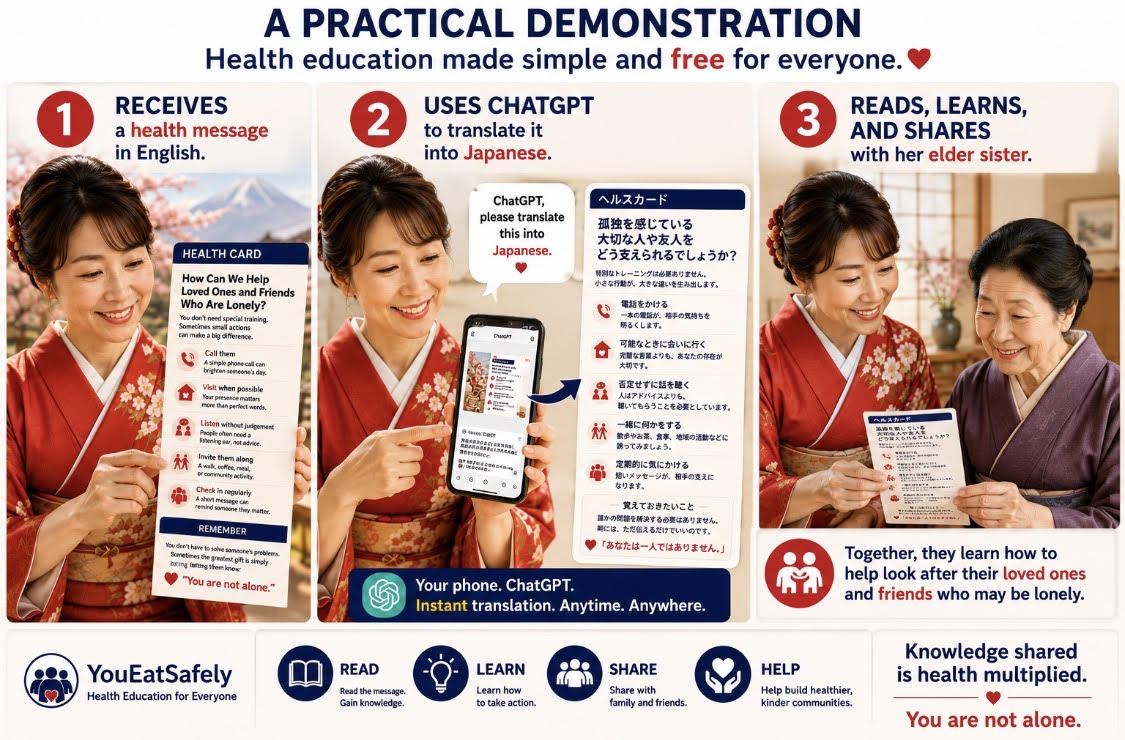
- Breaking the language barrier: This addresses one of the greatest barriers to health education worldwide. Many people do not speak English as their first language. Others struggle with medical terminology, even in their native language. Through our International Health Education Help Desk, people can ask questions in their preferred language and receive explanations they can better understand. AI-powered translation and communication tools have the potential to make health education accessible to communities that have traditionally been underserved.
Taken together, these seven applications suggest a new direction for health education. The greatest opportunity may not be that AI can answer questions. Rather, it is that AI can transform health education from a one-way transfer of information into an interactive conversation. For the first time, a mobile phone can help people learn, reflect, self-assess, improve their lifestyle, and access health education in their own language.
Artificial intelligence should never replace doctors, nurses, dietitians, or other health care professionals. However, it can help people become more informed participants in their own health care.
The goal is simple: to help people better understand their health, improve their lifestyle, and work with their health care professionals to achieve the best possible outcomes. If used responsibly, AI may prove to be one of the most important health education tools of our time.
Siva Navaratnam is a retired anesthesiologist in Australia. Shimazu Yumi is a health care executive.