This is why we get it wrong
As clinicians, we were taught that advance directives (ADs) and Portable Orders for Life-Sustaining Treatment (POLSTs) protect patient autonomy. So, we encourage our patients to complete them. Hospitals and health systems promote and measure our efforts. Public and private insurers pay for it. And policymakers celebrate them.
But these familiar tools upon which we so heavily rely at the end of life have been creating a nationwide patient safety problem. For two decades, research has consistently shown that clinicians frequently misinterpret ADs and POLSTs. This results in undertreatment. Patients who wanted life-saving treatment never received it. And misinterpretation also results in overtreatment. Patients who wished to die naturally were subjected to aggressive and painful interventions that they sought to avoid.
ADs and POLSTs are not clinically interpretable, consistently or with high quality
Physicians and clinicians make two types of interpretation errors. First, they treat patients who want resuscitation as though they are DNR just because they have an AD. Some clinicians might even convert the AD into a POLST or DNR/CMO or DNR/Limited Treatment order. Second, physicians and clinicians may treat patients with invasive procedures, intensive care, antibiotics, or prolonged treatment even though those patients carefully documented a desire for comfort-focused care. Some might even refrain from administering pain control because the POLST says “Limited Treatment” rather than “Comfort Measures Only.” Both undertreatment and overtreatment are failures of patient-centered care.
Real physician voices, twice a week
Free, and one click to unsubscribe.
ADs are not inherently flawed. They remain valuable tools that help patients communicate their goals, reduce conflict among family members, and guide clinical decision-making. The problem is that ADs often require interpretation. That is what is broken. Interpretation is highly variable.
With ADs and POLSTs, words such as “comfort measures,” “limited treatment,” and even “do not resuscitate” mean different things to different clinicians. For example, an emergency medicine physician may interpret the document one way because the patient is a medical stranger to them, and this is a first encounter. But a palliative medicine physician may interpret the same AD/POLST differently because they have a longer relationship with the patient and understand their goals.
When ambiguity exists, patient safety suffers. We trivialize the problem by calling it “discordance.” But it is harmful medical error that should never occur.
Over several years, multiple TRIAD studies involving emergency physicians, EMS personnel, and other physician specialties have demonstrated significant discordance between what patients want and how clinicians interpreted their ADs. Perhaps the most concerning finding is that 80 percent of physicians, 88 percent of nurses, and 90 percent of EMS mistakenly equate the mere presence of an AD with an automatic DNR order. Similarly, studies reveal significant misinterpretation rates with POLST as well as discordant understanding between what clinicians document and what the patient or agent expects. Adding scientific rigor, TRIAD findings have been reproduced by independent research teams.
Think about that for a moment. That is a complete failure.
Patient safety suffers as medical errors grow
Suppose a patient completes an AD as a part of good estate planning, specifically requesting treatment in certain circumstances. Unfortunately, contrary to those instructions, many clinicians will withhold that treatment, erroneously equating the very presence of an AD with a desire to forgo treatment.
No physician would accept a medication error rate approaching these levels. We would never tolerate widespread confusion surrounding insulin dosing, anticoagulation management, or procedural safety checklists. Yet when it comes to end-of-life decision-making, we assume traditional ADs and POLSTs are sufficient.
They are not.
Wrongful prolongation of life litigation has been expanding
Traditionally, clinicians perceived little legal risk from misinterpreting ADs. After all, how could a patient be “harmed” from saving their life? But that’s been changing. Over the past decade, courts across the country have increasingly recognized claims for wrongful prolongation of life. We now have a long line of appellate judgments, jury verdicts, and settlements against clinicians and health care entities. The cases confirm that administering CPR to a patient contrary to their AD or POLST violates that patient’s rights. And it increasingly results in civil or disciplinary penalties.
Video reduces misinterpretation errors and helps assure value-congruent care
Medicine has repeatedly demonstrated that communication improves when information is delivered through multiple channels. We use imaging, laboratory data, electronic alerts, and checklists to reduce errors. Advance care planning (ACP) and end-of-life planning should be the same.
Video has an effective and important role here. We commonly utilize videos to educate patients making decisions. We use video-based patient decision aids to support informed consent and shared decision-making. But we fail to use videos to support communication in the opposite direction. We do not use patient-created videos to inform medical teams. This is called patient-to-clinician video (PCV).
A brief prescribed patient-recorded video does something a document cannot. It captures the patient’s voice, facial expressions, emotions, reasoning, and values. It allows clinicians and family members to hear directly from the individual whose wishes are at stake. Moreover, PCV is also evidence-based as shown in the TRIAD VIII multicenter nationwide study.
A physician reviewing a video is not interpreting stale words on a page. They are hearing the patient themselves explain what matters most to them.
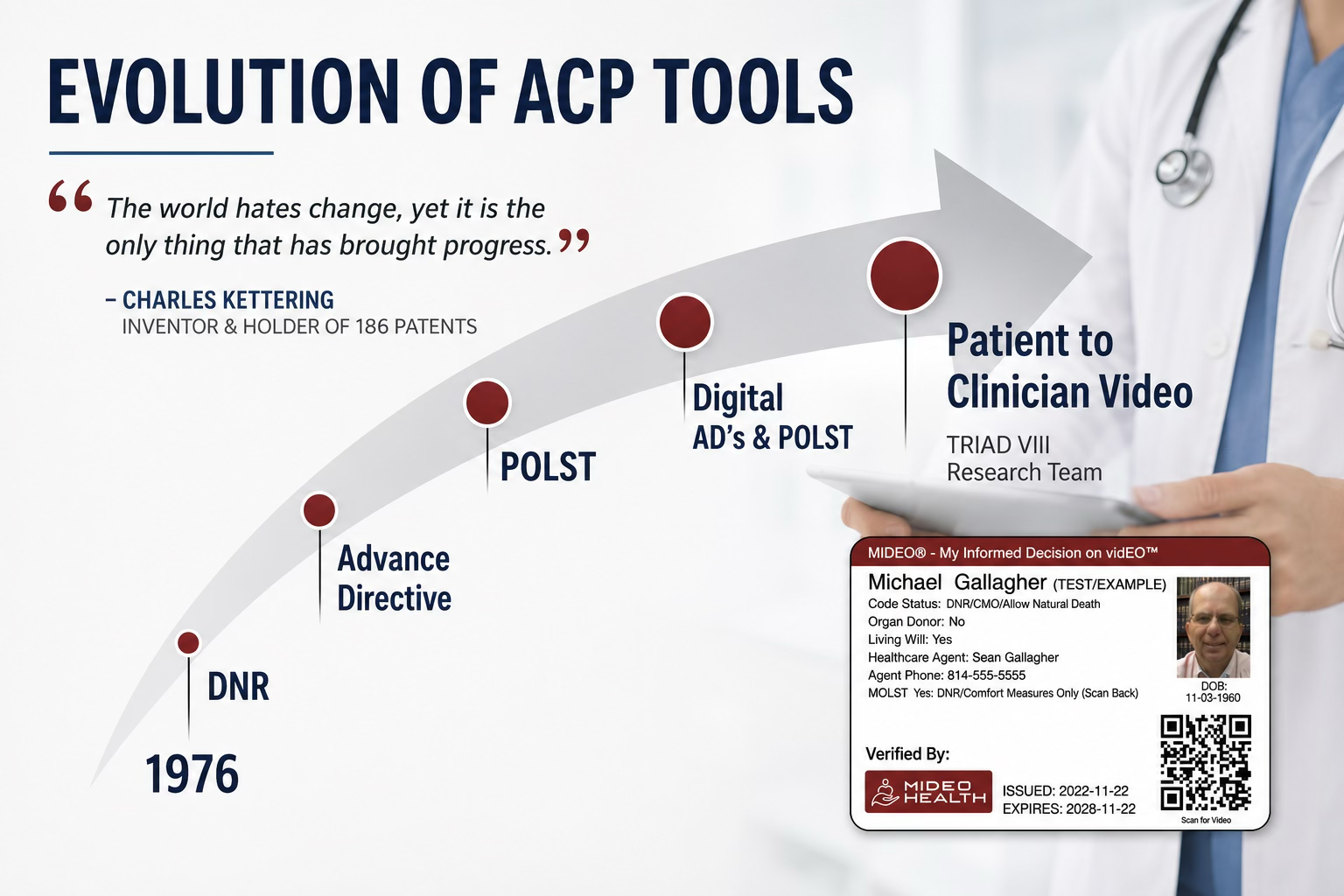
The goal is not to replace ADs and POLSTs. The goal is to strengthen these tools and make them safer. As shown in figure 1, this is an evolutionary process. But it has not significantly adopted available technology to make this safer for patients.
Imagine a future when a clinician can immediately access (in seconds) both a patient’s written AD/POLST and a short video explanation. The document provides legal structure. The video provides context. Together, they reduce uncertainty and improve confidence for families and clinicians alike. At its core, this is a patient safety issue.
Assure accurate AD and POLST interpretation with better tools
Every day, health care organizations invest enormous resources to prevent medical errors. Yet one of the most consequential decisions in medicine, whether to provide or withhold life-sustaining treatment, still relies heavily on documents that are frequently misunderstood in both their paper and digitized forms.
Patients deserve better. Families deserve better. And physicians and clinicians deserve tools that allow them to honor patient wishes with clarity and confidence.
To truly respect patient autonomy, we must move beyond simply asking patients to complete forms or have conversations. We must ensure that those forms are understood correctly when treatment decisions must be made by a medical stranger, or when a moment of crisis arrives. Advance directives and POLSTs work only when everyone interprets them the same way.
This essay is cited in the KevinMD record on end of life.
Figure 1: Depicting the evolution of ACP tools
Ferdinando Mirarchi is the chief executive officer and chief medical officer of MIDEO Health Technologies, LLC. He is the principal investigator of the TRIAD (The Realistic Interpretation of Advance Directives) Research Series, which identified a significant patient safety risk involving the misinterpretation of living wills, DNR orders, and Physician Orders for Life-Sustaining Treatment (POLST).
His research has been featured by The New York Times, The Washington Post, and other national media outlets, and it led to the development of MIDEO (My Informed Decision on VidEO), an evidence-based video advance directive and portable physician medical order designed to clarify patient wishes and improve emergency decision-making.
He is a reviewer for leading peer-reviewed journals, including CHEST, JAMA, and JAGS, serves on the editorial board of Patient Safety magazine, and authored Understanding Your Living Will. A fellow of both the American College of Emergency Physicians and the American Academy of Emergency Medicine, he previously held multiple leadership positions at UPMC Hamot and chaired the national palliative care committee at US Acute Care Solutions.
He shares updates on LinkedIn, Facebook, Instagram, and X.
Thaddeus Mason Pope is an attorney.