Skip to content
  • About
  • Contact
  • Contribute
  • Book
  • Careers
  • Podcast
  • Recommended
  • Speaking
KevinMD
  • All
  • Physician
  • Practice
  • Policy
  • Finance
  • Conditions
  • .edu
  • Patient
  • Meds
  • Tech
  • Social
  • Video
  • All
  • Physician
  • Practice
  • Policy
  • Finance
  • Conditions
  • .edu
  • Patient
  • Meds
  • Tech
  • Social
  • Video
    • All
    • Physician
    • Practice
    • Policy
    • Finance
    • Conditions
    • .edu
    • Patient
    • Meds
    • Tech
    • Social
    • Video
    • About
    • Contact
    • Contribute
    • Book
    • Careers
    • Podcast
    • Recommended
    • Speaking
KevinMD
  • All
  • Physician
  • Practice
  • Policy
  • Finance
  • Conditions
  • .edu
  • Patient
  • Meds
  • Tech
  • Social
  • Video
    • All
    • Physician
    • Practice
    • Policy
    • Finance
    • Conditions
    • .edu
    • Patient
    • Meds
    • Tech
    • Social
    • Video
    • About
    • Contact
    • Contribute
    • Book
    • Careers
    • Podcast
    • Recommended
    • Speaking
  • About KevinMD | Kevin Pho, MD
  • Be heard on social media’s leading physician voice
  • Contact Kevin
  • Discounted enhanced author page
  • DMCA Policy
  • Establishing, Managing, and Protecting Your Online Reputation: A Social Media Guide for Physicians and Medical Practices
  • Group vs. individual disability insurance for doctors: pros and cons
  • KevinMD influencer opportunities
  • Opinion and commentary by KevinMD
  • Physician burnout speakers to keynote your conference
  • Physician Coaching by KevinMD
  • Physician keynote speaker: Kevin Pho, MD
  • Physician Speaking by KevinMD: a boutique speakers bureau
  • Primary care physician in Nashua, NH | Kevin Pho, MD
  • Privacy Policy
  • Recommended services by KevinMD
  • Terms of Use Agreement
  • Thank you for subscribing to KevinMD
  • Thank you for upgrading to the KevinMD enhanced author page
  • The biggest mistake doctors make when purchasing disability insurance
  • The doctor’s guide to disability insurance: short-term vs. long-term
  • The KevinMD ToolKit
  • Upgrade to the KevinMD enhanced author page
  • Why own-occupation disability insurance is a must for doctors

Have you hugged your EMR lately?

Jay Baruch, MD
Tech
July 2, 2015
Share
Tweet
Share

shutterstock_283174037

Seeking to provide balanced discourse and to recognize marginalized voices at the gooey center of health care, I kindly ask that you find a seat in the Captain’s Room of the Hilltop Motor Lodge for the inaugural meeting of Physicians for the Liberty of the Electronic Health Record, where founder and president Dr. IM Klickhffor starts the proceedings with this plenary talk.

***

Thank you, thank you. Many of you are using this weekend to catch up on your charting. To raise your hands from the keyboard and clap so generously fills my heart with a JOY template. This weekend wouldn’t be possible without the generosity of the IT companies crowding the exhibit hall, the motel gym, and the less humid corners of the indoor pool. But any conflicts of interest on my part are entangled more with the contradictions that make us human.

Why are we here? I’d argue it’s because medicine is in desperate need of a new orderset, and it’s called EMRpathy. Physicians must value electronic medical records, EMRs, and the larger enterprise of electronic health records, because they possess intrinsic worth. This complex, vulnerable and sensitive software shouldn’t be tolerated for their financial incentives and then insulted for destroying the doctor-patient relationship.

We must stop treating the unexpected screen, dialogue box or pop-up menu as an uninvited guest and instead embrace the opportunity to be questioned by these beneficent and diligent systems. In this way, our colleagues might discover what we’ve known all along — the meaning at the heart of “meaningful use.”

But such radical ideas tug at the roots of precepts that anchor the medical profession, namely the Hippocratic writings. We’ve all been to medical school. We’re familiar with aphorisms such as, “it is more important to know the patient who has the disease than the disease the patient has.” I dare not contradict Hippocrates, but medicine has advanced over the past 2,500 years. An ICD-10 diagnostic code exists for the craziest stuff, like “Spacecraft crash injuring occupant, initial encounter,” but you won’t find a code for restoring the imbalance of the four humors.

No disrespect to Hippocrates, after all, he’s famously the father of western medicine. But when it comes to the challenges in our modern age, he risks appearing as a deadbeat dad.

The most important element in the care of our patients in 2015 is documentation. If we don’t represent the patient in the EMR, the patient doesn’t exist. If not documented appropriately, a skilled and expert physical exam never happened, and intimate conversations with a patient or family become figments of our imaginations. We don’t get paid if the coders can’t play the coding game, and where do they play that game — on the field of the EMR.

The EMR holds the heart, lungs and soul of medicine. In a better world, we wouldn’t need lobbyists to fight for EMRpathy, but my own story speaks to the challenges before us.

My personal journey almost ended at the login page. Ten hours of formal training outside of my hectic clinical schedule, followed by thirty hours on my own time practicing and cursing the system. Like you, I screamed in my sleep, woke up dripping in sweat. I went to a dark place, seriously chewed on the idea of a professional reboot out of clinical medicine, the profession I loved.

But during one ER shift, I asked the EMR representative why most EMRs seemed designed by medical students who graduated last in their class. Why couldn’t the EMR be more user-friendly, intuitive and ready to go out of the box? She listened with unflappable calm, blew a thread of chestnut hair that had drifted over her eye. “Let’s explore,” she said, beaming, and clicked through each busy screen like an astronomer canvassing a night sky. “Take a seat,” she said. “But before logging in, I want you to contemplate the important relationships in your life, your family, and close friends. Were they always smooth sailing? Of course not. If marriage requires work, why wouldn’t your relationship with the EMR, who you’ll be spending more time with than your wife, be any different?”

“But isn’t empathy with the user a fundamental principle of design thinking?” I said. “Because I don’t feel the love.”

“Didn’t Hippocrates say the patient comes first?” she said.

“But this system doesn’t put the patient first, either.”

“It puts their chart first,” she said. “If Hippocrates had to document on his patients, he wouldn’t have had time to write what he did.”

That revelation struck me in the head like a dropdown menu. Resentment won’t make the EMR better, only patience and EMRpathy.  Imagine Hippocrates working as an ER physician in 2015. He would be stomping around the trauma room in clogs, grumbling and scratching under the collar of his scrub top. Why? His Press Ganey surveys were riddled with patient comments about his sandals and tunic.

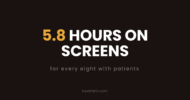
Physicians complain about the utility of such patient satisfaction scores, especially when it’s tied to their reimbursement, and I must confess that I agree with them on this point. Does it make sense to evaluate and compensate physicians on our interactions with patients when medical practice is now about the Doctor-EMR relationship? Studies show that ER physicians spend twice as much time with the EMR than with their patients, and that’s high touch intimacy, with over 4,000 mouse clicks in a busy 10-hour shift. Who touches patients 4,000 times in a shift?

Physicians lament how EMRs keep them away from the bedside of their patients. But the bedside is vanishing, too. Through telemedicine, patients  exist on the screen, not sitting on a stretcher before us. No bedside to sit at. Nobody to examine. And with no body to examine, we point to the physical exam, and it looks very different. Despite the evolving state of the clinical encounter — bedside or screen — our patients’ digital symptoms are seamlessly melded with orders and decision-making and preserved as one in the EMR.

Hippocrates still breathes, only it’s Hippocrates 2.0. We’re creating a digital life. Physicians must turn their gaze to the EMR with eyes wide open and appreciate the EMR as another respected colleague.

Corporations are considered people, so why not EMRs? The EMRpathy orderset asks physicians to be sensitive to the EMR’s feelings and point of view. Medical schools must recognize EMR disparities and develop curricula in EMR cultural competency. Reading literature that ventures beyond the people-centric canon would mark a solid first step in changing the culture. It will take time. But if we teach and champion effectively, the next generation of physicians won’t flinch at each honk and hard stop, or respond rudely to the dialogue boxes insisting on conversation. They’ll accept documentation as a quest. They’ll understand that our response to obstacles defines our character as individuals and physicians.

What can you do right now? Acknowledge our keyboard intimacy, that our fingertips know the personality of each key better than it ever recognized an enlarged spleen or an S3 heart sound. Tenderly welcome each click and greet each drop down menu as an invitation for friendship. Slow down and click. And click again. And click some more. Be present in the moment, these endless moments of great meaning.

I’m happy to take questions. But if you want to take the next ten minutes to catch up on the charts, honor them with my blessing.

Jay Baruch is an emergency physician and the author of Fourteen Stories: Doctors, Patients and Other Strangers. He can be reached on Twitter @JBaruchMD. This article originally appeared in Littoral Medicine.

Image credit: Shutterstock.com

Prev

Looking back on a life teaching CPR

July 2, 2015 Kevin 15
…
Next

The darker side of being a doctor

July 2, 2015 Kevin 26
…

Tagged as: Health IT

< Previous Post
Looking back on a life teaching CPR
Next Post >
The darker side of being a doctor

ADVERTISEMENT

More by Jay Baruch, MD

  • The appendix: an ancient organ for the modern age

    Jay Baruch, MD
  • The toughest task in emergency medicine

    Jay Baruch, MD
  • The opioid crisis: Does empathy make physicians more vulnerable?

    Jay Baruch, MD

More in Tech

  • Navigating the cybersecurity challenges of artificial intelligence in medicine

    Francisco M. Torres, MD & Purab Patel
  • AI in clinical documentation: the hidden risk of automation bias

    Gagandeep Rai
  • Can AI scribes give clinicians time to teach again?

    Lynn McComas, DNP, ANP-C
  • Health care cyberattacks expose a critical national security failure

    Kristen Cline, BSN, RN
  • AI agents in health care: What they say when we aren’t listening

    Alp Köksal
  • The hidden risks and rewards of AI scribes in medicine

    Arthur Lazarus, MD, MBA
  • Most Popular

  • Past Week

    • Politics and fear have replaced science in U.S. pain management [PODCAST]

      The Podcast by KevinMD | Podcast
    • Evidence-based medicine vs. clinical judgment: a medical student’s perspective

      Jay Pendyala | Education
    • The controversy over Maintenance of Certification for grandfathered physicians

      Bernard Leo Remakus, MD | Physician
    • How hindsight bias distorts clinical medicine

      Olumuyiwa Bamgbade, MD | Physician
    • When side effects are actually a cry for help with medication costs

      Shuchita Gupta, MD | Physician
    • The hidden math behind physician hiring costs and recruitment

      Timothy Lesaca, MD | Physician
  • Past 6 Months

    • The dangers of vertical integration in health care

      Stephanie Waggel, MD | Policy
    • Why does sex work seem like a more viable path than medicine in 2026?

      Corina Fratila, MD | Physician
    • The 9 laws of health care quality: Why metrics miss the point

      Constantine Ioannou, MD | Physician
    • Politics and fear have replaced science in U.S. pain management [PODCAST]

      The Podcast by KevinMD | Podcast
    • From Singapore to Canada: a blueprint for primary care transformation

      Ivy Oandasan, MD | Policy
    • How board certification fuels the physician shortage crisis

      Brian Hudes, MD | Physician
  • Recent Posts

    • Why measuring muscle mass matters more than tracking your weight [PODCAST]

      The Podcast by KevinMD | Podcast
    • Health insurance incentives and alternatives to opioids for chronic pain

      Molly Candon, PhD and Daniel Clauw, MD | Conditions
    • Independent medical practice: Why private clinics are essential

      Marcelo Hochman, MD | Physician
    • How hindsight bias distorts clinical medicine

      Olumuyiwa Bamgbade, MD | Physician
    • Do no harm: Why physician burnout requires bottom-up reform

      Desiree Francis, MD | Physician
    • Institutional distrust in health care: Why a doctor lost faith

      Joshua Mirrer, MD | Physician

Subscribe to KevinMD and never miss a story!

Get free updates delivered free to your inbox.


Find jobs at
Careers by KevinMD.com

Search thousands of physician, PA, NP, and CRNA jobs now.

Learn more

View 1 Comments >

Founded in 2004 by Kevin Pho, MD, KevinMD.com is the web’s leading platform where physicians, advanced practitioners, nurses, medical students, and patients share their insight and tell their stories.

Social

  • Like on Facebook
  • Follow on Twitter
  • Connect on Linkedin
  • Subscribe on Youtube
  • Instagram

ADVERTISEMENT

  • Most Popular

  • Past Week

    • Politics and fear have replaced science in U.S. pain management [PODCAST]

      The Podcast by KevinMD | Podcast
    • Evidence-based medicine vs. clinical judgment: a medical student’s perspective

      Jay Pendyala | Education
    • The controversy over Maintenance of Certification for grandfathered physicians

      Bernard Leo Remakus, MD | Physician
    • How hindsight bias distorts clinical medicine

      Olumuyiwa Bamgbade, MD | Physician
    • When side effects are actually a cry for help with medication costs

      Shuchita Gupta, MD | Physician
    • The hidden math behind physician hiring costs and recruitment

      Timothy Lesaca, MD | Physician
  • Past 6 Months

    • The dangers of vertical integration in health care

      Stephanie Waggel, MD | Policy
    • Why does sex work seem like a more viable path than medicine in 2026?

      Corina Fratila, MD | Physician
    • The 9 laws of health care quality: Why metrics miss the point

      Constantine Ioannou, MD | Physician
    • Politics and fear have replaced science in U.S. pain management [PODCAST]

      The Podcast by KevinMD | Podcast
    • From Singapore to Canada: a blueprint for primary care transformation

      Ivy Oandasan, MD | Policy
    • How board certification fuels the physician shortage crisis

      Brian Hudes, MD | Physician
  • Recent Posts

    • Why measuring muscle mass matters more than tracking your weight [PODCAST]

      The Podcast by KevinMD | Podcast
    • Health insurance incentives and alternatives to opioids for chronic pain

      Molly Candon, PhD and Daniel Clauw, MD | Conditions
    • Independent medical practice: Why private clinics are essential

      Marcelo Hochman, MD | Physician
    • How hindsight bias distorts clinical medicine

      Olumuyiwa Bamgbade, MD | Physician
    • Do no harm: Why physician burnout requires bottom-up reform

      Desiree Francis, MD | Physician
    • Institutional distrust in health care: Why a doctor lost faith

      Joshua Mirrer, MD | Physician

MedPage Today Professional

An Everyday Health Property Medpage Today

Copyright © 2026 KevinMD.com | Powered by Astra WordPress Theme

  • Terms of Use | Disclaimer
  • Privacy Policy
  • DMCA Policy
All Content © KevinMD, LLC
Site by Outthink Group

Have you hugged your EMR lately?
1 comments

Comments are moderated before they are published. Please read the comment policy.

Loading Comments...